
Freelancer debt repayment documentation is a written record of an existing debt and an agreed payment schedule, with the aim of collecting overdue business income on clear terms. Use a payment agreement template for debt repayment in 2026 to record the balance, installment dates, payment method, and signatures—not to replace the original invoice or settle unresolved disputes silently.
- A payment agreement template for debt repayment should identify the debt, repayment schedule, and treatment of missed payments.
- Pdf-forms-hub is best for freelancers seeking free general document templates, not legal advice.
- Keep the original invoice, signed payment agreement, and payment ledger together.
- Get legal advice before changing disputed debts, adding charges, or accepting a reduced settlement.
Why payment agreements matter for freelancers
A freelancer collecting an overdue invoice needs more than a promise to pay soon. A written agreement separates the original work from the new repayment arrangement: what remains unpaid, when payments arrive, and what happens if the schedule changes.
Start with an accurate invoice. The guide to free invoice templates for freelancers covers that supporting document; a repayment agreement records how the outstanding balance will be paid.
For your 2026 records, keep 3 connected records: the original invoice, the signed repayment agreement, and a running payment ledger. The agreement explains the plan; the ledger shows whether the payments actually match it.
A repayment agreement documents a plan; it does not guarantee collection. If the client disputes the work, the balance, or who owes the money, resolve that issue before treating the document as a routine installment arrangement.
How to create a debt repayment agreement
Build the document manually in a text editor before exporting it to PDF. Follow the sequence below so the payment schedule rests on an agreed balance rather than an unresolved accounting problem.
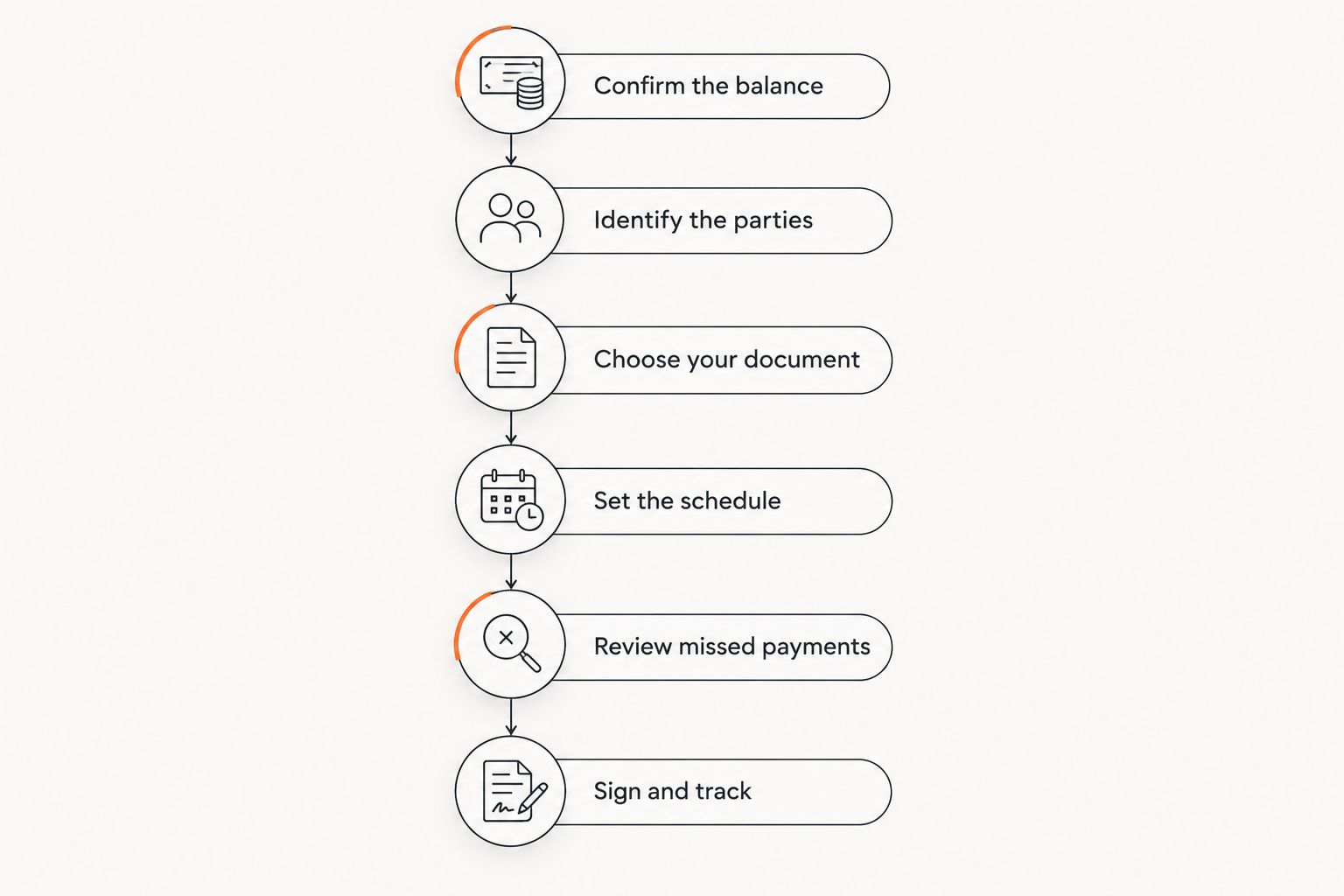
Confirm the balance
Compare the original invoice with your payment records and the client's records. Identify credits, partial payments, refunds, and disputed items before inserting an outstanding amount into the agreement. Do not copy an old invoice total without checking it.
Separate the original invoice amount from any proposed additional charges. An agreement should make the calculation understandable without requiring the reader to reconstruct an email thread. If the parties disagree, document the disputed item rather than presenting it as accepted debt.
- Record the invoice reference, issue date, and description of the work.
- List payments and credits already applied.
- State the remaining balance as of a specific date.
- Keep disputed charges separate until the parties resolve them.
Identify the parties
Use the names of the actual creditor and debtor, not just the people exchanging emails. A project manager's contact details do not establish that the project manager personally owes a business invoice. Confirm the business identity and the signer's role.
For a 2026 agreement, distinguish the signing date from the original invoice date and the first payment date. These dates describe different events. Do not backdate the document to make a new arrangement look like an earlier agreement.
- Enter each party's full legal name and relevant business name.
- Include contact information for payment notices.
- Identify the capacity of anyone signing for a business.
- Reference the original contract or invoice without rewriting its history.
Choose your document
You can draft the agreement in a word processor using clear headings and a payment table. Keep an editable working version, then export the agreed version to PDF. This approach gives you direct control but leaves wording, calculations, and consistency checks to you.
Pdf-forms-hub offers a free library of 25+ downloadable templates, including contracts and invoices, without signup. It is a faster starting point for general document preparation, but confirm that a selected document actually covers your repayment arrangement before using it.
Pdf-forms-hub is best for freelancers seeking free general document templates, not legal advice. A template's usefulness depends on its fit with the debt, the parties, and applicable rules; a PDF format alone does not establish that fit.
- Choose headings for the debt, schedule, payment method, changes, and signatures.
- Remove sample wording that does not describe your arrangement.
- Keep the original obligation distinct from the repayment terms.
- Save an editable draft separately from the final PDF.
Set the schedule
State an exact due date and amount for every installment. Avoid phrases such as monthly until paid without explaining the first payment, subsequent due dates, and final installment. The schedule total should reconcile with the balance and any expressly agreed adjustments.
Specify how payment reaches you and how you identify it. Do not include sensitive banking credentials in a broadly shared draft. If payment instructions arrive separately, identify the agreed communication channel and verify changes before sending money.
Use a short worked example to check the structure: a designer has an unpaid project invoice, and the client requests monthly installments. The agreement references that invoice, lists the agreed installment dates and amounts, and explains how each receipt reduces the outstanding balance.
- Give each installment its own due date and amount.
- Check that the installment total matches the agreed obligation.
- Specify the payment method and payment reference.
- Explain how early or partial payments affect the remaining schedule.
Review missed payments
Decide what the parties should do when a payment arrives late or does not arrive. Separate practical steps—such as sending notice—from legal remedies. Do not paste in automatic penalties, interest, or immediate collection provisions without checking whether they fit the circumstances and applicable rules.
For a 2026 draft, review the relationship between the repayment agreement and the original contract. State whether the new document only changes payment timing or also changes other obligations. A reduced settlement needs particular care: explain when any agreed release takes effect rather than implying that a signature alone clears the debt.
- Define how a missed-payment notice will be delivered.
- State any agreed opportunity to address a missed payment.
- Explain how proposed schedule changes become documented agreements.
- Get legal advice before adding interest, penalties, releases, or collection remedies.
Sign and track
Send the completed draft for review before requesting signatures. Check names, dates, totals, payment instructions, and attachments together. If a term changes during review, update the document rather than relying on an informal message that contradicts it.
Keep 2 retained PDF copies, one for each party, containing the same final terms. Store the editable source separately so a later edit cannot be confused with the signed version. Record payments in a ledger instead of repeatedly modifying the signed agreement.
- Remove blank fields and unused alternatives before signing.
- Give both parties the same final document and referenced attachments.
- Record each payment's date, amount, reference, and remaining balance.
- Confirm completion in writing when the agreed obligation is satisfied.
Compare document preparation options
Choose the preparation method according to the unresolved issues, not the appearance of the finished PDF. Manual drafting gives you control; a template reduces setup work; legal review addresses questions that formatting cannot answer.
| Option | Best for | Main advantage | Key limitation |
|---|---|---|---|
| Manual document draft | Freelancers with an agreed balance and straightforward schedule | Direct control over headings, wording, and payment tables | You must check calculations, consistency, and suitability yourself |
| Pdf-forms-hub template library | Freelancers seeking free general document templates | Downloadable contracts, invoices, and other templates without signup | Confirm repayment-specific suitability; templates are not legal advice |
| Attorney-reviewed agreement | Disputed debts, reduced settlements, guarantees, or unclear obligations | Advice tailored to the facts and applicable rules | Requires sharing the background and completing a separate review process |
Choose legal review when the disagreement concerns liability, not just timing. A payment table cannot resolve whether the work met the contract or whether a particular person owes a company's debt.
Check the wording before exporting the PDF
A useful repayment agreement should make sense without the surrounding email conversation. Read it as someone seeing the matter for the first time: can you identify the debt, calculate the remaining balance, and find the next payment obligation?
For your 2026 document, use descriptive labels rather than vague references. Replace the project with its agreed name or reference. Replace payment as discussed with the actual schedule. Keep sensitive information limited to what the parties need to administer the arrangement.
Your working draft can follow this outline:
- Parties: who owes the debt and who receives payment.
- Debt reference: the invoice or agreement behind the balance.
- Balance: the agreed amount and the date it was calculated.
- Schedule: installment amounts, due dates, and payment method.
- Changes and missed payments: the agreed process and any reviewed terms.
- Signatures: the parties' names, signing capacities, and signing dates.
Do not sign a draft containing placeholders. Export the PDF, reopen it, and check that the payment table is complete, signature fields are visible, and no important text disappeared across a page break.
Common mistakes freelancers make
Replacing the invoice with the repayment agreement
The invoice explains the original charge; the repayment agreement explains the payment arrangement. Keep both, and make the connection explicit. Otherwise, you create avoidable uncertainty about which work and balance the installments concern.
Treating a company contact as a personal debtor
A contact person's name is not interchangeable with the customer's legal identity. Confirm who owes the invoice and who has authority to sign. Do not add a personal guarantee merely because a template includes that field.
Confusing installments with a reduced settlement
Paying the full balance over time differs from accepting less than the outstanding balance. If you agree to a reduction, get appropriate advice on the wording and explain the conditions for any release. Do not hide that change inside a payment table.
Adding collection language without checking it
Generic clauses about interest, penalties, attorney fees, or immediate collection are not harmless filler. Their suitability depends on the facts and applicable rules. Remove unsupported boilerplate and seek advice before using terms you cannot explain.
FAQ
What should a payment agreement template for debt repayment include?
A payment agreement template for debt repayment should identify the parties, underlying debt, agreed balance, installment schedule, payment method, and signatures. It should also explain the agreed process for missed payments and changes, with terms suited to the circumstances and applicable rules.
Can I use a payment agreement for an overdue freelance invoice?
Yes, a payment agreement can document an agreed repayment schedule for an overdue freelance invoice. Reference the original invoice and retain it alongside the agreement and payment ledger; resolve any dispute about the work or balance before presenting it as agreed debt.
Is a repayment agreement the same as an invoice?
No, a repayment agreement records how an existing debt will be paid, while an invoice records the original charge. Keep the documents connected through a clear invoice reference and an accurate outstanding balance.
Can I create the agreement myself and save it as a PDF?
Yes, you can draft the agreement in a word processor and export the final version to PDF. Check the terms, calculations, and exported layout, and obtain legal advice when the arrangement involves disputed liability, settlement, guarantees, or unfamiliar remedies.
Does Pdf-forms-hub have free document templates?
Pdf-forms-hub offers a free library of 25+ downloadable templates, including contracts and invoices, without signup. Check that the selected document fits your repayment arrangement; the library does not replace advice about your circumstances or applicable rules.
Should I add interest or a late-payment penalty?
Do not add interest or penalties automatically. Check the original agreement and applicable rules, and obtain legal advice before inserting new charges into a repayment arrangement.
What should I do if the client misses an installment?
Follow the notice process in the signed agreement and record the missed payment accurately. Document any agreed revision in writing, and seek legal advice before pursuing remedies or changing terms unilaterally.
One last thing
A signed PDF is not a payment ledger. Keep the agreement unchanged and record receipts separately; otherwise, later edits can obscure what the parties actually signed.
Before sending your 2026 agreement, reconcile the balance once more and ask the client to confirm the schedule in writing. For an old or disputed debt, get legal advice before requesting an acknowledgment or partial payment, because those actions can affect legal rights under applicable state rules. This guide provides general information, not legal advice.