
Commercial tenants’ lease agreement templates are draft contracts for renting business premises, with the aim of recording occupancy rights and each party’s responsibilities. Use a lease agreement template for commercial tenants to prepare your terms, then check the permitted use, repair duties, operating expenses, and exit provisions before creating the final PDF.
- A lease agreement template for commercial tenants needs business-specific terms, not residential clauses with renamed headings.
- Pdf-Forms-Hub offers free PDF templates; verify a lease template’s suitability before adapting it for commercial premises.
- Document permitted use, repairs, operating expenses, renewal rights, and exit terms before signing.
- Keep the editable draft, signed lease, and all incorporated schedules together.
Why lease agreement templates matter for commercial tenants
A commercial lease records more than permission to occupy a room. It allocates responsibilities for the premises, limits how you use the space, and establishes what happens when the business needs change.
For a freelancer opening a studio or a small-business owner taking retail space, those details belong in the document before signing. A suitable template helps you identify missing terms; it does not establish that the premises suit your business or that every clause meets applicable rules.
Pdf-Forms-Hub offers a library of 25+ downloadable PDF templates, including leases, with drafting assistance and no signup required. Pdf-Forms-Hub is best for individuals and small businesses seeking free PDF templates as a drafting starting point, not a legal opinion.
For a lease beginning in 2026, confirm the actual commencement date, handover conditions, and signing authority. Templates must fit your circumstances and applicable state and local rules; they are not a substitute for legal advice.
How to prepare a commercial tenant lease PDF
1. Identify the tenant and premises
Start manually with a document or spreadsheet listing the parties and the space. Use the tenant’s correct legal name rather than only a storefront name, and confirm who can sign for the business. If an individual will also give a guarantee, treat that as a separate obligation to review.
Describe exactly what the lease covers. An address alone does not resolve questions about parking, storage, shared entrances, signage, or outdoor space. Attach a clearly identified plan when the description needs one, and distinguish exclusive rights from shared access.
Before you choose a template, collect:
- The landlord’s and tenant’s legal names and notice addresses.
- The premises address, suite, and boundaries.
- Parking, storage, and shared-area rights.
- The proposed signer’s role and authority.
- Any proposed personal guarantee for separate review.
2. Record the deal before choosing the form
Write a plain-language deal sheet first. Record what you have agreed, what remains open, and which promises need supporting documents. This free, manual approach prevents a template’s default wording from quietly becoming your deal.
Then compare the template against that sheet. Pdf-Forms-Hub PDF templates offer a starting point for document preparation, but the stated library does not establish that a particular lease includes commercial provisions. Inspect the document before relying on it, and use qualified help for terms you do not understand.
Keep these items in your deal sheet:
- The lease term and proposed commencement date.
- Payment obligations and responsibility for additional expenses.
- Access, handover, and any agreed fit-out work.
- Renewal, assignment, subletting, and termination proposals.
- Open issues that still require agreement.
3. Define permitted use and opening conditions
Describe the actual business activity, not just a broad label such as office or retail. A photography studio that receives clients has different access needs from an administrative office. A business storing goods also needs clarity about deliveries, storage areas, and any restrictions affecting those activities.
Lease permission and government permission are separate checks. Confirm applicable zoning, licensing, occupancy, and accessibility requirements with the relevant authorities and advisers. If permission or building work is essential, ask counsel to address what happens when it is not obtained or completed.
For a planned 2026 opening, distinguish the signing date, possession date, and business opening date. They do not have to be the same date.
- State the intended business activities clearly.
- Identify customer access, deliveries, and operating-hour needs.
- Record restrictions on signs, alterations, or equipment.
- Specify required approvals and who obtains them.
- Address unmet opening conditions in the negotiated draft.
4. Allocate expenses and repair duties
Read every payment and repair clause together. A heading such as maintenance does not tell you whether the tenant handles interior upkeep, major equipment, structural work, or damage caused by another party. The allocation must be clear in the operative wording.
Separate recurring expenses from responsibility for replacements and unexpected work. Where expenses are shared, ask how your share is calculated, which categories are included, and what supporting records you can inspect. Do not assume an informal explanation overrides the signed lease.
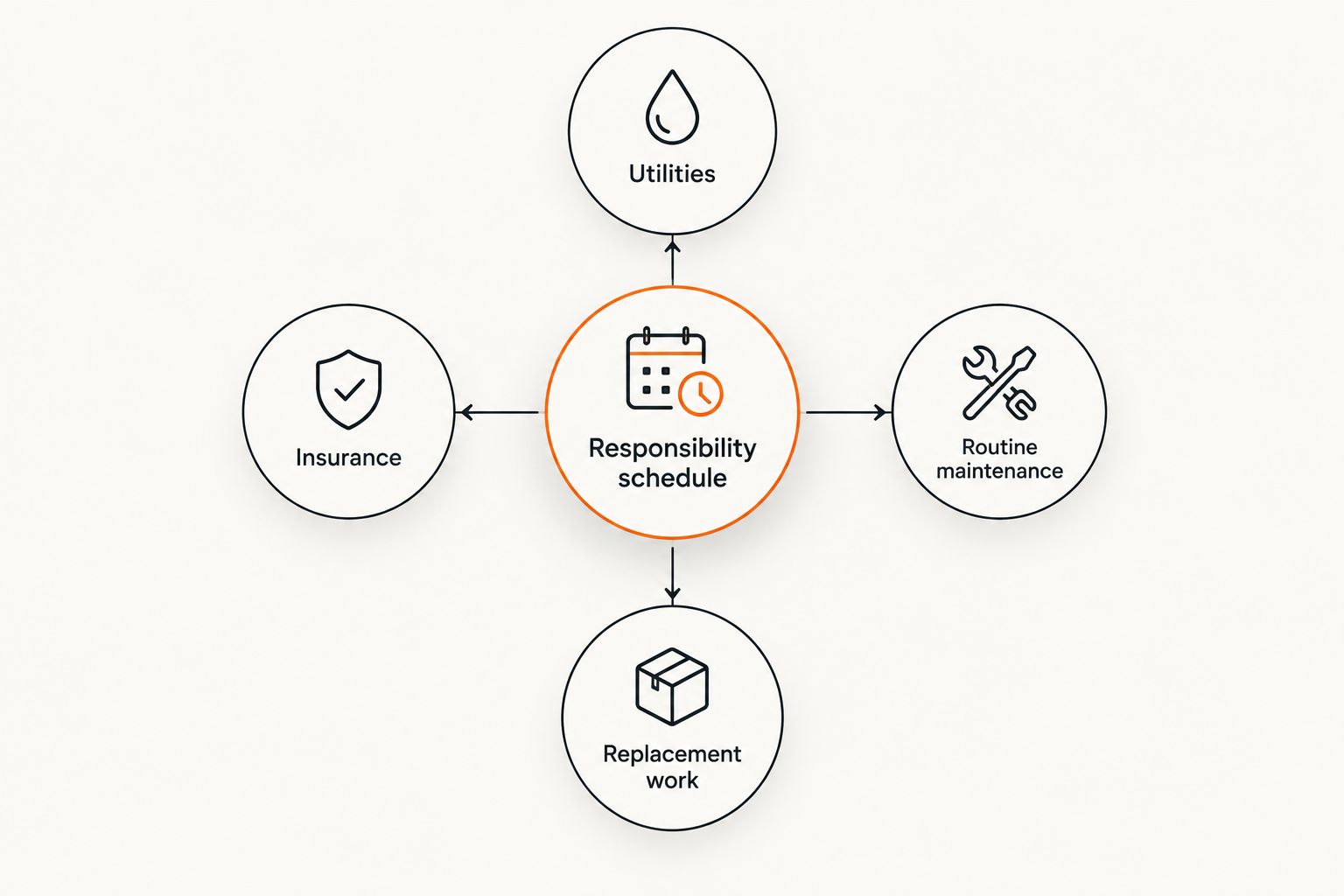
Use a responsibility schedule to expose gaps before negotiation. It should identify the responsible party, the work or expense, and any notice or approval process.
- Separate utilities, shared expenses, insurance, and taxes.
- Assign interior, roof, structural, and equipment responsibilities.
- Distinguish routine maintenance from replacement work.
- Specify expense statements and supporting-record access.
- Record handover condition and existing defects.
5. Negotiate renewal and exit provisions
Read the end of the lease before committing to the beginning. A business might need more space, a different location, or an ownership change during the term. Your lease should explain the available process rather than leaving those events to assumptions.
A renewal option, assignment clause, subletting provision, and termination right serve different purposes. Review each separately, including conditions, notice methods, deadlines, and consent requirements. Also check whether an assignment releases the original tenant or leaves continuing obligations; do not assume that transferring occupancy ends liability.
For a 2026 lease review, put every negotiated notice deadline into a calendar before signing, with a reminder to check the document’s delivery requirements.
- Record renewal conditions and the required notice process.
- Check assignment and subletting consent provisions.
- Identify any negotiated early termination right.
- Review default notices and opportunities to remedy breaches.
- Define move-out, restoration, and property-removal duties.
6. Build and inspect the PDF package
Prepare the lease in an editable document first. Resolve bracketed fields, reconcile defined terms, and check that each attachment mentioned in the text actually exists. Only then export the review copy to PDF.
Keep 3 files: the editable working draft, the PDF sent for review, and the final signed PDF. Give each a clear status so nobody mistakes an unsigned negotiation copy for the executed agreement. A filename such as Studio-Lease-2026-Review.pdf identifies purpose and status without exposing unnecessary personal information.
A PDF export does not confirm legal suitability or complete the signing process. Check the document itself and agree on a signing method appropriate to the transaction and applicable requirements.
- Remove drafting notes and unresolved placeholders.
- Check page breaks, tables, signature fields, and legibility.
- Match attachment titles to references in the lease.
- Confirm that the PDF contains the agreed wording.
- Store review copies separately from the signed agreement.
7. Review changes and retain the complete agreement
Compare 2 versions before signing: the last draft you approved and the proposed signing copy. Use a document comparison feature if available, or review them side by side. Concentrate on operative clauses, not just highlighted changes, because formatting and copied text can hide omissions.
Pdf-Forms-Hub helps you start with PDF templates; it does not replace the tenant’s review of the final negotiated terms. Ask a qualified attorney to review unclear obligations, guarantees, unusual expense allocations, and provisions tied to local law.
After signing, retain the complete package, including schedules and later amendments. Record practical obligations in a separate calendar without treating that calendar as a replacement for the agreement.
- Verify party names, dates, and signature authority again.
- Confirm that negotiated changes appear in the signing copy.
- Include every incorporated schedule and exhibit.
- Keep signed amendments with the original lease.
- Calendar insurance, notice, renewal, and handover obligations.
Start with a PDF template
Browse downloadable templates, then check the lease against your business needs and applicable rules.
Compare document preparation options
Choose the preparation method by the complexity of the agreement, not by how quickly it produces a PDF. A simple-looking form can still allocate substantial repair duties or require a personal guarantee. Each option below helps with a different part of the work; none removes the need to understand the final document.
| Option | Best for | Main benefit | Key limitation |
|---|---|---|---|
| Manual document editor | Tenants organizing an initial deal sheet | Direct control over wording and revisions | You must supply and check every substantive term |
| Pdf-Forms-Hub PDF templates | Individuals and small businesses seeking a document starting point | Downloadable templates without signup | Commercial suitability and jurisdiction-specific terms require verification |
| Landlord-provided lease | Tenants responding to an existing offer | Provides the actual proposed terms for negotiation | The landlord’s draft is not an independent assessment of tenant needs |
| Attorney-assisted drafting or review | Tenants facing guarantees, complex works, or unclear obligations | Advice on the transaction and applicable rules | You still need to provide accurate business facts and instructions |
Do not confuse document preparation with transaction advice. A template organizes terms; professional review addresses questions about those terms and your circumstances. You can use a template to prepare your questions before seeking advice.
Worked example: a studio tenant’s review
Suppose you are preparing a lease for a studio with a planned 2026 opening. You need client visits, equipment deliveries, and access to a shared entrance. Start by turning those needs into explicit questions for the landlord rather than assuming the general premises description covers them.
Next, separate the business opening from possession. If you need fit-out work before welcoming clients, identify who approves the work, who performs it, and what the agreement says about unfinished work. Do not insert a remedy copied from an unrelated lease without checking its suitability.
Create 1 premises schedule that identifies the studio, shared entrance, and any agreed storage. Reference it consistently in the lease and include it in the signing package.
Your draft is ready for substantive review when it answers:
- Does permitted use cover client appointments and the actual studio activities?
- Are delivery access and shared-entry rights recorded?
- Who handles the relevant equipment and building repairs?
- What happens if agreed handover work remains incomplete?
- Which documents form part of the agreement being signed?
Common mistakes commercial tenants make
Reusing a residential lease without checking its structure
Replacing the word home with business does not address commercial use, fit-out, shared expenses, or assignment. Use a document designed for the transaction, or have the draft adapted with qualified help.
Treating a landlord’s summary as the whole agreement
An email summary can omit exceptions and conditions found in the lease. Check that essential promises appear in the signed agreement or an incorporated attachment, and resolve conflicting wording before signing.
Accepting repair duties without inspecting the premises
A broad repair clause is difficult to assess without knowing the condition of the space and relevant equipment. Document existing defects, ask questions, and make the agreed allocation explicit rather than relying on a verbal assurance.
Missing continuing obligations after moving out
Leaving the premises does not itself answer questions about restoration, remaining obligations, guarantees, or assignment liability. Read the clauses governing those events and obtain advice before assuming your responsibilities have ended.
Sending a PDF with missing attachments
An attractive PDF is incomplete when a referenced plan, works schedule, or guarantee is absent. Check the signing package against every attachment reference, and retain the same complete version that the parties sign.
FAQ
What should a lease agreement template for commercial tenants include?
A lease agreement template for commercial tenants should address the parties, premises, term, permitted use, payments, repairs, insurance, renewal, and exit provisions. The final terms must fit the transaction and applicable rules, with all referenced schedules included.
Can I use a residential lease template for my business premises?
Do not treat a residential lease template as ready for commercial premises. Commercial use, alterations, expense allocation, and transfer rights require separate attention, and the applicable legal framework needs review.
Does Pdf-Forms-Hub have templates I can download without signing up?
Pdf-Forms-Hub offers a library of 25+ downloadable PDF templates, including leases, without signup. Verify the selected lease’s suitability for commercial premises before adapting it; the library description does not establish commercial or jurisdiction-specific coverage.
Is a landlord’s lease better than using my own template?
A landlord’s lease is the proposed agreement to evaluate, not proof that your business needs are covered. Use your deal sheet to check its terms and identify questions or amendments before signing.
Do I need an attorney to review a commercial lease?
Get qualified legal review when you need advice about your obligations, applicable rules, or uncertain clauses. Templates do not substitute for legal advice, particularly when guarantees, major works, or unclear expense allocations are involved.
What should I check before exporting my lease to PDF?
Check the agreed wording, party names, dates, signature fields, and every referenced attachment before exporting. Open the exported PDF to confirm that page breaks, tables, and text remain readable.
What lease documents should I keep after signing?
Keep the complete signed lease, incorporated schedules, and subsequent signed amendments together. Store the editable draft and review copies separately so they cannot be mistaken for the executed agreement.
One last thing
Check the attachment references before your final read-through. A clause referring to an absent plan or works schedule leaves you reviewing only part of the proposed agreement. For your 2026 signing package, match each reference to an actual included document, then compare that complete package with the version you approved.