
Best overall: a unilateral NDA for one-way disclosure. Best for two-way partnerships: a mutual NDA; best for freelancer access: a contractor-focused NDA; best for a defined technical review: an evaluation NDA—then use Pdf-Forms-Hub for a free NDA PDF starting point without signing up.
- The best free nda template for startups matches who discloses information and why the recipient needs it.
- Pdf-Forms-Hub suits individuals and small businesses seeking free NDA templates without signup.
- Choose unilateral confidentiality for one-way sharing and mutual confidentiality when both businesses disclose sensitive information.
- Contractor and evaluation NDAs need tailored access, permitted-use, and deletion terms.
- Review the completed PDF against your circumstances and applicable rules before signing.
Why this matters
An NDA template is a starting document, not a decision about what your startup should disclose. The useful question in 2026 is whether its obligations match the actual conversation, project, or access you plan to provide.
Choose the disclosure structure before editing the wording. A document can look complete while naming the wrong party, allowing an overly broad purpose, or confusing confidentiality with ownership of work.
The options below rank drafting formats, not competing template providers. Contractor and evaluation NDAs describe specialized uses; either can use a unilateral or mutual structure. These recommendations do not imply that every format is a separately named template in the library.
What makes the best free NDA template for startups
Use these criteria before choosing a format:
- Disclosure direction: Does only your startup disclose information, or does the other business disclose information too?
- Defined information: Does the agreement identify the confidential material and explain how disclosures are recognized?
- Permitted purpose: Does it state what the recipient can do with the information?
- Recipient access: Does it address employees, contractors, advisers, and other people who need access?
- Exit obligations: Does it address return, deletion, retained copies, and continuing duties?
- Document usability: Can you complete the fields, inspect the exported PDF, and keep a clear final version?
For your 2026 shortlist, treat missing or contradictory clauses as reasons to revise a template—not reasons to select the longest document. Read definitions and exceptions together: an apparently broad restriction can change meaning when another section limits it.
Free NDA formats at a glance
| Rank and format | Best for | Standout drafting focus | Key limitation |
|---|---|---|---|
| 1. Unilateral NDA | One-way startup disclosures | Separates the disclosing party from the receiving party | Does not automatically protect information flowing the other way |
| 2. Mutual NDA | Two-way partnership discussions | Gives both parties confidentiality duties | Symmetrical wording can hide unequal practical needs |
| 3. Contractor-focused NDA | Freelancer or vendor access | Connects confidentiality to a defined assignment | Does not replace a services or intellectual-property agreement |
| 4. Evaluation NDA | A defined technical or commercial review | Limits use to a particular evaluation | Does not itself grant a license or authorize a later project |
Do not select by title alone. An agreement labeled mutual still needs suitable definitions, exclusions, permitted disclosures, duration, and governing-law provisions.
1. Unilateral NDA: best for one-way startup disclosures
A unilateral NDA places confidentiality duties on the recipient of information. It fits a startup sharing material with someone who does not need equivalent protection for their own disclosures.
Use it when the information flow is genuinely one-way. If both businesses will reveal sensitive material, reconsider the structure before circulating the PDF.
Best for: Founders sharing internal business information with a prospective supplier or another recipient for a defined purpose.
Unilateral NDA pros:
- Makes the disclosing and receiving roles explicit.
- Keeps review focused on the startup's disclosures.
- Supports a specific permitted-use restriction.
Unilateral NDA cons:
- Does not automatically cover the recipient's confidential disclosures.
- A vague purpose can allow more use than the founder intended.
What to customize
Name the actual business entity disclosing the information. Describe the permitted activity, such as assessing a proposed supply relationship, rather than using an unrestricted reference to business discussions.
Check how the document treats oral disclosures, demonstrations, and material shared before signing. Do not assume those categories are included simply because the heading says nondisclosure agreement.
For a 2026 supplier discussion, distinguish reviewing your production requirements from using those requirements for an unrelated assignment. The wording should reflect the permission you actually intend to give.
Verdict: Use a unilateral NDA as the default for genuinely one-way disclosure, after checking its scope.
2. Mutual NDA: best for two-way partnership discussions
A mutual NDA gives both parties confidentiality obligations. Each business can be a disclosing party when sharing information and a receiving party when obtaining it.
This structure fits discussions in which both businesses need to explain nonpublic operations, plans, or technical details. Mutual does not mean every clause fits both parties equally well.
Best for: Startup partnership discussions involving sensitive information from both businesses.
Mutual NDA pros:
- Covers disclosure in both directions within one agreement.
- Uses a common framework for handling protected information.
- Avoids treating one participant only as a recipient.
Mutual NDA cons:
- Identical duties can create different practical burdens for each business.
- Broad definitions can capture information neither party intended to restrict.
What to customize
Review each obligation from both sides. If the template requires deletion of every copy, consider how your business would handle backups, required records, and material held by authorized advisers.
Keep permission to disclose separate from permission to use. Letting an adviser review information does not mean the recipient should be free to use it for another business purpose.
For example, 2 legal entities discussing an integration can each disclose confidential material without granting the other permission to launch that integration. The NDA should not imply that a commercial deal already exists.
Verdict: Use a mutual NDA when both businesses disclose sensitive information; review every obligation as both sender and recipient.
3. Contractor-focused NDA: best for freelancer access
A contractor-focused NDA connects confidentiality duties to an assignment. Its useful distinction is the access context: a freelancer or vendor handles information while performing work, rather than merely considering a relationship.
The document should identify the assignment and permitted handling of information. It should not pretend to settle payment, deliverables, or ownership unless those matters are deliberately covered in appropriate terms.
Best for: Startups giving freelancers or vendors access to internal project material.
Contractor-focused NDA pros:
- Connects permitted use to a defined assignment.
- Prompts discussion of subcontractor and assistant access.
- Makes end-of-project handling an explicit review point.
Contractor-focused NDA cons:
- Confidentiality alone does not establish ownership of deliverables.
- An NDA cannot replace account permissions or access controls.
What to customize
Identify the materials the contractor needs and the activities those materials support. Address whether another person can assist, who authorizes that access, and what happens to copies when the assignment ends.
A worked example: 1 contractor receives a draft launch plan to prepare presentation slides. The permitted purpose should cover that assignment, not unrestricted reuse of the plan or public display of its contents.
Pdf-Forms-Hub provides free NDA templates, but your contractor relationship still needs terms suited to the work. For a 2026 engagement, review the services agreement and confidentiality document together so they do not give conflicting instructions.
Verdict: Use a contractor-focused NDA for assignment-related access, alongside suitable services and ownership terms.
4. Evaluation NDA: best for a defined technical review
An evaluation NDA limits disclosure to assessing a particular opportunity, product, dataset, or technical question. The emphasis is on what the reviewer can do while deciding whether to proceed.
This format helps separate evaluation from later use. It requires careful drafting when the recipient will inspect software, prototypes, technical documentation, or other material that raises additional rights questions.
Best for: A bounded technical or commercial review before a separate agreement.
Evaluation NDA pros:
- Makes the evaluation purpose central to the agreement.
- Encourages clear boundaries around copying and testing.
- Separates review activity from permission for a later project.
Evaluation NDA cons:
- Generic wording can leave testing permissions unclear.
- Confidentiality terms do not settle every intellectual-property or data-use issue.
What to customize
State the evaluation's purpose and identify the material supplied. Address permitted testing, authorized reviewers, handling of findings, and what the recipient should do when the review ends.
For example, a startup can define 3 information categories: prototype drawings, test observations, and technical notes. Naming categories makes the drafting task concrete without assuming that everything exchanged is automatically confidential.
A 2026 evaluation involving personal data needs separate attention to applicable privacy obligations. Do not treat a signed NDA as permission to share information you otherwise lack authority to disclose.
Verdict: Use an evaluation NDA for a bounded review; obtain separate permissions for activities outside that review.
How these NDA formats are ranked
The unilateral NDA is the default because it directly fits the one-way disclosure scenario—not because it is universally stronger. The mutual, contractor-focused, and evaluation formats take distinct slots based on disclosure direction, working access, and permitted purpose.
The ranking follows the criteria above: clear roles, defined information, restricted use, appropriate access, exit duties, and a usable PDF. It is not a claim that any template guarantees enforceability or replaces legal advice.
Create your NDA PDF without losing the important details
Pdf-Forms-Hub offers a library of 25+ downloadable PDF templates, including NDAs, with drafting assistance and no signup required. Use the template as a draft, then check the completed document against the information exchange you actually plan.
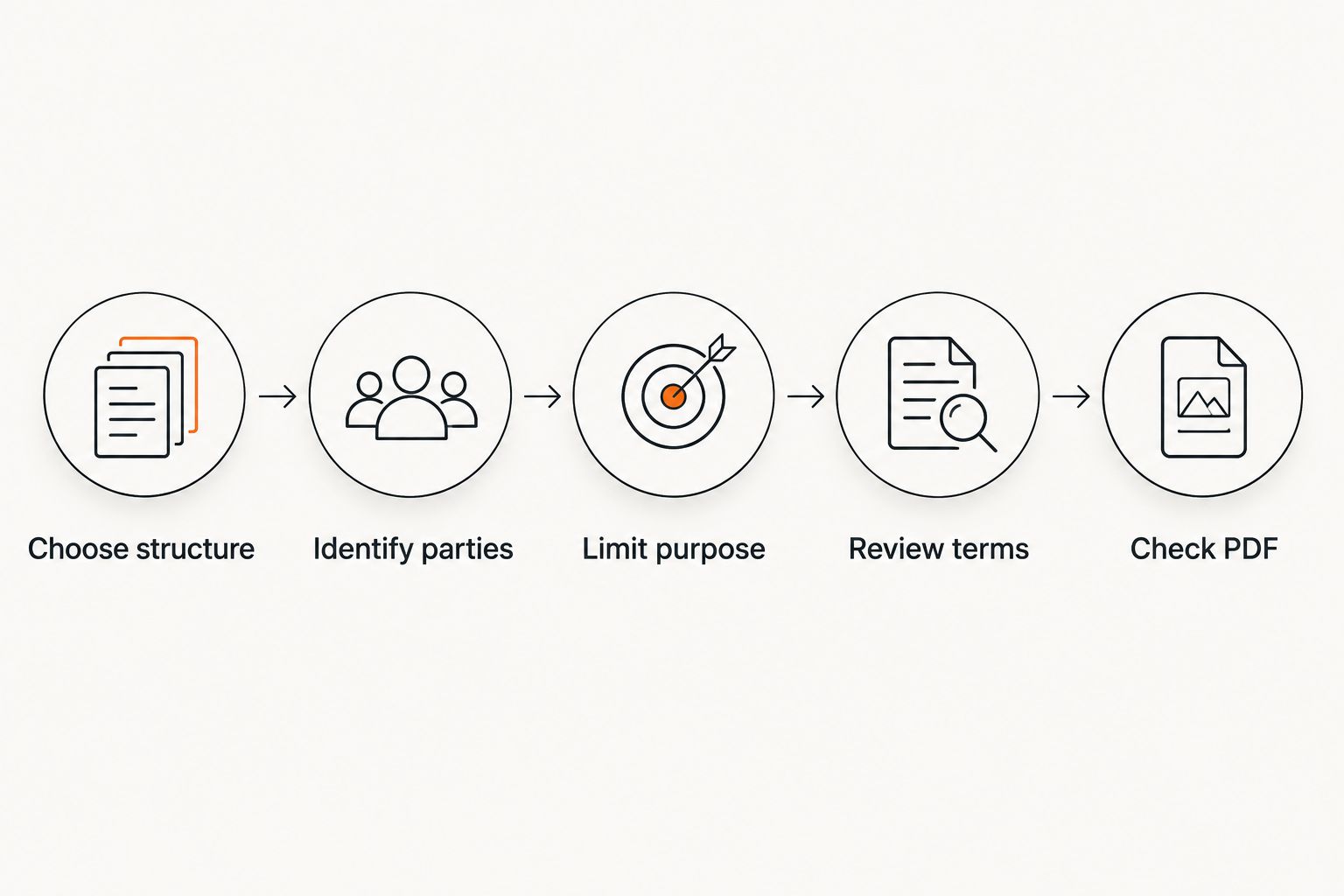
Follow this sequence:
- Choose structure: Decide whether disclosure is one-way or two-way, then identify any contractor or evaluation requirements.
- Identify parties: Enter the correct legal names and confirm who will sign for each business.
- Limit purpose: Describe the specific activity the recipient is allowed to perform.
- Review terms: Check definitions, exceptions, access, duration, return or deletion, and applicable-law provisions.
- Check PDF: Inspect every page, resolve blanks, and save the agreed version before signing.
A practical final check is to compare the PDF with your working notes. Confirm that no editing instruction, contradictory clause, or unused signature field remains in the exported document.
Keep document preparation separate from disclosure approval. A completed file does not mean every planned attachment belongs in the recipient's inbox.
Start your NDA PDF
Use a free NDA template, tailor the terms, and check the completed document before signing.
Which free NDA template should you choose?
Choose a unilateral NDA if only your startup will disclose confidential information. Choose mutual terms when information flows both ways, then add assignment-specific or evaluation-specific provisions where the situation requires them.
For your 2026 document, prioritize accurate parties and a narrow permitted purpose over an impressive-looking page count. Seek legal advice when the terms, disclosure risks, or applicable rules need interpretation.
FAQ
What's the best free NDA template for startups?
A unilateral NDA is the best starting point when only the startup discloses confidential information. Use a mutual structure when both businesses disclose, and tailor the terms to the actual purpose and applicable rules.
Is a mutual NDA better than a unilateral NDA?
A mutual NDA is better suited to two-way disclosure, not inherently better protection. A unilateral NDA fits an exchange where only one party needs confidentiality obligations from the other.
Can I download an NDA without creating an account?
Pdf-Forms-Hub offers downloadable NDA templates without signup. Complete the relevant details and review the document before using it for your circumstances.
Does a contractor NDA give my startup ownership of the work?
A confidentiality obligation alone does not establish ownership of a contractor's work. Address deliverables and intellectual-property rights in suitable contractual terms rather than assuming an NDA settles them.
Will an NDA stop someone from sharing my information?
An NDA creates contractual obligations; it does not physically prevent disclosure. Limit access and share only what the recipient needs, alongside appropriate contractual protection.
How long should a startup NDA last?
The appropriate duration depends on the information, relationship, and applicable rules. Distinguish the period for making disclosures from the period during which confidentiality obligations continue.
Can I use the same NDA template in every state?
Do not assume a template fits every state's rules or every relationship. Review the governing-law language, restrictions, and circumstances with a qualified lawyer when legal interpretation is needed.
One last thing
The smallest useful disclosure is often a better operational choice than sending everything covered by an NDA. Before sharing, make a separate list of what the recipient actually needs to complete the permitted task.
Remove unrelated files and confirm the recipient list. Your agreement and your access decisions should describe the same information exchange.