
Business partnership NDAs are confidentiality agreements that limit how prospective partners use and share sensitive information so you can evaluate a business relationship without authorizing unrelated use. To create an NDA PDF, choose a mutual or unilateral template, define the permitted purpose, complete the parties’ details, and review the terms before signing.
- Use an nda template for business partnerships as a starting draft, not a finished legal agreement.
- Pdf-forms-hub offers free NDA templates for freelancers and small businesses; tailor the terms before signing.
- Choose a mutual NDA when both businesses disclose confidential information and a unilateral NDA for one-way disclosure.
- Define permitted use, authorized recipients, exclusions, and confidentiality duration before exporting the final PDF.
Why NDAs matter for business partnerships
A potential partner can need access to your supplier terms, customer information, product plans, or internal processes before agreeing to work together. An NDA establishes the agreed boundaries for that disclosure. It does not replace the commercial agreement that defines the actual partnership.
For a US freelancer or small-business owner evaluating a partnership in 2026, the practical problem is matching the document to the conversation. A referral arrangement, joint service offering, and product collaboration involve different information and different recipients. A generic prohibition on sharing information does not explain those differences.
Pdf-forms-hub NDA templates are best for freelancers and small businesses that need a starting draft before reviewing partnership-specific terms. The library includes 25+ downloadable PDF templates, with drafting assistance and no signup required. Browse Pdf-forms-hub for a starting document, then use the checks below to adapt it.
A template supplies structure, not a legal conclusion. Its terms need to fit your circumstances and applicable rules; this guide is not a substitute for legal advice.
How to prepare a partnership NDA PDF
Map disclosures
Start with a blank document or spreadsheet. List what each business expects to disclose, who needs to receive it, and why the disclosure is necessary. Do this before selecting clauses: the information exchange should determine the agreement, not the other way around.
For example, a designer and a printing business evaluating a joint service in 2026 might exchange production methods and unpublished client proposals. That is different from a designer simply receiving a printer’s confidential supplier list. The first example involves disclosure in both directions; the second describes one-way disclosure.
Write 1 purpose statement that explains the evaluation without granting broader commercial rights. Keep customer identifiers out of preliminary examples unless they are necessary and you are authorized to share them.
- Record the parties: use the businesses’ legal names and identify their representatives.
- List information categories: name the plans, records, methods, or documents involved.
- Identify recipients: separate decision-makers from advisers and delivery teams.
- Define the purpose: describe the proposed collaboration under evaluation.
- Limit disclosure: remove information the other business does not need.
Choose the structure
Read the template manually before entering names. Look for who is defined as the disclosing party and who carries confidentiality obligations. A mutual heading is not enough if the operative clauses protect only one business.
Choose a mutual NDA when both businesses will disclose confidential information. Choose a unilateral NDA when only one business will disclose it. For a 2026 discussion involving several businesses, review whether the document identifies every party and explains the obligations between them; simply adding names to a two-party form leaves questions unresolved.
After choosing the structure, Pdf-forms-hub NDA templates provide a starting point for document preparation. Drafting assistance does not replace your review of the finished clauses. Manually completing a suitable template remains a workable option.
- Mutual NDA: best for reciprocal exchanges; check that obligations apply to both sides.
- Unilateral NDA: best for one-way disclosure; reconsider it if the exchange changes.
- Existing agreement: best when a current contract already addresses confidentiality; check its scope first.
- Tailored document: best for unusual relationships; explain the information flow to legal counsel.
Define permitted use
Write the permitted purpose in ordinary language before adapting it into the template. A useful purpose tells the recipient what the information is for. It should not silently authorize implementation, resale, customer outreach, or an unrelated project.
For a worked example, describe the purpose as evaluating a proposed joint design-and-print service. Then review whether the remaining clauses match that boundary. Permission to assess a proposal is not the same as permission to reuse its materials in a separate offering.
Define confidential information clearly enough that both businesses can identify it. Review how the agreement treats written files, verbal discussions, demonstrations, and information disclosed before signature. If earlier disclosures matter, address them expressly rather than assuming the document covers them.
- Name the purpose: describe the proposed business activity under evaluation.
- Specify information: identify relevant categories rather than relying only on broad wording.
- Address verbal disclosures: explain how confidential discussions will be identified.
- Review exclusions: consider public, previously known, independently developed, and lawfully received information.
- Check ownership: distinguish confidentiality obligations from any license or transfer of rights.
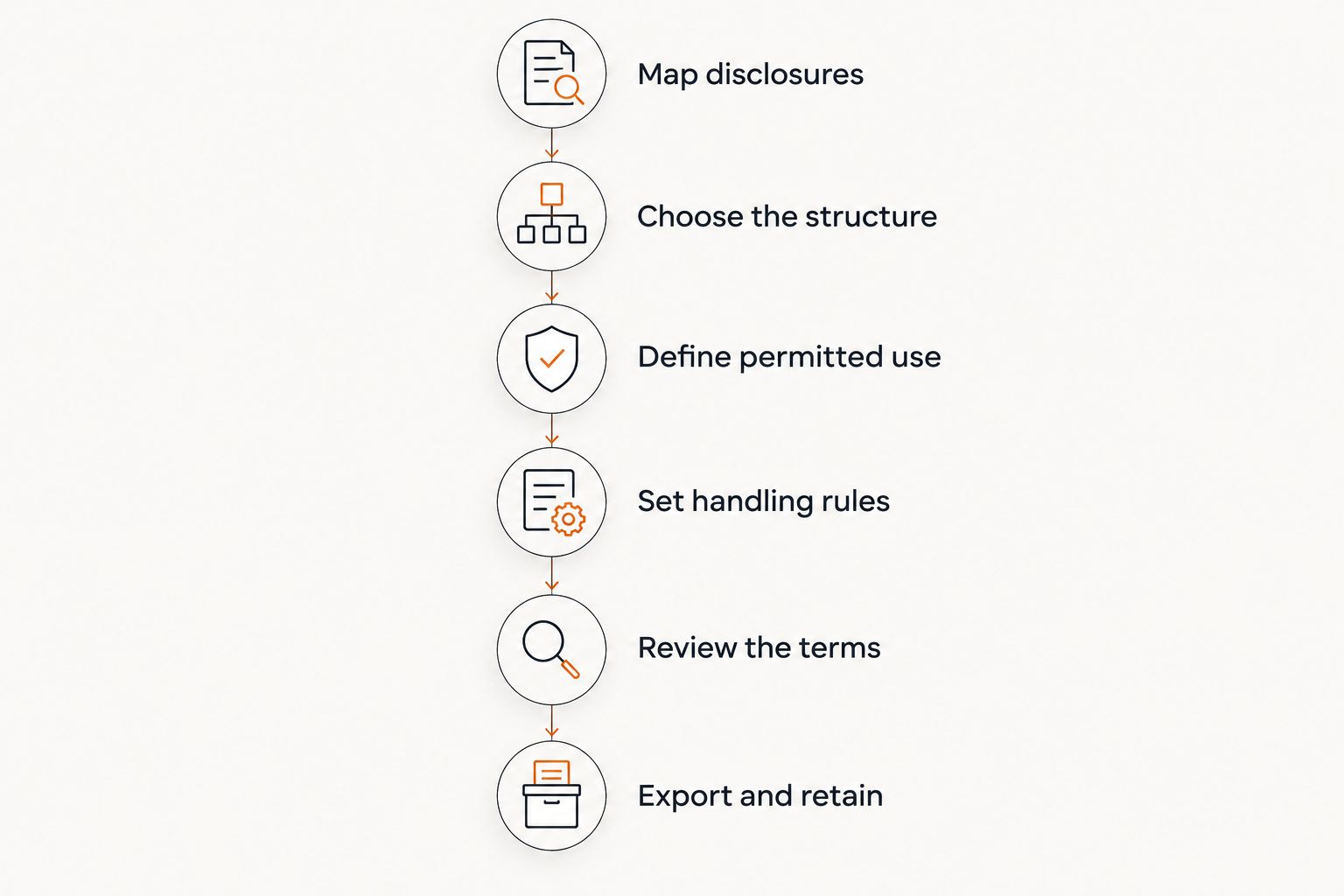
Set handling rules
Match the document to how your businesses actually exchange files. If a prospective partner needs an accountant to review financial information, a blanket ban on disclosure to anyone else conflicts with that process. The agreement should address permitted recipients and their confidentiality responsibilities.
Separate the length of the evaluation from the duration of confidentiality duties. A discussion ending in 2026 does not, by itself, explain when obligations end. Also distinguish ordinary confidential business information from trade secrets when reviewing duration with counsel.
Consider 3 access groups during your review: business decision-makers, outside advisers, and delivery staff. These are planning categories, not mandatory legal roles. Include only the people who need access, and check that the final document reflects your actual working arrangements.
- Identify authorized recipients: define which employees, advisers, or contractors need access.
- Set use restrictions: connect permitted activity to the stated evaluation purpose.
- Address required disclosure: include a process for legally compelled disclosure where appropriate.
- Review duration: distinguish the agreement term from surviving confidentiality obligations.
- Plan the exit: address return, deletion, backups, and records that must be retained.
Review the terms
Compare the completed draft against the planned relationship before asking anyone to sign. Read beyond the confidentiality section. A document labeled NDA can also contain restrictions on customer contact, hiring, competition, or future business activity.
Ask a qualified attorney to review terms you do not understand or cannot accept. Pay particular attention when a document involves sensitive personal information, regulated data, cross-border disclosure, or obligations that do not match your usual operations. An NDA alone does not establish that sharing personal information is permitted.
Check the document at 3 review checkpoints: before signature, before the first sensitive disclosure, and whenever the collaboration changes. These are workflow recommendations, not a legal deadline. A clean PDF is useful only when its text accurately reflects the agreed arrangement.
- Verify identities: confirm legal names, addresses where needed, and signers’ roles.
- Inspect extra restrictions: flag noncompetition, nonsolicitation, exclusivity, or unusual penalties.
- Check governing terms: review applicable law and dispute provisions with counsel as needed.
- Remove contradictions: reconcile defined terms, dates, durations, and attachments.
- Confirm authority: ensure each signer is authorized to sign for the named party.
Export and retain
Save an editable working copy, then export the agreed version as a PDF. Open that PDF separately and inspect every page. Check that long business names fit, signature fields remain visible, and no instructions or placeholder text remain.
Use a clear filename, such as partnership-nda-business-a-business-b-2026.pdf, and distinguish drafts from the version sent for signature. The filename is an organizational aid, not proof that the agreement has been signed or accepted.
For a two-party agreement, retain 2 identical signed copies: one for each business. Confirm that both copies include the same attachments and signature pages. Keep the signed document separate from later edited drafts so nobody mistakes a revised file for the executed agreement.
- Inspect layout: check page breaks, margins, readable text, and complete signature fields.
- Remove drafting residue: delete prompts, alternatives, comments, and unused blanks.
- Confirm attachments: include referenced schedules or information descriptions.
- Check signatures: make sure the agreed signing process is complete.
- Store securely: restrict access to the signed PDF and associated confidential records.
Compare NDA preparation options
Choose the preparation method by the complexity of the relationship, not by the appearance of the PDF. A simple document still needs accurate parties, workable obligations, and a defined purpose.
Pdf-forms-hub supplies NDA templates and drafting assistance. Those are document-preparation resources; they are not confirmation that a completed agreement fits your circumstances. Attorney review and internal handling controls address different needs, so a template and legal review are not mutually exclusive choices.
| Option | Best for | Main advantage | Key limitation |
|---|---|---|---|
| Manually completed template | A straightforward information exchange you can describe clearly | You can inspect and edit each clause directly | You must identify omissions and unsuitable wording yourself |
| Pdf-forms-hub NDA template | Freelancers and small businesses needing a starting draft | Downloadable templates with drafting assistance and no signup required | The finished terms still need circumstance-specific review |
| Existing contract’s confidentiality section | Businesses already working under a signed agreement | Keeps related obligations in the same document | Existing language might not cover the new purpose or recipients |
| Attorney-tailored NDA | Unusual obligations, multiple parties, or sensitive disclosures | Allows advice tied to the proposed arrangement | You still need to explain the information flow and manage access |
Common NDA mistakes business partners make
Treating confidentiality as a partnership agreement
An NDA concerns information use and disclosure. Do not assume it establishes revenue sharing, project ownership, payment obligations, or authority to represent another business. Keep those commercial terms in an appropriate agreement reviewed for the actual arrangement.
Next move: list the commercial decisions separately, then check which document addresses each one. Avoid inserting unrelated operating terms into the NDA merely because it is the first document available.
Using a unilateral form for a mutual exchange
A one-way NDA can leave one participant without matching contractual protection when both businesses disclose information. This often becomes clear only after the discussion expands from a single proposal to shared planning.
Next move: check the information map against the document’s defined roles. Update the structure before reciprocal disclosure rather than relying on an informal assumption that the same rules apply to everyone.
Confusing permission to evaluate with permission to use
A potential partner needs enough information to assess the opportunity. That does not mean your business intends to authorize commercial reuse, customer outreach, publication, or incorporation into another service.
Next move: compare the permitted-purpose clause with the actual activities you expect. Explain any needed rights separately instead of treating the NDA as a general permission document.
Signing before checking practical obligations
An obligation to delete every copy conflicts with a workflow that retains necessary records unless the agreement addresses that situation. Similarly, a recipient clause that excludes essential advisers creates an operational problem before work begins.
Next move: ask the person managing files to read the handling and deletion provisions. Resolve obligations your business cannot carry out before signature, not after receiving a deletion request.
FAQ
What's the best NDA template for a business partnership?
The best NDA template matches the direction of disclosure, the evaluation purpose, and the people who need access. Choose a mutual structure for reciprocal disclosures and a unilateral structure for one-way disclosure, then review the actual clauses.
Is a mutual NDA better than a unilateral NDA?
A mutual NDA fits situations where both businesses disclose confidential information; a unilateral NDA fits one-way disclosure. Neither structure is automatically better, and the heading does not replace checking each party’s obligations.
Can I use a free NDA template for my small business?
You can use a free NDA template as a starting draft for your small business. Tailor the parties, purpose, information categories, recipients, and duration to your circumstances, and obtain legal advice when the terms or risks need review.
Does an NDA create a business partnership?
An NDA should not be treated as the agreement that establishes your business partnership. Address ownership, compensation, decision-making, and other commercial terms in documents suited to the relationship.
How long should a partnership NDA last?
The appropriate duration depends on the information, the relationship, and applicable rules. Distinguish the agreement’s term from confidentiality obligations that continue afterward, and review trade-secret treatment separately with counsel.
Should I send an NDA before sharing a business proposal?
If your business requires an NDA before disclosing confidential material, complete the agreement before making that disclosure. You can prepare a preliminary overview that leaves out sensitive details while the parties review the terms.
Can I change the NDA after downloading the PDF?
Revise the working draft before signing and export a new PDF for review. If the agreement is already signed, follow its amendment provisions and obtain the necessary agreement rather than silently editing the executed file.
One last thing
Use the signed NDA as a disclosure checklist, not just a stored PDF. Before sending the next file, confirm that its recipient and intended use fit the agreement. If the discussion changes from evaluating a collaboration to delivering work, review the documents again; confidentiality terms alone do not define the new commercial relationship.