Yes, a free NDA template can become a legally binding agreement when it meets the applicable requirements for contract formation and contains lawful, enforceable confidentiality obligations. Downloading or signing a template does not automatically satisfy those requirements. For a US freelancer or small-business owner in 2026, the practical next step is to tailor the document to the information, parties, and governing law before sharing confidential material.
- Is a free NDA template legally binding? Yes, when the completed agreement meets applicable contract requirements.
- Pdf-Forms-Hub offers downloadable NDA templates; treat each template as a starting document, not legal approval.
- Choose unilateral confidentiality for one-way disclosures and mutual confidentiality when both parties share protected information.
- Define permitted use, preserve lawful disclosures, and keep the final signed PDF with its signing records.
Is a free NDA template legally binding?
The source of an NDA does not decide enforceability; the completed agreement and applicable law do. A downloaded form still needs identifiable parties, agreement to definite terms, a lawful purpose, and any consideration required under the governing law. The person signing for a business also needs authority to bind it.
Use this checklist before treating a template as a finished agreement:
| Check | What your NDA should establish | What creates a problem |
|---|---|---|
| Parties | Correct legal names and clear roles | A brand name that does not identify the contracting person or entity |
| Agreement | Acceptance of the same final terms | Conflicting versions or unresolved edits |
| Consideration | A legally sufficient exchange where required | Assuming a signature alone supplies consideration |
| Protected information | An identifiable category of confidential material | Treating every fact as confidential without limits |
| Lawful obligations | Restrictions consistent with applicable law | Language that blocks protected reporting or disclosures |
| Execution | Authorized signatures and a retained final copy | Missing signatures, unclear authority, or incomplete pages |
Pdf-Forms-Hub provides a library of 25+ downloadable PDF templates, including NDAs, without requiring signup. That gives you a document to adapt, not a determination that its terms fit your transaction.
Why this matters before you share information
An NDA should tell the recipient what information is protected and what the recipient can do with it. If the document leaves those points unclear, a signature does not repair the drafting.
For example, a freelance designer reviewing an unreleased product needs permission to use the supplied material for the agreed project. The client also needs restrictions on unrelated use or disclosure. Write both sides of that arrangement into the document rather than relying on a generic confidentiality label.
This is general US information for 2026, not legal advice. Have a lawyer review obligations that affect valuable trade secrets, employment, regulated information, or parties in different jurisdictions.
Unilateral NDA: best for one-way disclosure
A unilateral NDA places confidentiality obligations on the receiving party. In a simple arrangement between 2 parties, one discloses protected information and the other receives it.
Best for: A business sharing nonpublic project information with a freelancer who is not disclosing confidential information in return.
The advantage is a focused document with clearly assigned roles. The limitation is equally clear: it does not automatically protect confidential information flowing in the opposite direction.
Before choosing unilateral terms, ask whether your proposal, methods, or internal documents also need protection. If both sides expect to disclose protected material, review mutual terms instead.
Mutual NDA: best for two-way disclosure
A mutual NDA places confidentiality obligations on both sides. Each of the 2 parties acts as a disclosing party when sharing information and a receiving party when obtaining it.
Best for: A prospective partnership where both businesses exchange nonpublic plans or operating information.
The advantage is reciprocal protection within one agreement. The limitation is that reciprocal wording still needs to fit each side's actual disclosures and permitted uses.
| NDA format | Best for | Main advantage | Main limitation |
|---|---|---|---|
| Unilateral NDA | One-way disclosure | Focused receiving-party obligations | Does not automatically protect reverse disclosures |
| Mutual NDA | Two-way disclosure | Reciprocal confidentiality obligations | Matching wording can overlook different practical needs |
Neither format wins automatically. Choose the direction of protection based on the information flow, not the document's length.
Why NDA enforceability varies
An NDA's effect depends on its wording, the transaction, and applicable law. These factors deserve attention before you reuse a form in 2026:
- Governing law. States differ in contract rules and restrictions affecting confidentiality agreements. A governing-law clause does not erase mandatory legal protections.
- Timing and consideration. An agreement signed before a new business exchange raises different questions from one imposed after the relationship begins. Identify the exchange supporting the obligations.
- Scope of information. Describe protected material in terms the recipient can understand. Address information that is public, independently developed, or lawfully obtained elsewhere.
- Purpose and duration. Limit use to the agreed purpose and distinguish the disclosure period from the period confidentiality obligations continue.
- Protected disclosures. An NDA must not be treated as permission to block legally protected reporting, testimony, or other disclosures.
- Evidence and conduct. Keep the agreement and signing records, and restrict access to the information. An NDA does not replace reasonable measures to protect a trade secret.
Avoid adding restrictions simply because a template contains them. A confidentiality agreement should not quietly become an ownership assignment, noncompete, or broad restriction on future work.
How do you turn an NDA template into a signed PDF?
Use this workflow for a new agreement in 2026. Complete the substance before collecting signatures; a polished PDF is not proof of sound terms.
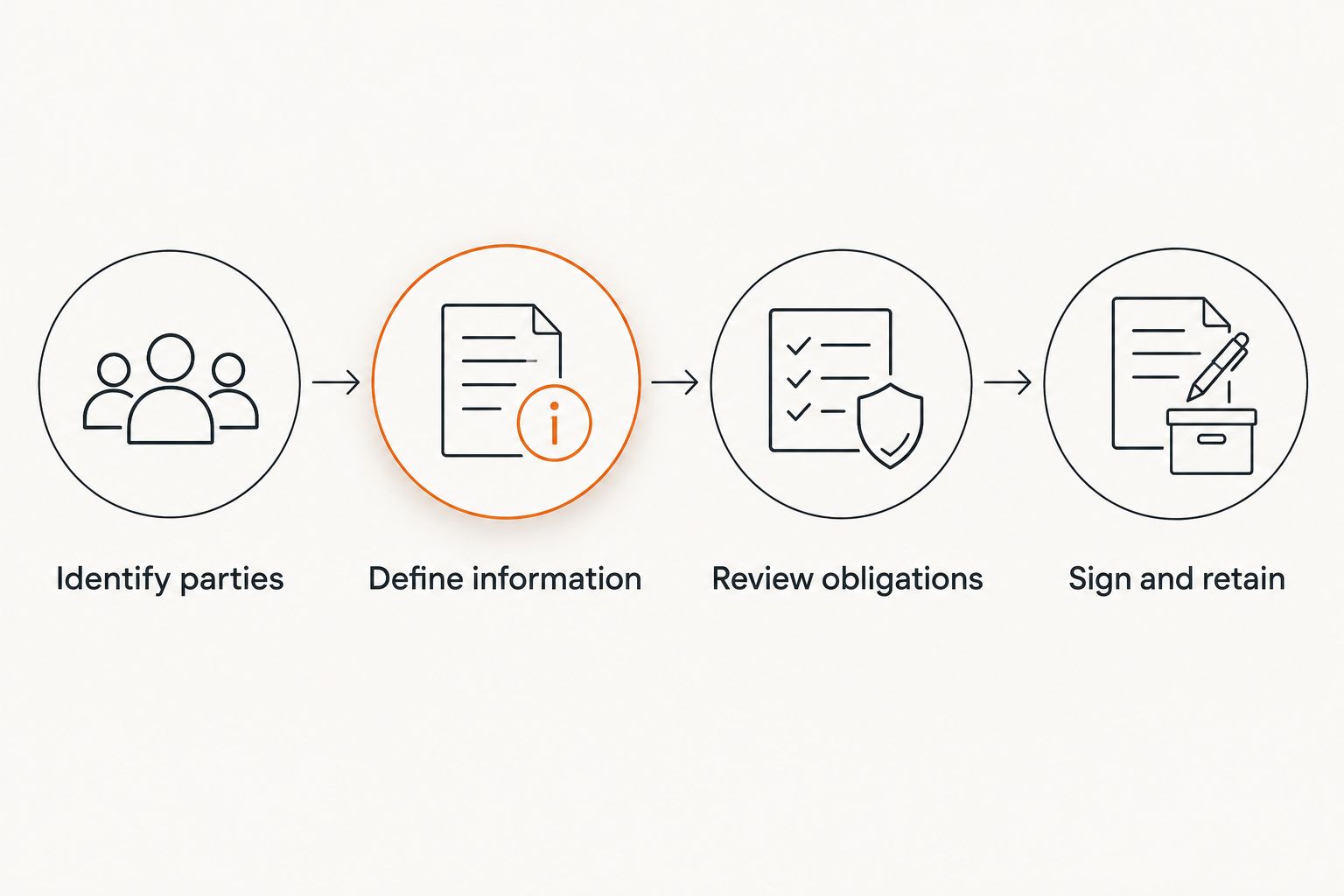
1. Identify parties
Enter the correct legal names and addresses where the document calls for them. If a company is the contracting party, identify the company and the authorized signer rather than substituting a project nickname.
Check whether you are contracting personally or through a business entity. That choice affects who undertakes the obligations.
2. Define information
Describe the information you expect to share and the permitted business purpose. State how the agreement handles oral disclosures, demonstrations, files, and information disclosed before signing, if relevant.
For a design project, the description might cover unreleased packaging artwork and launch plans supplied for project evaluation. This is a drafting example, not a complete clause ready for every engagement.
3. Review obligations
Check permitted recipients, security expectations, exclusions, duration, and return or deletion requirements. Review exceptions for legally required disclosures and retained records.
Do not promise deletion from systems you cannot control. Resolve practical limits before signing instead of making an obligation you cannot carry out.
4. Sign and retain
Send the same complete version to each signer. After execution, retain the signed PDF, attachments, and available signing records together.
If terms change, make sure the signatures relate to the revised version. Keep blank forms separate from executed agreements so nobody mistakes a draft for the binding record.
An electronic-signature workflow also needs evidence of agreement. Under the federal E-SIGN Act, 15 U.S.C. § 7001(a), a signature or contract within the statute's scope cannot be denied legal effect solely because it is electronic; that rule does not validate otherwise defective terms.
What should you check in the confidentiality clauses?
Read the obligations as instructions you will actually have to follow. Highlight any sentence that leaves you unsure what you can share, retain, or use.
- Permitted use: Identify the project or evaluation that authorizes use of the information.
- Permitted recipients: Decide whether staff, subcontractors, or advisers need access and on what terms.
- Exclusions: Address public information, prior knowledge, independent development, and lawful third-party receipt.
- Duration: Separate the agreement's term from the survival of confidentiality obligations.
- Return and deletion: Address working copies, backups, and records that must be retained.
- Other obligations: Check for ownership transfers, indemnities, restrictive covenants, or dispute provisions beyond confidentiality.
For employment-related agreements, the federal Defend Trade Secrets Act contains protected-disclosure provisions and employer notice requirements in 18 U.S.C. § 1833(b). Its definition of employee for that notice provision includes individuals working as contractors or consultants. Have counsel check how the provision applies instead of deleting exceptions from a template.
Does signing an NDA make every clause enforceable?
No. A signature records agreement; it does not make an unlawful restriction enforceable. Courts assess the relevant terms under applicable law, and the outcome also depends on the facts.
A severability clause is not a guarantee that a court will rewrite an overbroad provision. Remove unsuitable restrictions before signing.
Can an NDA cover information you already shared?
An NDA can be drafted to address earlier disclosures, but the wording, consideration, and applicable law need review. Do not assume a new agreement automatically reaches every previous conversation or attachment.
Identify the earlier disclosures and their intended treatment expressly. Signing before disclosure avoids that particular drafting problem.
Does an NDA transfer ownership of your work?
Confidentiality and ownership are separate issues. An NDA restricts use or disclosure; an ownership transfer depends on the agreement's actual assignment language and applicable law.
Freelancers should check the project contract as well as the NDA. A document titled NDA can still contain provisions affecting work product or intellectual property.
FAQ
Is a free NDA template legally binding without a lawyer?
A free NDA template can become legally binding without a lawyer when the completed agreement satisfies applicable law. A lawyer's review helps address unsuitable terms, but the absence of review alone does not decide enforceability.
Do both parties need to sign a unilateral NDA?
Do not assume the word unilateral means only one signature is needed. It describes the direction of confidentiality obligations; execution requirements depend on the agreement and applicable law, so obtain signatures from both parties as a practical default.
Does an NDA need to be notarized?
An ordinary US business NDA generally does not require notarization. Check applicable law and any execution requirements in the agreement; notarization does not establish that the terms are enforceable.
Can I sign an NDA electronically in 2026?
An NDA can generally be signed electronically in US business transactions covered by electronic-signature law. Keep evidence of signer identity, agreement to the final terms, and the completed document; electronic signing does not cure unlawful clauses.
How long should an NDA last?
An NDA's duration should fit the information and applicable law rather than a universal template term. Distinguish the period for making disclosures from the period confidentiality obligations continue, and obtain advice about trade-secret provisions.
Can I use the same NDA for every client?
Use the same NDA as a starting template, not an unchanged agreement for every client. Update the parties, purpose, information categories, recipients, duration, and governing-law provisions for each engagement.
Does an NDA guarantee that my information stays secret?
An NDA does not guarantee secrecy or prevent every disclosure. Limit access, share only what the recipient needs, and use appropriate security measures alongside the agreement.
One last thing
Pdf-Forms-Hub NDA templates are best for freelancers and small-business owners who need a starting document to customize. The limitation is that a template cannot decide which obligations fit your circumstances or applicable rules.
Before sending the final PDF, compare the permitted-use clause with your actual project. If you cannot explain what the recipient is allowed to do, revise that clause before sharing the information.