
Best overall: a fixed-scope project agreement. Best for repeat client work: a master services agreement with statements of work. Best for recurring support: a retainer agreement. The best freelance contract template for agencies in 2026 matches how you deliver, approve and bill for the work—not just the document’s title.
- The best freelance contract template for agencies defines deliverables, approvals, revisions and payment obligations.
- Choose a fixed-scope agreement for a defined project; use a retainer for recurring services.
- Pdf-Forms-Hub provides downloadable PDF templates; adapt contract language to your work and applicable rules.
- Separate client agreements from subcontractor agreements, and check confidentiality and ownership terms across both.
Why this matters
An agency contract needs to describe the relationship you actually have. Hiring a freelance designer is different from selling a website project to a client; the responsibilities, approval rights and ownership terms change with your role.
Pdf-Forms-Hub is a starting point for agencies that need downloadable PDF contract templates without signing up. Its PDF template library includes contracts and NDAs. The formats ranked below are agreement structures to look for or draft, not a claim that each is a named template in the library.
Templates need to fit your circumstances and applicable rules. This guide explains document selection and drafting checks; it is not legal advice or a promise that a particular agreement is enforceable.
What makes the best freelance contract template for agencies
Use these criteria to choose your 2026 contract format before filling in names:
- Correct relationship: Identify whether your agency is hiring a freelancer or supplying services to a client.
- Defined scope: State deliverables, exclusions, dependencies and the process for approving changes.
- Clear approvals: Identify who can accept work and how the parties handle revisions or disputed deliverables.
- Payment obligations: Explain billing triggers, invoice timing and what happens when work stops.
- Rights and responsibilities: Address intellectual property, confidentiality, third-party materials and access to client systems.
- Practical exit: Explain termination, unfinished work, handover and obligations that continue after the engagement.
A longer document does not automatically meet these criteria. A short agreement with specific attachments is more useful than pages of general language that never describe the actual assignment.
Agency contract templates at a glance
| Rank and format | Best for | Standout feature | Key limitation |
|---|---|---|---|
| 1. Fixed-scope project agreement | A defined client project | Connects deliverables, milestones and acceptance | Needs written changes when the assignment expands |
| 2. Master services agreement with statements of work | Repeat projects for the same client | Separates standing terms from individual assignments | Requires consistent documents and clear precedence |
| 3. Retainer agreement | Recurring support or reserved capacity | Defines what each service period includes | Vague capacity and rollover terms create confusion |
| 4. Time-and-materials agreement | Work with an uncertain scope | Connects billing to recorded work and approved expenses | Requires spending controls and useful records |
| 5. Subcontractor agreement | Hiring freelancers to fulfill agency work | Defines delivery duties and the rights your agency needs | Must be checked against the client agreement |
1. Fixed-scope agreement: best for a defined client project
A fixed-scope project agreement describes a specific result: a website build, a copywriting package or a design assignment. It connects that result to delivery dates, client inputs, revision limits and acceptance.
Best for: An agency delivering a bounded assignment with an identifiable finish.
The strongest starting point is a deliverables attachment. Describe the files or services the client receives, then list exclusions so an omitted service does not become an assumed obligation.
Fixed-scope agreement pros:
- Gives both parties a defined finish line.
- Connects milestone approval to a named deliverable.
- Makes additional requests easier to identify.
Fixed-scope agreement cons:
- Requires amendments when the assignment changes.
- Breaks down when client dependencies remain undefined.
Worked example: For an illustrative website project, specify 6 pages, 2 revision rounds and a client review period of 10 business days. Those are drafting examples, not default terms. Also define what counts as a revision and what happens if feedback arrives late.
Verdict: Use a fixed-scope agreement for a project you can describe before work starts.
2. MSA with SOWs: best for repeat client projects
A master services agreement, or MSA, sets standing terms for a client relationship. Each statement of work, or SOW, describes a particular assignment, including its deliverables, schedule and commercial terms.
Best for: An agency expecting separate projects with the same client.
This structure separates recurring legal terms from changing project details. In a 2026 contract refresh, check that each new SOW identifies the governing MSA and explains which document controls if the terms conflict.
MSA with SOWs pros:
- Keeps recurring terms in a central agreement.
- Gives each project its own scope and approvals.
- Separates project changes from relationship-wide changes.
MSA with SOWs cons:
- Creates more documents to track and reconcile.
- Leaves gaps if a SOW omits key project details.
For example, an agency might use separate SOWs for a brand identity assignment and a later website project. Each needs its own deliverables and dependencies; the second assignment should not silently inherit the first project’s revision allowance.
Verdict: Use an MSA with SOWs when the relationship continues but the assignments change.
3. Retainer agreement: best for recurring agency support
A retainer agreement defines an ongoing service arrangement. Depending on the agreement, the client receives specified recurring deliverables, reserved working capacity or access to defined services.
Best for: An agency providing continuing support rather than a single finished project.
Choose the model explicitly. A promise to deliver recurring reports is different from a promise to reserve working hours, and neither automatically promises immediate responses to every request.
Retainer agreement pros:
- Defines recurring services in a reusable structure.
- Creates a place for request and priority rules.
- Addresses renewal, cancellation and unused capacity.
Retainer agreement cons:
- Encourages scope confusion when described as general support.
- Requires clear rules for capacity limits and excess requests.
For a monthly content engagement, name the included outputs, required client inputs and approval process. If unused capacity expires or carries forward, state the agreed treatment instead of leaving the parties to infer it.
Verdict: Use a retainer agreement for recurring work only after defining what each service period includes.
4. Time-and-materials agreement: best for uncertain scope
A time-and-materials agreement connects billing to time worked and any agreed reimbursable expenses. It suits assignments where the tasks become clearer during the work, such as investigating an unfamiliar website or handling changing production requests.
Best for: An agency handling an assignment that cannot yet be scoped reliably.
The agreement should explain how work is authorized, recorded and reported. Define whether an estimate is a planning figure or a binding limit, and identify who can approve additional work.
Time-and-materials agreement pros:
- Accommodates changing tasks without pretending the scope is fixed.
- Connects invoices to recorded activity.
- Supports staged authorization as requirements become clearer.
Time-and-materials agreement cons:
- Gives the client less certainty about the final total.
- Requires consistent records and spending approvals.
A useful project attachment lists permitted activities, excluded expenses and reporting expectations. If the client wants a spending cap, explain what happens when the work approaches it: pause, request approval or reduce scope by agreement.
Verdict: Use a time-and-materials agreement when uncertainty is real and approval controls are explicit.
5. Subcontractor agreement: best for hiring freelancers
A subcontractor agreement governs the relationship between your agency and a freelancer supplying part of the work. It needs to address delivery responsibilities, confidentiality, access, ownership and the freelancer’s permitted use of the finished work.
Best for: An agency commissioning outside help to fulfill a client engagement.
Do not simply reverse the names in your client contract. Your agency needs terms that fit the freelancer’s actual assignment and the commitments your agency has already made to the client.
Subcontractor agreement pros:
- Assigns responsibility for specific deliverables.
- Documents the ownership or license rights being granted.
- Addresses client information and system access.
Subcontractor agreement cons:
- Requires reconciliation with the client contract.
- Does not settle worker classification merely by naming the relationship.
Check portfolio permissions, third-party assets and whether further subcontracting requires approval. A client confidentiality promise and a freelancer portfolio permission need deliberate alignment, not separate assumptions.
Verdict: Use a subcontractor agreement whenever a freelancer supplies agency work, and review classification under applicable rules.
How these contract formats rank
The ranking follows the selection criteria: relationship, scope, approvals, payment, rights and exit. It is a fit-based guide, not a test of individual vendors or a claim that one document meets every legal requirement.
The fixed-scope agreement takes the default position because it requires you to describe the project directly. The other formats address specific needs: repeated assignments, recurring services, uncertain scope or outsourced delivery.
When using Pdf-Forms-Hub contract templates, choose the agreement structure before drafting. Formatting a document as a PDF does not resolve missing business terms.
Turn your chosen format into a usable PDF
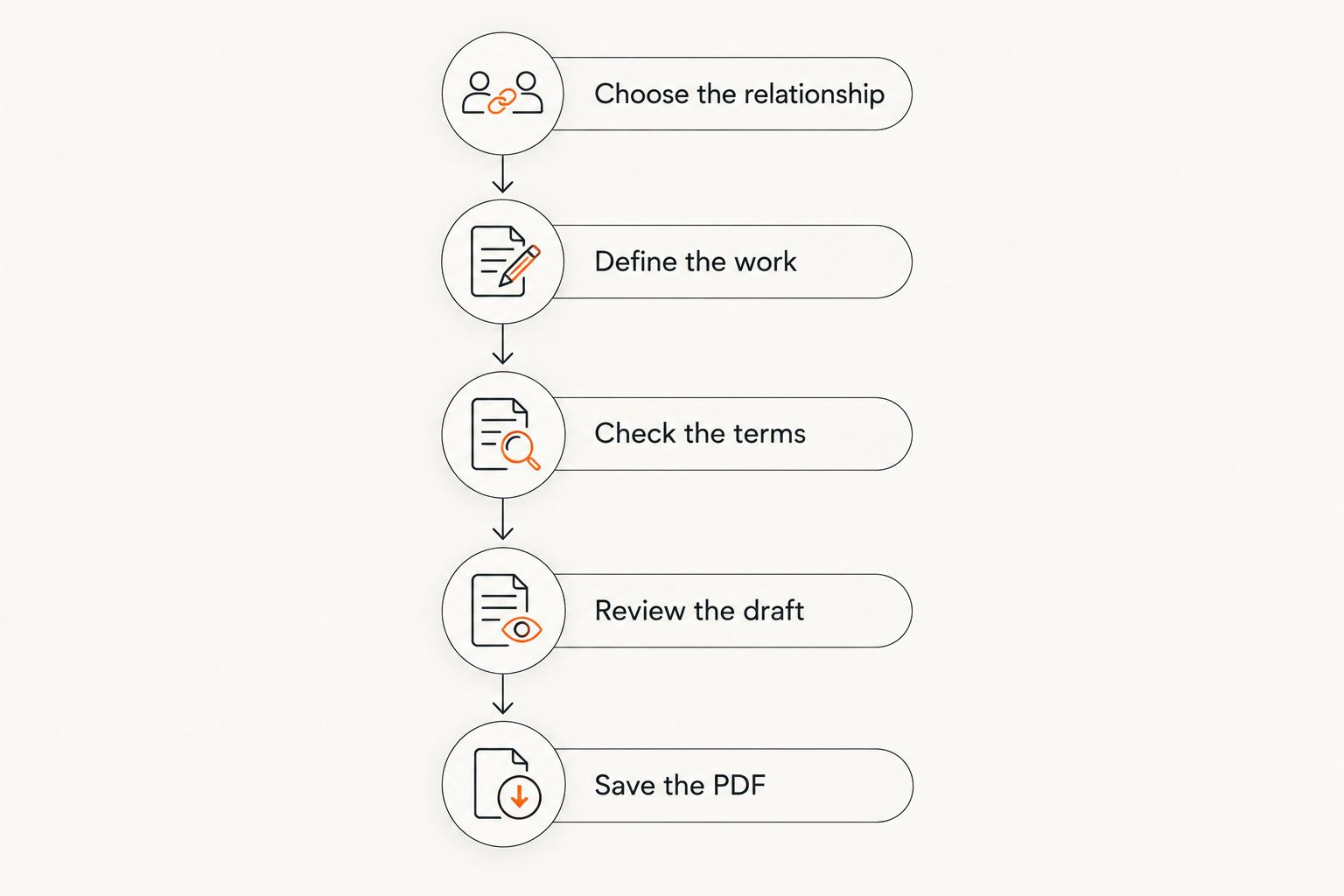
Use this sequence for your 2026 agency agreement. Resolve the business decisions first; export the document after the parties have reviewed its substance.
- Choose the relationship. Identify the contracting parties and whether your agency is the service provider or buyer.
- Define the work. Attach deliverables, exclusions, dependencies and approval responsibilities.
- Check the terms. Review billing, changes, ownership, confidentiality, termination and applicable rules.
- Review the draft. Remove placeholders, resolve conflicting clauses and confirm attachments are included.
- Save the PDF. Check readability, signature fields, page breaks and the final version before circulation.
Keep editable working files separate from the version sent for signature. Use a clear filename, such as Agency-Client-Project-2026-Final.pdf, and avoid circulating several different files marked final.
Check these details before signing
- Do legal names match across the agreement and attachments?
- Can a reader identify exactly what is included and excluded?
- Does the agreement explain how additional work gets approved?
- Are ownership and third-party asset permissions consistent?
- Does termination address completed work and handover?
- Have both parties reviewed the same final version?
Use qualified legal advice where the agreement involves material liability, sensitive information, unusual ownership terms or unfamiliar jurisdiction requirements. A generic template cannot make those decisions for you.
Start your PDF document
Browse downloadable contracts and other PDF templates. No signup required.
Which agency contract template should you choose?
Choose a fixed-scope project agreement unless your working arrangement calls for a different structure. It forces a useful first question: what exactly are you agreeing to deliver?
For repeat assignments, choose an MSA with separate SOWs. For continuing support, choose a retainer; for uncertain tasks, choose time-and-materials terms. When hiring the freelancer rather than serving the client, use a subcontractor agreement.
Pdf-Forms-Hub supplies a starting point for PDF documents, not a replacement for project definition or legal review. Your best 2026 template is the one whose scope, approvals and obligations match the actual engagement.
FAQ
What’s the best freelance contract template for agencies?
A fixed-scope project agreement is the default choice for a defined agency project. Use an MSA with SOWs for repeat assignments, a retainer for recurring services or a subcontractor agreement when hiring a freelancer.
Should an agency use the same contract for clients and freelancers?
No. A client agreement governs what your agency supplies, while a subcontractor agreement governs what the freelancer supplies to your agency. Check that confidentiality, ownership and delivery obligations fit together.
Is an NDA enough to hire a freelancer?
No. An NDA addresses confidentiality, not the complete service relationship. You still need terms covering work, payment, approvals, ownership and termination.
What should an agency contract say about revisions?
An agency contract should define included revisions, how feedback is submitted and how additional requests are approved. Distinguish correcting a failure to meet the agreed brief from changing the brief.
Does calling someone a subcontractor establish their legal status?
No. Worker classification depends on applicable rules and the actual working relationship, not just the agreement’s title. Get advice appropriate to the jurisdictions and circumstances involved.
Does saving a contract as a PDF make it legally valid?
No. PDF is a file format, not a legal guarantee. The agreement’s terms, formation, signing process and applicable rules still matter.
Can I start with a free PDF contract template?
Yes. A free template provides a drafting starting point, but you still need to adapt it to the assignment and applicable rules. Review the finished agreement rather than assuming the template covers your circumstances.
One last thing
Check the handover clause before the signature fields. A project can reach its final milestone while the parties still disagree about source files, account access, third-party licenses or unfinished work.
Name the handover materials and responsibilities in the agreement. That final check connects the document to what your client—or your agency—actually needs when the work ends.