
Best overall: a project-specific NDA. Best for one-way disclosure: a unilateral NDA. Best for shared confidential information: a mutual NDA. Best for delegated work: a subcontractor NDA. The best free NDA template for freelancers in 2026 matches who shares information, who receives it, and what the recipient can do with it.
- The best free NDA template for freelancers matches the disclosure direction and permitted project use.
- Pdf-forms-hub provides downloadable NDA templates without signup; adapt the wording before signing.
- Choose a unilateral NDA for one-way disclosure or a mutual NDA when both parties disclose confidential information.
- Check portfolio rights, subcontractor access, exclusions, and deletion duties before creating the final PDF.
Why this matters
A freelance NDA should explain how you can use confidential information while doing the work. A document that ignores your workflow can leave practical questions unanswered: whether your editor can see the files, whether you can retain backups, or whether you can show the finished project.
Pdf-forms-hub offers free downloadable NDA templates within a library of 25+ PDF templates, without signup. Pdf-forms-hub is best for freelancers who want a downloadable NDA starting point without signing up.
Use a template as a draft, not a legal guarantee. Its terms need to fit your circumstances and applicable rules; a template is not a substitute for legal advice.
What makes the best free NDA template for freelancers?
For your 2026 projects, judge an NDA by the work it permits and the obligations it creates—not its length. Check these criteria before downloading or signing:
- Disclosure direction: State whether one party or both parties will share confidential information.
- Defined information: Describe the material being protected, with exclusions for information that should not be treated as confidential.
- Permitted purpose: Explain the project activities for which the recipient can use the information.
- Practical access: Address assistants, subcontractors, advisers, and storage arrangements where relevant.
- Duration and exit: Separate the agreement period from confidentiality duties, and address return or deletion.
- Freelance boundaries: Check portfolio use, ownership language, and restrictions unrelated to confidentiality.
Write down 2 party names, 1 permitted purpose, and the information you expect to exchange. These are drafting checkpoints, not a legal completeness test.
Freelance NDA structures at a glance
These recommendations rank drafting approaches, not separate named products. A project-specific NDA can also be unilateral or mutual; the labels answer different questions about scope, disclosure, and access.
| NDA approach | Best for | Standout feature | Key limitation |
|---|---|---|---|
| Project-specific NDA | A defined freelance assignment | Connects confidentiality to the actual work | Needs revision when the project changes |
| Unilateral NDA | Receiving a client's confidential material | Assigns duties around one-way disclosure | Does not automatically protect your disclosures |
| Mutual NDA | Sharing confidential information in both directions | Gives both parties confidentiality obligations | Still needs balanced definitions and exceptions |
| Subcontractor NDA | Giving an assistant access to client material | Addresses confidentiality in delegated work | Does not itself authorize client-information sharing |
Read the full terms before choosing. A document's title does not establish what its clauses actually require.
1. Project-specific NDA: best for a defined freelance assignment
A project-specific NDA ties the confidentiality rules to a named engagement. It identifies the parties, describes the protected information, and explains why the recipient needs access. It can use either one-way or mutual obligations.
For freelancers choosing a 2026 NDA, this is the strongest default because you can check its wording against a concrete task. Start with a downloadable NDA, then adapt the purpose and information descriptions to the assignment.
Project-specific NDA pros:
- Makes the permitted use easier to compare with your scope of work.
- Lets you describe relevant files, discussions, and access arrangements.
- Gives you a place to address project-specific portfolio permission.
Project-specific NDA cons:
- Requires another review when the assignment expands.
- Does not replace payment, ownership, or delivery terms in your services agreement.
Worked example: a website redesign
Suppose you are redesigning a client's website and receive unpublished copy, customer research, and launch plans. Describe the purpose as evaluating and completing the redesign, rather than using an undefined phrase such as business purposes.
Then check whether the draft permits access by your developer. If you want to show the finished website in your portfolio, address that separately instead of assuming public launch gives permission.
Pdf-forms-hub provides an NDA starting point, not confirmation that a particular draft covers these circumstances. Review the completed wording before making the final PDF.
Best for: Freelancers with a defined assignment and identifiable confidential inputs.
Verdict: Use a project-specific NDA as your default, then choose unilateral or mutual duties.
2. Unilateral NDA: best for receiving client information
A unilateral NDA places confidentiality obligations on the recipient of information disclosed by another party. It suits an engagement where your client provides confidential material and you do not need reciprocal protection for your own disclosures.
Check the definitions carefully. Receiving client files does not mean every idea, method, or document you create should automatically become the client's confidential information.
Unilateral NDA pros:
- Matches a one-way exchange without adding unnecessary reciprocal duties.
- Makes the disclosing party and receiving party explicit.
- Focuses review on your permitted use of the client's material.
Unilateral NDA cons:
- Does not automatically protect confidential information you share.
- Can be too broad if it labels all interactions confidential without clear boundaries.
Worked example: editing an unpublished report
Suppose a client sends an unpublished report for editing. A unilateral NDA can address your use of the report for that assignment, access by an approved proofreader, and handling of the files afterward.
If the discussion also requires you to disclose a confidential research method, reassess the structure. One-way protection no longer matches the whole exchange.
Best for: Editors, designers, consultants, and other freelancers receiving confidential client inputs without sharing their own confidential material.
Verdict: Use a unilateral NDA for genuinely one-way disclosure; skip it when you need reciprocal protection.
3. Mutual NDA: best for sharing confidential information both ways
A mutual NDA gives both parties duties when they receive the other's confidential information. It fits exploratory discussions or joint work in which the client and freelancer each need to disclose protected material.
Mutual does not mean balanced. Review whether the same definitions, exclusions, permitted uses, and handling duties apply appropriately to each party.
Mutual NDA pros:
- Addresses confidential disclosures from both sides.
- Avoids relying on separate one-way agreements for the same discussion.
- Lets each party identify the information it needs protected.
Mutual NDA cons:
- Adds obligations you must manage when receiving the other party's information.
- Can still contain unequal exceptions or restrictions despite its title.
Worked example: a joint proposal
Suppose a consultant shares a confidential delivery method while a prospective client shares an internal expansion plan. A mutual NDA can address both disclosures and limit their use to evaluating the proposed engagement.
Keep ownership separate from confidentiality. Permission to review your method should not silently become permission to own or reuse it; inspect any intellectual-property clauses alongside the NDA's main terms.
Best for: Freelancers and clients exchanging confidential methods, plans, or commercial information.
Verdict: Use a mutual NDA when both parties disclose confidential information, not merely because it sounds fairer.
4. Subcontractor NDA: best for delegated freelance work
A subcontractor NDA addresses confidential information shared with someone helping you deliver an assignment. The key question comes before drafting: does your agreement with the client permit that person's access?
A separate confidentiality agreement cannot fix an unauthorized disclosure. Check the client's terms and obtain any required permission before sharing files.
Subcontractor NDA pros:
- States confidentiality duties for the person doing delegated work.
- Connects access to an assigned task rather than your entire client account.
- Provides a place to address further sharing, return, and deletion.
Subcontractor NDA cons:
- Does not replace client consent where consent is required.
- Needs to fit the obligations you have already accepted from the client.
Worked example: bringing in a video editor
Suppose a client gives you unreleased interview footage, and you want an editor to prepare a cut. First check whether the editor can receive the footage. Then define the editing purpose and restrict unrelated use or further sharing.
Also check whether the editor's storage and backup practices fit the agreed handling duties. Do not promise deletion arrangements you cannot carry out.
Best for: Freelancers using assistants or subcontractors who need access to protected client material.
Verdict: Use a subcontractor NDA only alongside the required authority to share the information.
How to turn your NDA draft into a usable PDF
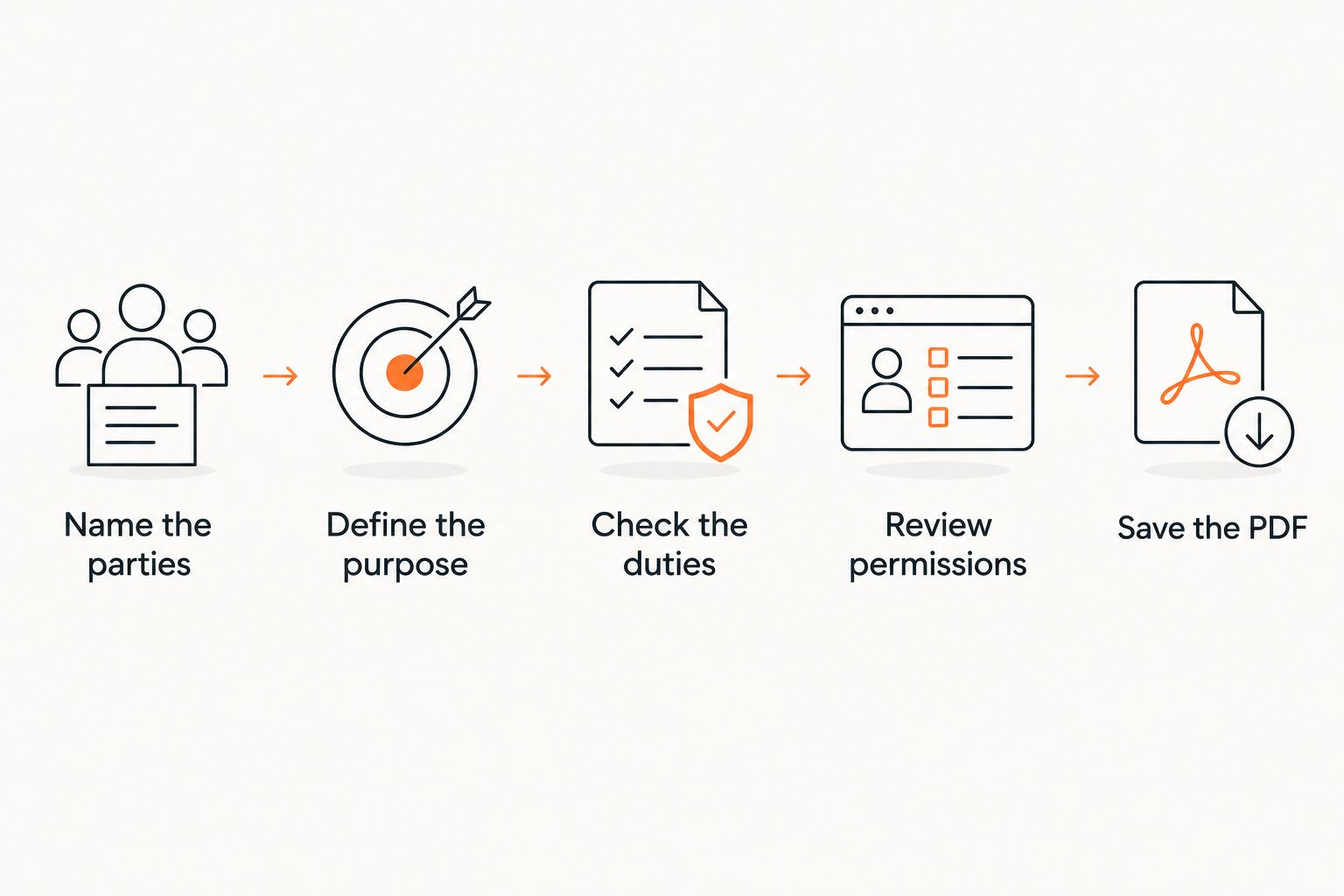
For a 2026 engagement, finish the substantive review before treating the PDF as ready to sign. Follow this sequence:
- Name the parties. Confirm the legal names and who is entering the agreement. Do not assume a trading name identifies the contracting person or entity.
- Define the purpose. Describe the assignment and the information needed to complete it. Remove wording that grants broader use than intended.
- Check the duties. Review exclusions, permitted recipients, duration, and return or deletion requirements. Compare them with how you actually work.
- Review permissions. Resolve subcontractor access, portfolio use, and any conflicts with the services agreement before signing.
- Save the PDF. Check names, dates, signature fields, page breaks, and remaining placeholders. Keep the agreed signed version separate from drafts.
For example, if you receive 3 files—an unpublished brief, customer research, and a launch schedule—check that the information description covers those materials. Also decide how later additions will be handled. Do not assume the first file list covers every future disclosure.
Export 1 final PDF after both parties agree on the wording. Open it again and inspect the actual document, not just the editable draft.
How these NDA approaches are ranked
This 2026 ranking prioritizes fit with a defined freelance assignment, disclosure direction, and practical access requirements. It does not rank legal enforceability or report product testing.
The project-specific approach comes first because it forces you to connect the agreement to the work. Unilateral and mutual structures then determine whose disclosures need protection; subcontractor terms address delegated access.
Which free NDA template should you choose?
Choose a project-specific NDA first, then match its obligations to the disclosure. Use unilateral duties when only your client shares confidential information, mutual duties when both sides share it, and subcontractor terms when approved helpers need access.
Use Pdf-forms-hub for a free downloadable NDA starting point. Before signing, compare the completed draft with your services agreement and seek legal advice about terms you do not understand or cannot meet.
FAQ
What's the best free NDA template for freelancers?
A project-specific NDA is the best starting approach for a defined freelance assignment. Choose unilateral or mutual obligations according to who will disclose confidential information, then adapt the terms to the actual work.
Should a freelancer use a mutual or unilateral NDA?
Use a unilateral NDA for one-way confidential disclosure and a mutual NDA when both parties disclose confidential information. Check the clauses rather than relying on the document's title.
Where can I download an NDA without signing up?
Pdf-forms-hub offers downloadable NDA templates without signup. Review and adapt the document to your circumstances and applicable rules before signing.
Does an NDA replace a freelance contract?
An NDA does not replace a services agreement covering scope, payment, delivery, and ownership. Check the documents together so their provisions do not conflict.
Can I show work in my portfolio after signing an NDA?
Portfolio permission depends on the agreements and permissions that apply to the work. Address it explicitly rather than assuming that public release authorizes your use.
Can I share confidential client files with a subcontractor?
Share confidential client files only when the applicable terms and permissions allow that access. A subcontractor NDA does not itself grant permission from the client.
Is a free NDA template automatically legally enforceable?
A free NDA template does not carry an automatic enforceability guarantee. The wording, circumstances, and applicable law matter; obtain legal advice for questions about your agreement.
One last thing
Before signing a 2026 NDA, read the deletion clause against your backup routine. If the document requires removal from systems you cannot control, resolve that obligation before accepting it—not when the client asks you to delete the files.