
An NDA should protect confidential information for as long as that information needs protection; there is no single duration that fits every agreement. Separate the period for sharing information from the period for keeping it confidential, and address trade secrets separately rather than giving every disclosure the same expiration date.
- How long should an NDA last? Match the confidentiality period to the information’s useful life.
- Ending an NDA does not necessarily end confidentiality duties; read the survival clause.
- Trade secrets need separate treatment tied to their legal status and applicable law.
- Pdf-Forms-Hub suits freelancers needing free NDA templates; customize the duration before signing.
Pdf-Forms-Hub is best for freelancers and small businesses that need free NDA templates without signing up. A template gives you a starting document, not a determination that its duration fits your situation.
How long should an NDA last?
Choose an NDA duration based on what you disclose, when its sensitivity ends, and which law applies. Read the timing provisions together: the agreement’s term, the confidentiality period, and any duties that survive termination.
| Duration approach | Best for | Practical benefit | Limitation |
|---|---|---|---|
| Fixed confidentiality period | Information with a reasonably predictable useful life | Gives both parties an identifiable endpoint | Protection can expire while information remains sensitive |
| Event-based endpoint | Information tied to an identifiable event, such as an authorized public release | Connects the obligation to a business event | An unclear event creates uncertainty |
| Separate trade-secret provision | Information that meets the applicable trade-secret definition | Avoids treating trade secrets like ordinary short-lived information | Calling information a trade secret does not establish its legal status |
These approaches are drafting choices, not interchangeable guarantees. An NDA signed in 2026 should explain which rule applies to each relevant category of information and how overlapping provisions work together.
Why this matters
A project can end while confidential material remains useful. Conversely, a marketing plan can become public before the business relationship ends.
If you use the project’s end date as the only deadline, you leave the treatment of later confidentiality duties unclear. Write the disclosure window and the protection period as separate instructions.
Duration also does not settle enforceability. For the broader question, read whether a free NDA template is legally binding, then adapt the document to your circumstances and applicable rules.
Fixed confidentiality periods: use an explicit trigger
A fixed confidentiality period needs both a duration and a starting event. Without the trigger, the parties can read the same clause differently.
Check whether the period starts on:
- The agreement’s effective date.
- Each individual disclosure.
- The end of the project or business relationship.
- Termination or expiration of the NDA.
A period measured from each disclosure creates different endpoints for information shared on different dates. A period measured from termination uses a common trigger, but the parties still need to know when termination occurs.
Best for: information whose sensitivity has a reasonably identifiable endpoint. The benefit is a clear cutoff; the drawback is that a fixed cutoff does not adjust automatically when the information remains valuable longer than expected.
Do not copy a duration merely because it appears in a template. First decide which information needs protection, then choose and document the timing rule.
Event-based protection: define the event precisely
An event-based clause connects protection to something that happens rather than only to elapsed time. For example, an agreement can address information that becomes publicly available through authorized disclosure.
Be precise about the event. A product announcement does not necessarily disclose the underlying manufacturing process, customer research, or technical documentation.
For a launch planned in 2026, distinguish the public-facing material from supporting information that stays private. Avoid wording that treats every document associated with the launch as public once the announcement appears.
Best for: information tied to a clearly identifiable disclosure event. The benefit is relevance to the actual business situation; the limitation is that vague descriptions of the event make the endpoint harder to establish.
Also distinguish an authorized release from a recipient’s unauthorized disclosure. Do not draft the endpoint so that a recipient can end the duty simply by breaching it.
Trade-secret protection: address legal status separately
A trade secret is not simply anything marked confidential. Under the federal definition in 18 U.S.C. § 1839(3), trade-secret status requires reasonable measures to keep the information secret and independent economic value from its secrecy, among other elements.
For a 2026 NDA, separate ordinary confidential information from information that qualifies as a trade secret. Ask counsel whether protection tied to continued trade-secret status fits the agreement and applicable law.
Best for: qualifying information whose value depends on continued secrecy. The benefit is a provision that addresses that continuing status; the limitation is that the contract’s label cannot replace the legal requirements or actual secrecy measures.
Your handling practices matter alongside the wording. Limit access, use appropriate access controls, and keep a record of authorized disclosures. A broad confidentiality clause is not a substitute for protecting the material in practice.
Why NDA duration varies
The right duration follows the information and the transaction. Use these factors to decide what the agreement needs to say:
- Useful life: Identify when the information stops providing a business advantage through confidentiality.
- Public disclosure: Specify whether an authorized release ends protection for the released information, without sweeping in material that remains private.
- Disclosure pattern: Decide whether information will be shared once or throughout an ongoing relationship.
- Information category: Separate ordinary confidential material from qualifying trade secrets instead of applying an unexplained blanket rule.
- Termination trigger: Make the end of the agreement identifiable, including how either party gives notice where relevant.
- Applicable law: Have the duration and related restrictions reviewed under the rules governing the particular agreement.
A longer term is not automatically a better clause. A useful clause tells both parties what is protected, when the clock starts, and what ends the obligation.
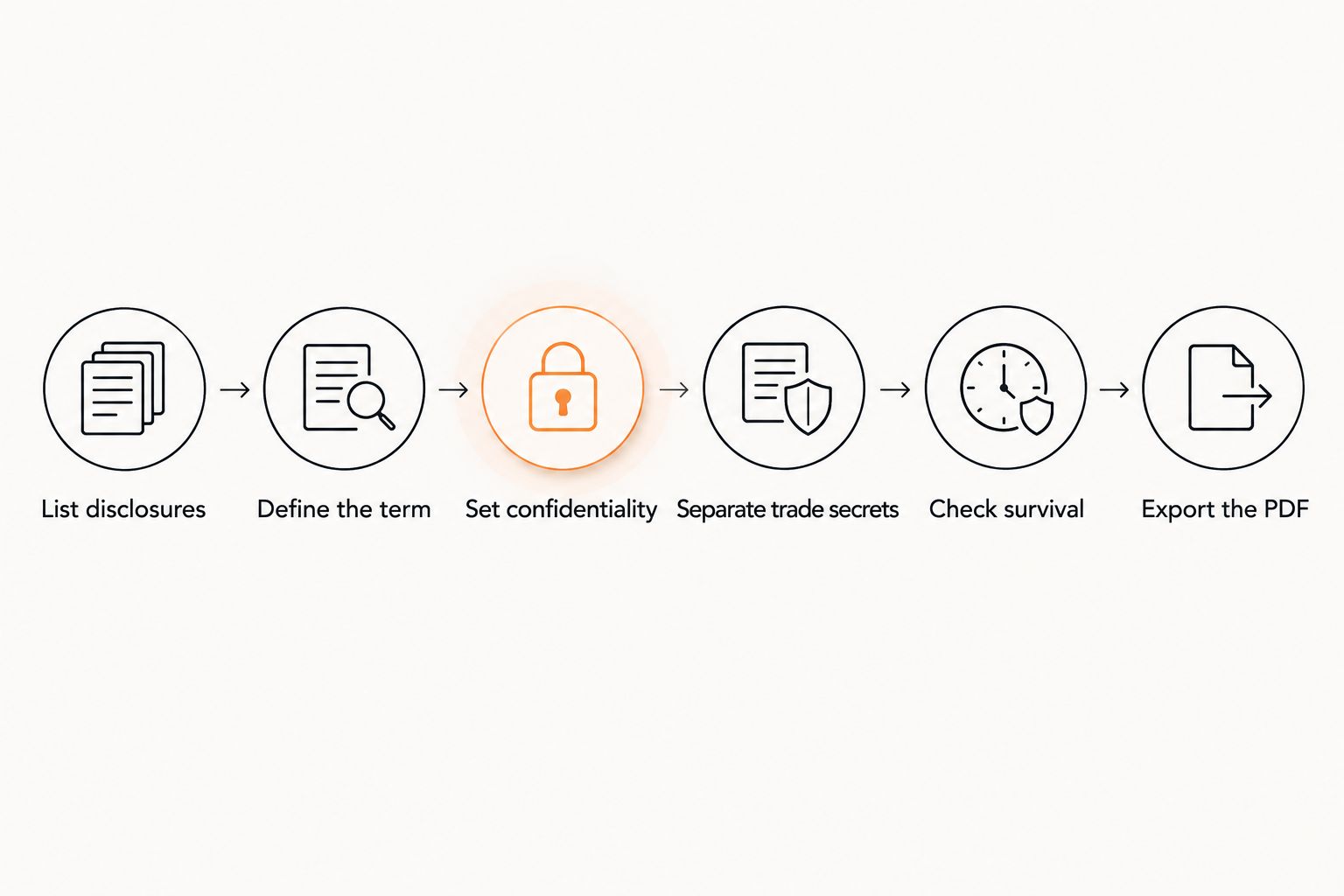
How do you set the duration before creating the PDF?
Set the timing rules before you export the NDA. Editing the PDF after agreement can introduce conflicting versions and unclear changes.
- List disclosures. Name the information you expect to share, such as proposal details, client records, or unpublished designs.
- Define the term. State when the agreement begins and when it ends or can be terminated.
- Set confidentiality. Identify the duration and trigger for the confidentiality obligation.
- Separate trade secrets. Address qualifying trade secrets without assuming all confidential material qualifies.
- Check survival. Confirm that termination, return, deletion, and confidentiality provisions agree with one another.
- Export the PDF. Review the completed document before sending it for signature.
Pdf-Forms-Hub provides free downloadable NDA templates within its library of 25+ PDF templates. Use the template as the document framework, then review the completed clauses rather than assuming the original wording matches your project.
Start your NDA draft
Use a free NDA template, then adapt the duration and confidentiality clauses to your situation.
What does this look like for a freelancer?
Consider a freelance designer working on a confidential launch in 2026. The client shares unreleased packaging, an internal brief, and a private customer list.
Do not treat those materials as having an identical endpoint. The final packaging becomes visible when released, but the public release does not itself disclose the internal brief or customer list.
Use a drafting worksheet before selecting the duration:
| Information | Question to resolve | Drafting action |
|---|---|---|
| Unreleased packaging | What becomes public at launch? | Describe the effect of an authorized release on that material |
| Internal brief | Which parts remain confidential after launch? | Identify the protected information and its timing rule |
| Customer list | Does it qualify for trade-secret protection under applicable law? | Review its legal status and actual secrecy measures |
The practical lesson is separation. A single project can involve several information categories, and a single launch date does not answer the duration question for all of them.
Does an NDA expire when the project ends?
An NDA does not necessarily expire when the project ends. The agreement can end while specified confidentiality obligations survive, depending on its wording and applicable law.
Find the termination and survival provisions. Check that they identify the same trigger and do not contradict the confidentiality clause.
Can an NDA last indefinitely?
An NDA can contain an indefinite confidentiality obligation, but that wording does not establish enforceability. The information covered, applicable law, and scope of the restriction all require review.
Treat a broad indefinite clause differently from a provision addressing qualifying trade secrets. Ask counsel to review language that covers every disclosure indefinitely without distinguishing information categories.
Can you disclose information before the NDA ends?
An NDA’s end date does not override legally protected disclosures or every other exception. Read the exceptions and required-disclosure provisions rather than treating the duration as an absolute ban.
For US agreements involving employees, contractors, or consultants, federal trade-secret law includes protected reporting circumstances and notice provisions under 18 U.S.C. § 1833(b). Get legal advice about their application; do not use confidentiality wording to obstruct protected reporting.
Final checks before you sign
Before signing a 2026 NDA, read it as a set of instructions you must actually follow. Resolve unclear timing language before exchanging confidential material.
- Effective date: Does the document say when coverage begins?
- Earlier disclosures: Does it expressly address information already shared, if that is intended?
- Starting event: Can both parties identify when the confidentiality period begins?
- Ending event: Is the endpoint clear for each covered category?
- Survival: Does the agreement state which duties continue after termination?
- Return and deletion: Are those duties consistent with confidentiality, retention requirements, and any agreed exceptions?
- Final PDF: Are names, dates, attachments, and signature fields complete and consistent?
This is drafting guidance, not legal advice. Templates need to fit your circumstances and applicable rules; they do not promise enforceability or replace review by a qualified attorney.
FAQ
How long should an NDA last for a freelancer?
A freelancer’s NDA should last as long as the covered information needs protection, with a clear starting event and endpoint. Separate the project term from surviving confidentiality duties and review the wording under applicable law.
Does every NDA need an expiration date?
An NDA does not necessarily need a single calendar expiration date for every duty. Its terms should clearly explain when the agreement ends and when confidentiality obligations end or continue.
Can confidentiality continue after an NDA terminates?
Confidentiality can continue after termination when the agreement provides for surviving obligations, subject to applicable law. Read the survival clause alongside the confidentiality period rather than assuming termination releases all duties.
Should a mutual NDA have the same duration for both parties?
A mutual NDA should make each party’s confidentiality duties clear, including their duration. If the parties need different protection periods, describe those differences explicitly rather than relying on the word mutual.
Does marking a document confidential make it a trade secret?
Marking a document confidential does not by itself make it a trade secret. The applicable legal definition and actual measures used to preserve secrecy matter.
Can I use a free NDA template in 2026?
You can use a free NDA template as a drafting starting point in 2026. Pdf-Forms-Hub offers free NDA templates, but you still need to adapt the duration, covered information, exceptions, and governing provisions to your circumstances.
One last thing
An NDA can have an end date without giving every confidentiality duty that same end date. Before signing, identify the sentence that explains what survives termination and compare it with the duration clause. If those provisions give conflicting instructions, resolve the conflict before sharing information.