
Best overall: a fixed-installment agreement. Best for project work: a milestone payment agreement. Best for an overdue invoice: an outstanding-balance repayment agreement. For 2026, choose the format that matches what the customer owes, then complete the terms before creating the PDF.
- The best payment agreement template for small business is a fixed-installment agreement when an agreed balance needs scheduled payments.
- Use milestone payment terms for project deliverables and an outstanding-balance agreement for an unpaid invoice.
- Pdf-Forms-Hub offers free PDF templates without signup; choose the payment agreement structure before preparing your document.
- Check amounts, dates, signatures and applicable rules before sending a payment agreement PDF.
Why this matters
A payment agreement should answer a practical question: what must each party do next? A document that leaves the balance, due dates or payment trigger unclear leaves you with the same disagreement in a different format.
Pdf-Forms-Hub offers a free library of 25+ downloadable PDF templates, including contracts and invoices, without signup. For payment agreements, start with the structure below rather than assuming any general contract fits your transaction.
A template is a starting point, not a guarantee of enforceability or a substitute for legal advice. Adapt it to your circumstances and applicable rules, especially when adding interest, fees, collection terms or consequences for missed payments.
What makes the best payment agreement template?
Judge a small-business payment agreement by these criteria before choosing a format:
- Defined obligation: Identify the parties, the balance and the transaction behind it.
- Clear payment trigger: State whether payment follows a calendar date, a deliverable or a recurring service period.
- Usable schedule: Give each payment its own amount and due date rather than burying the schedule in a paragraph.
- Exception handling: Address disputed work, missed payments and changes without contradicting an existing contract.
- Document control: Include signature fields, referenced attachments and a way to identify the final version.
A short agreement that answers these questions is more useful than a long template filled with unrelated clauses. Choose by transaction, not page count.
Payment agreement templates at a glance
These are recommended document structures, not rankings of named software products or claims about specific downloadable files.
| Rank and template | Best for | Standout feature | Key limitation |
|---|---|---|---|
| 1. Fixed-installment agreement | An agreed balance paid over time | A dated repayment schedule | Does not define project acceptance |
| 2. Milestone payment agreement | Projects with separate deliverables | Payment tied to defined work | Vague acceptance terms create ambiguity |
| 3. Outstanding-balance repayment agreement | An existing unpaid invoice | Connection to the original obligation | Requires careful treatment of existing terms |
| 4. Recurring-service payment agreement | Ongoing service relationships | Repeating billing and payment rules | Needs clear cancellation and final-billing terms |
| 5. Single-due-date payment agreement | A straightforward one-time obligation | One balance and one deadline | Does not handle staged payments well |
1. Fixed-installment agreement: best for scheduled repayment
A fixed-installment agreement divides an agreed balance into dated payments. It is the default choice when the amount is settled and the main task is agreeing when the customer will pay.
Keep the schedule separate from the general terms. For a worked example, list 3 installments with separate due-date fields, then check that their amounts add up to the agreed balance.
Fixed-installment agreement pros:
- Makes each payment deadline visible.
- Gives both parties a shared repayment schedule.
- Supports a straightforward comparison between payments received and payments due.
Fixed-installment agreement cons:
- Does not explain whether unfinished work meets the original project requirements.
- Needs additional wording if payment amounts or dates can change.
Best for: A small business and customer who agree on the balance but need to spread repayment over time.
Before using this format in 2026, state whether the agreement changes only the payment schedule or replaces other terms. Do not leave that relationship to interpretation.
Verdict: Use the fixed-installment agreement as your default for an agreed balance paid over time.
2. Milestone payment agreement: best for project deliverables
A milestone payment agreement connects payment to defined stages of work. Use it when a freelancer or small business needs payment terms that follow delivery rather than a calendar alone.
For a design project, name the deliverable and explain how acceptance happens. A label such as draft approval is incomplete unless the agreement explains what the customer reviews and how approval is recorded.
Milestone payment agreement pros:
- Connects each payment to a specific deliverable.
- Makes project payment stages easier to discuss before work starts.
- Separates completion requirements from invoice administration.
Milestone payment agreement cons:
- Ambiguous acceptance language leaves the payment trigger unclear.
- Scope changes require corresponding changes to milestones and payment terms.
Best for: Project-based work with identifiable stages, such as design, consulting or installation.
Include a process for requested revisions and disputed deliverables. Do not treat sending a file as acceptance unless the agreement expressly defines the process that way and the terms fit applicable rules.
Verdict: Use the milestone payment agreement when payment depends on completed work, not just elapsed time.
3. Outstanding-balance agreement: best for an overdue invoice
An outstanding-balance repayment agreement records a plan for an existing unpaid obligation. Identify the original invoice or contract and distinguish the remaining balance from amounts already paid or disputed.
Do not quietly turn a disputed invoice into an acknowledgment that the customer accepts every charge. Resolve the disputed amount explicitly or get advice on how to document the disagreement.
Outstanding-balance agreement pros:
- Connects the repayment plan to the original transaction.
- Provides space to acknowledge previous payments.
- Creates a clear schedule for addressing the remaining balance.
Outstanding-balance agreement cons:
- Can conflict with the original contract if the relationship is unclear.
- Settlement, release or waiver wording needs careful review.
Best for: A business arranging repayment of an existing unpaid invoice.
For a repayment plan signed in 2026, distinguish the original invoice date from the new agreement date. Also state what happens to the original payment terms; a new schedule should not leave competing deadlines unexplained.
Verdict: Use the outstanding-balance agreement for existing debt; skip it for work that has not yet been agreed.
4. Recurring-service agreement: best for ongoing client work
A recurring-service payment agreement defines how a continuing service is billed and paid. It should connect the service period, invoice timing, payment deadline and end-of-service process.
This format suits ongoing work better than a repayment plan. The amount relates to services provided under the arrangement, not simply an old balance divided into installments.
Recurring-service agreement pros:
- Establishes a repeatable payment process.
- Connects billing periods to the services covered.
- Gives cancellation and final billing a defined place in the document.
Recurring-service agreement cons:
- Unclear cancellation terms leave uncertainty about the last payment.
- Variable work needs a method for approving charges outside the agreed scope.
Best for: Ongoing client relationships with repeating service periods.
Separate payment obligations from authorization to charge a payment method. Signing a service agreement should not be presented as permission for automatic withdrawals unless the relevant authorization is expressly addressed and appropriate.
Verdict: Use the recurring-service agreement for continuing work; skip it for a fixed debt repayment plan.
5. Single-due-date agreement: best for a simple one-time payment
A single-due-date payment agreement records an obligation payable by one deadline. Keep the document focused on the parties, the transaction, the balance, payment instructions and signatures.
This is the simplest structure in this comparison. It is not the right shortcut when the transaction includes separate deliverables, recurring charges or several payment dates.
Single-due-date agreement pros:
- Keeps the payment obligation easy to locate.
- Avoids an unnecessary installment schedule.
- Provides a concise record of a straightforward arrangement.
Single-due-date agreement cons:
- Does not accommodate staged payments without revision.
- Can omit important project conditions if treated as a full service contract.
Best for: An agreed one-time obligation with a single payment deadline.
Write the deadline as an unambiguous date. For example, June 30, 2026 is clearer than a numeric date that readers might interpret differently.
Verdict: Use the single-due-date agreement for one payment; skip it when the transaction needs stages or continuing terms.
How these templates were ranked
The ranking follows the criteria above: a defined obligation, a clear trigger, a usable schedule, exception handling and document control. Fixed installments take the default position because they directly address an agreed balance that needs scheduled repayment.
The other formats win for different jobs. A milestone agreement is the better choice for deliverable-based payment, even though it ranks below installments in the general list. This is a transaction-fit comparison, not a legal-quality certification.
Turn the right structure into a usable PDF
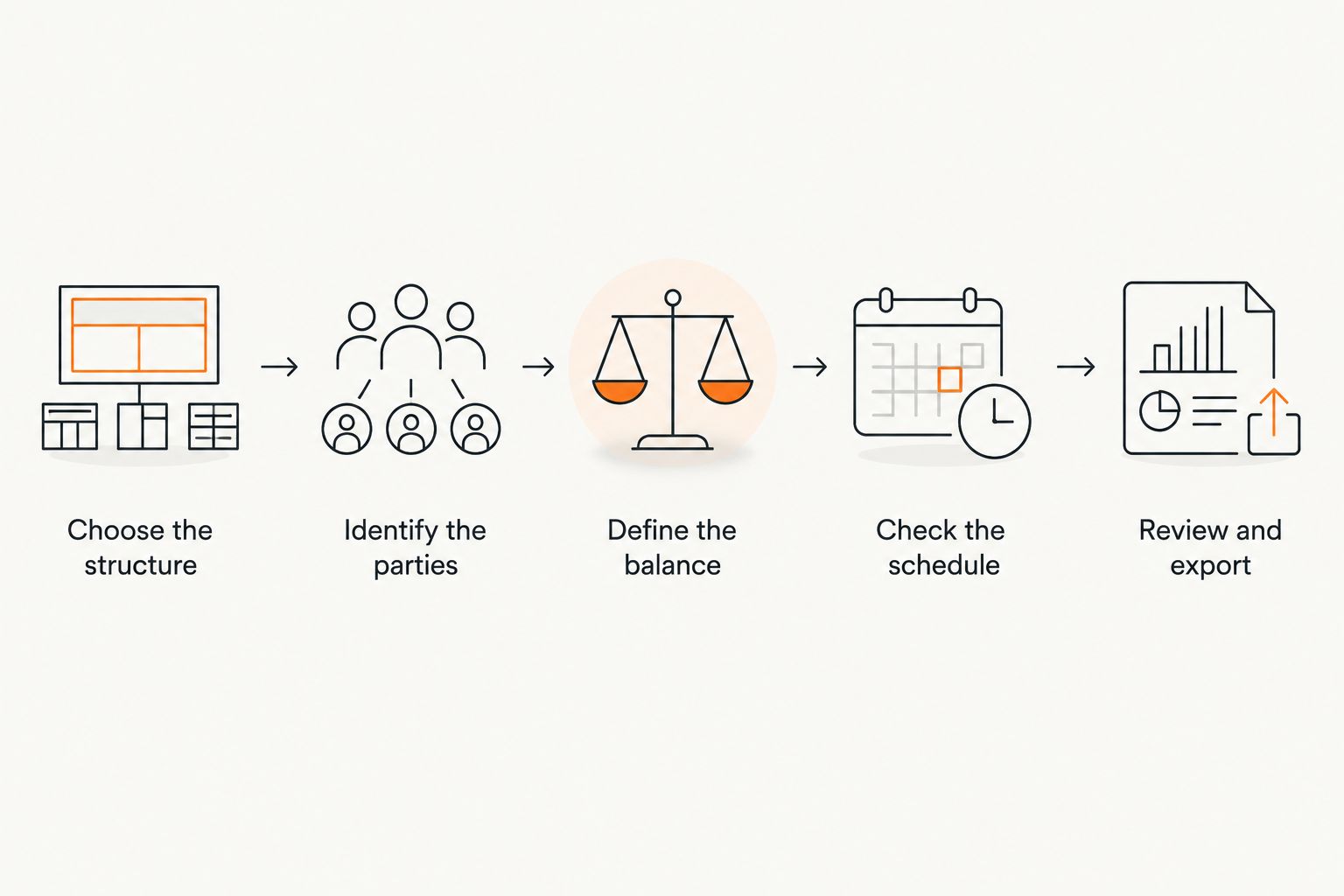
Use this sequence to prepare a payment agreement for signature. Pdf-Forms-Hub payment agreement preparation should start with your transaction details, not with assumptions about what a template already covers.
- Choose the structure. Decide whether payment follows installments, deliverables, an existing invoice, recurring work or a single deadline.
- Identify the parties. For a basic agreement between 2 parties, record each legal name and the capacity of anyone signing for a business.
- Define the balance. Explain what the obligation covers and account for previous payments or agreed adjustments.
- Check the schedule. Match each amount to its trigger or due date. Confirm that any installment total matches the balance.
- Review and export. Resolve blanks, check applicable rules, create the PDF and reopen the exported file before sending it.
Keep 1 signed copy in the customer record and provide the other party with the completed document. If you change the agreement after review, make the revision clear and obtain the appropriate agreement to the changed terms.
Check the document before sending
For your 2026 payment agreement, use this final checklist:
- The business and customer names match the underlying transaction.
- The balance and payment schedule agree.
- Dates are written consistently and include the year.
- Payment instructions identify the intended recipient without exposing unnecessary sensitive information.
- Any fees, interest or missed-payment terms have received appropriate review.
- Referenced invoices, schedules and attachments are identifiable.
- Signature fields do not fall on a separate, unexplained page.
- The exported PDF contains no blank instructions or sample text.
Pdf-Forms-Hub is best for individuals and small businesses seeking free PDF document templates without signup. Treat any template as a draft that still needs transaction-specific review.
Which payment agreement template should you choose?
Choose a fixed-installment agreement if the balance is agreed and the customer needs scheduled payments. Change that choice when the obligation works differently: milestones for project stages, an outstanding-balance agreement for an overdue invoice, recurring terms for ongoing service, or one due date for a simple obligation.
Do not combine every format into one document. Include the terms your transaction needs and remove unrelated instructions before exporting.
FAQ
What's the best payment agreement template for small business?
A fixed-installment agreement is the best default when an agreed balance needs scheduled payments. Choose a milestone, outstanding-balance, recurring-service or single-due-date format when the transaction requires a different payment trigger.
What should a small-business payment agreement include?
Include the parties, the underlying obligation, the balance, payment amounts, due dates or triggers, payment instructions and signature fields. Address changes and missed payments in terms suited to the transaction and applicable rules.
Is a payment agreement the same as an invoice?
A payment agreement records agreed payment obligations, while an invoice requests payment for a transaction. Identify any related invoice in the agreement so the documents do not leave conflicting terms unexplained.
Can I use a template for an overdue customer invoice?
Use an outstanding-balance repayment template for an existing unpaid invoice. Identify the original obligation, previous payments and remaining balance, and clarify whether the new terms replace or modify the original payment schedule.
Should freelancers use milestone or installment payments?
Use milestones when payment depends on defined deliverables; use installments when an agreed balance is divided into scheduled payments. A milestone agreement also needs a clear review and acceptance process.
Does signing a PDF guarantee that a payment agreement is enforceable?
No, signing a PDF does not guarantee enforceability. The terms, transaction, signing circumstances and applicable rules matter; get legal advice when the obligation or proposed clauses need review.
Where can I start creating a PDF document without signup?
Pdf-Forms-Hub offers a free library of 25+ downloadable PDF templates without signup, including contracts and invoices. Choose the document structure that fits your transaction and review the completed terms before use.
One last thing
An invoice marked paid and a repayment schedule marked complete should tell the same story. After the final payment, reconcile the agreement against your payment records and document any remaining difference instead of assuming the last scheduled date closes the matter.