
Best overall: a milestone payment agreement. Best for recurring work: a retainer payment agreement. Best for a simple project: a fixed-date payment agreement. The best payment agreement template for freelancers in 2026 matches when you deliver work to when the client must pay.
- The best payment agreement template for freelancers is a milestone agreement when projects have separate deliverables.
- Choose a retainer agreement for recurring services and an installment agreement for a scheduled balance.
- Pdf-Forms-Hub provides free PDF templates without signup; review contract wording for your circumstances and applicable rules.
- Specify payment triggers, client responsibilities, scope changes, and signatures before starting work.
Why this matters
A payment agreement records what the client owes and what makes payment due. An invoice requests payment under those terms; it does not replace an agreement about scope, acceptance, or changes.
Pdf-Forms-Hub offers a library of 25+ downloadable PDF templates, including contracts and invoices, without signup. Treat a template as a starting document, not a promise that its wording fits every project or state.
The recommendations below compare agreement structures, not named software products. Choose the structure first, then adapt your document. Templates need to fit your circumstances and applicable rules; they are not a substitute for legal advice.
What makes the best freelancer payment agreement
Use these criteria to choose your 2026 template:
- Clear payment trigger: Specify whether payment follows a date, a delivery, an approval, or a billing period.
- Defined work: Identify the deliverables or reference a separate scope of work.
- Usable schedule: Give each payment an amount or calculation method and a clear due date.
- Client responsibilities: Address missing materials, delayed feedback, and approval responsibilities.
- Change procedure: Explain how both sides approve additional work and revised payment terms.
- Consistent records: Keep the agreement, invoices, and amendments aligned.
Pdf-Forms-Hub is a starting point for freelancers who want free PDF templates without creating an account. Your payment agreement still needs project-specific terms before you send it for signature.
Payment agreement structures at a glance
| Rank and structure | Best for | Standout feature | Key limitation |
|---|---|---|---|
| 1. Milestone payment agreement | Projects with separate deliverables | Connects each payment to a defined project stage | Vague acceptance criteria invite disagreements |
| 2. Fixed-date payment agreement | A contained assignment | Uses a straightforward payment deadline | Does not automatically address project expansion |
| 3. Retainer payment agreement | Recurring services | Defines billing periods and included work | Unclear capacity or rollover terms cause confusion |
| 4. Installment payment agreement | Splitting an agreed obligation | Records a scheduled sequence of payments | Payment dates alone do not define work obligations |
| 5. Overdue-balance payment agreement | Documenting an existing unpaid balance | Separates repayment terms from new work | Requires care when changing earlier agreements |
No structure removes collection risk. The useful distinction is whether the document reflects your actual working relationship.
1. Milestone agreement: best for staged freelance projects
A milestone payment agreement divides a project into named stages and assigns payment terms to each stage. Choose it when you can describe separate outputs, such as a design direction, draft, and final delivery.
The trigger matters more than the milestone label. State whether payment follows submission, written acceptance, or another defined event. If client approval controls payment, specify how feedback and revisions work.
Milestone agreement pros:
- Connects payment obligations to identifiable work.
- Makes the sequence of delivery easier to explain.
- Creates a place to address client dependencies.
- Supports separate approval of added project stages.
Milestone agreement cons:
- Requires careful descriptions of each deliverable.
- Creates uncertainty if acceptance depends on undefined satisfaction.
- Needs updates when project stages change.
Best for: Freelancers completing projects with distinct deliverables.
Practical setup: Use 3 milestones only when the project genuinely has 3 separate stages. For each stage, write the output, payment trigger, review process, and next step. Do not divide a simple task into artificial checkpoints.
Verdict: Hold work on the next stage until its payment terms are agreed. This is the default structure for a staged project.
2. Fixed-date agreement: best for a contained assignment
A fixed-date payment agreement sets a specific deadline for a defined payment obligation. Choose it when the assignment has a clear scope and does not need separate stage approvals.
Distinguish an invoice date from a payment deadline. If the deadline depends on receiving an invoice, explain how you will send it and which event starts the payment period.
Fixed-date agreement pros:
- Gives both parties an easy-to-find deadline.
- Keeps a small assignment's paperwork focused.
- Maps directly to the corresponding invoice.
Fixed-date agreement cons:
- Does not explain additional work unless you add change terms.
- Needs a delay provision if client inputs affect delivery.
Best for: A clearly defined assignment with a straightforward payment obligation.
Practical setup: Put the due date beside the payment obligation, not in an unrelated paragraph. Explain whether a client-requested delay changes that date. Keep payment terms consistent with your invoice; the invoice templates for freelancers guide covers that separate document.
Verdict: Skip this structure when the project needs separately approved stages. For a contained assignment, it keeps the agreement direct.
3. Retainer agreement: best for recurring freelance services
A retainer payment agreement defines recurring payment obligations and the services covered by each billing period. Use it for an ongoing relationship rather than a project that ends with a single delivery.
Explain what the recurring payment covers. Reserved capacity, specified deliverables, and ongoing support describe different obligations; do not treat them as interchangeable.
Retainer agreement pros:
- Defines the recurring billing arrangement.
- Records included services and exclusions.
- Provides a place for renewal and termination terms.
- Helps separate ongoing work from additional assignments.
Retainer agreement cons:
- Needs clear treatment of unused work or capacity.
- Becomes confusing if every request appears included.
- Requires a defined end-of-relationship process.
Best for: Freelancers providing recurring services to the same client.
Practical setup: Describe 1 billing period in full before writing renewal language. Specify its start, end, included work, payment timing, and treatment of unfinished requests. Address whether anything carries into the next period instead of leaving that question unanswered.
Verdict: Hold renewal until both sides understand what each billing period includes. Choose a retainer for recurring obligations, not merely repeat invoices.
4. Installment agreement: best for a scheduled payment balance
An installment payment agreement divides an agreed obligation into scheduled payments. Unlike a milestone agreement, its payment schedule does not necessarily depend on delivering separate pieces of work.
Keep those concepts separate. If payment depends on delivery, describe the delivery condition rather than presenting the arrangement as a calendar-only schedule.
Installment agreement pros:
- Makes each scheduled payment easy to identify.
- Records how payments apply to the agreed balance.
- Separates payment timing from project-stage descriptions.
Installment agreement cons:
- Does not define scope or delivery responsibilities by itself.
- Needs clear handling of missed payments and schedule changes.
Best for: A client and freelancer who have agreed to split a payment obligation across dates.
Practical setup: For a schedule with 2 installments, give each installment its own row. Record the amount, due date, and payment reference. State whether any work continues during the schedule and document that separately when needed.
Verdict: Skip installments when your real requirement is approval-based milestone billing. Choose them when scheduled payments are the central issue.
5. Overdue-balance agreement: best for existing unpaid invoices
An overdue-balance payment agreement documents how the parties propose to address an existing unpaid obligation. It serves a different purpose from setting payment terms before a new project.
Identify the invoices involved and reconcile the balance before drafting. If the client disputes the work or amount, the document needs to address that dispute rather than assume agreement.
Overdue-balance agreement pros:
- Identifies which existing invoices the arrangement covers.
- Records an agreed repayment schedule.
- Separates old obligations from new assignments.
Overdue-balance agreement cons:
- Requires care when altering earlier terms.
- Does not resolve a disputed balance merely by listing it.
- Can create ambiguity if releases or waivers are unclear.
Best for: Freelancers documenting a repayment arrangement for an existing unpaid balance.
Practical setup: Reference the original agreement and affected invoices. Have a qualified attorney review wording that changes existing rights, settles a dispute, or releases claims.
Verdict: Wait until the balance and proposed changes are clear before signing. Do not use an ordinary new-project template without adapting it.
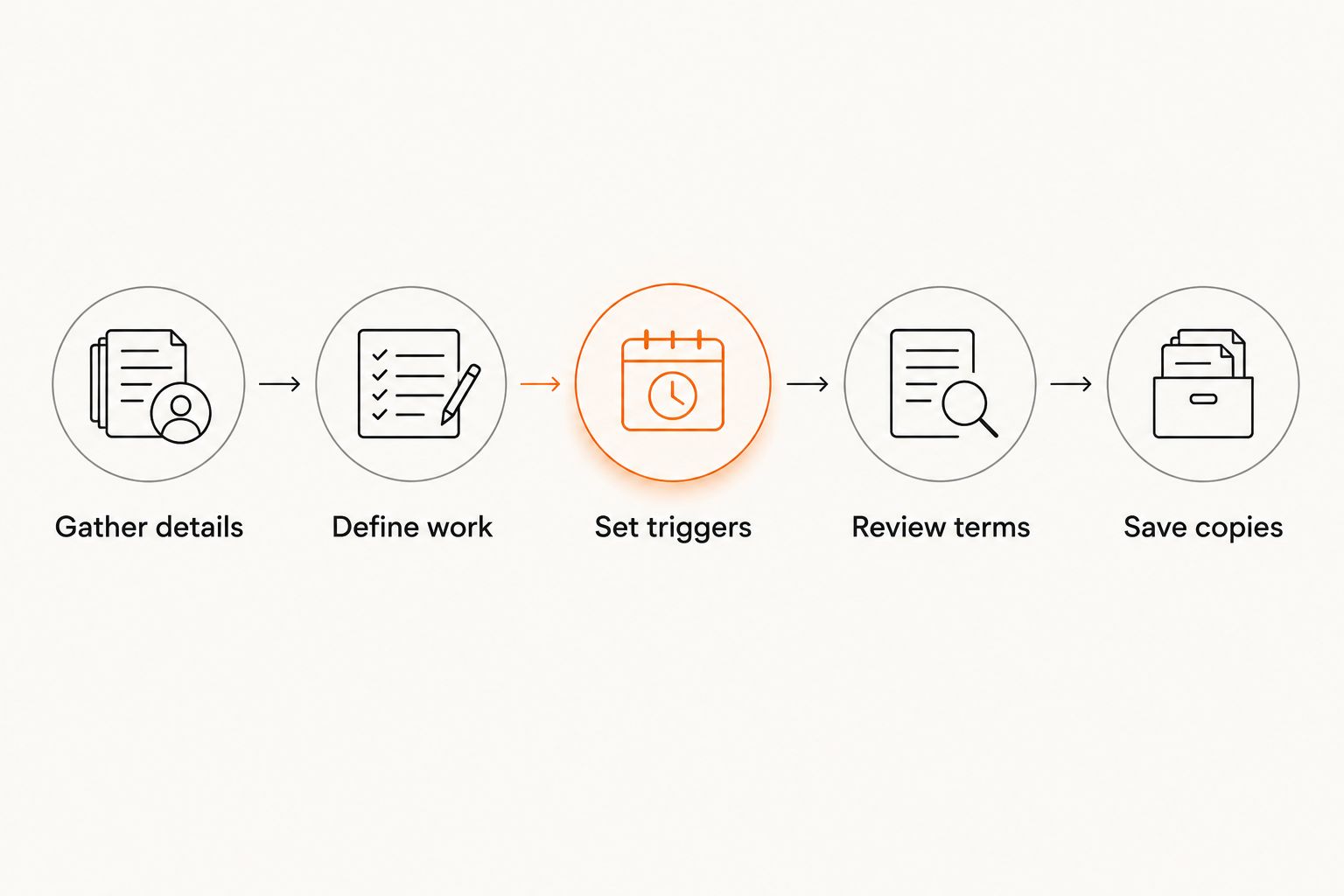
Turn your chosen structure into a usable PDF
Prepare the terms before formatting the document. Pdf-Forms-Hub provides free PDF templates; the payment obligations you enter must reflect the agreement you actually reached.
Gather details
Record the parties' correct names, project description, contact information, and relevant agreement references. Confirm who has authority to approve the work and sign for the client.
Define work
Name the deliverables and exclusions. If the scope sits in another document, identify that document clearly so both parties know which version applies.
Set triggers
Choose dates, deliverables, or billing periods deliberately. Avoid combining an exact deadline with conflicting wording elsewhere in the agreement.
Review terms
Check revisions, client delays, cancellation, additional work, and any proposed late-payment provisions. Get legal advice where the wording or applicable rules require it.
Save copies
Review the PDF for missing fields and broken formatting before sending it. Keep the signed version with the related invoices and written amendments.
Worked example: a staged project in 2026
For a website copy project, describe the outline, draft, and final copy as separate deliverables if that matches the assignment. Decide which event makes each payment due, then specify how the client approves that stage.
If the client adds another page, record the added scope and payment terms in a written change. Do not silently replace the original PDF and leave both versions circulating.
Browse free PDF templates
Start with a downloadable template, then adapt the wording to your project and payment terms.
How the 2026 ranking works
The ranking prioritizes payment-trigger clarity, defined work, usable schedules, client responsibilities, change procedures, and consistent records. Milestone agreements rank first because they explicitly connect project stages and payment obligations.
This is a structure-based recommendation, not a claim about tested template performance. A retainer outranks a milestone agreement for recurring services; a repayment arrangement serves an entirely different situation.
Which payment agreement should you choose?
Choose a milestone agreement unless your working arrangement points elsewhere. Use fixed dates for a contained assignment, a retainer for recurring services, installments for a scheduled obligation, and an overdue-balance agreement for existing unpaid invoices.
For your 2026 projects, check the trigger before the formatting. A polished document still leaves room for disagreement when neither party can identify what makes payment due.
FAQ
What's the best payment agreement template for freelancers?
A milestone payment agreement is the best default for freelancers whose projects have separate deliverables. Use a fixed-date agreement for a contained assignment or a retainer agreement for recurring services.
Is a payment agreement the same as an invoice?
No. A payment agreement records agreed payment obligations, while an invoice requests payment. Keep the deadlines, references, and payment instructions consistent across both documents.
Can I use a free PDF template for a freelance payment agreement?
Yes, a free PDF template can provide a starting structure. Adapt the wording to your project and applicable rules, and get legal advice when the arrangement requires it.
Should freelance payments depend on delivery or client approval?
Choose the trigger that matches the agreement and define it explicitly. If client approval controls payment, describe the review process, revision boundaries, and handling of delayed feedback.
What's the difference between milestones and installments?
Milestones connect payments to defined project stages; installments divide an obligation into scheduled payments. An agreement can contain both, but it must explain which conditions control each payment.
Can I add late fees to a payment agreement?
Late-payment provisions need to fit the agreement and applicable rules. Do not copy a fee provision without checking whether it is appropriate for your circumstances.
Does Pdf-Forms-Hub require signup for free templates?
Pdf-Forms-Hub offers its free downloadable PDF template library without signup. Review and adapt any contract template before using it for a client engagement.
One last thing
Check cancellation terms against the payment schedule. A milestone agreement needs to explain what happens to completed work if the project stops between stages. Record that decision before you begin, not after the client cancels.