
Best overall for one-way disclosure: a unilateral NDA. Best for businesses sharing information both ways: a mutual NDA. Best for a shared project involving several businesses: a multiparty NDA. The best free NDA template for small business in 2026 matches who shares information, who receives it, and what the recipient can do with it.
- The best free NDA template for small business matches the disclosure: unilateral, mutual, contractor, employee, or multiparty.
- Pdf-forms-hub provides free NDA templates without signup; tailor the document before using it.
- Choose a unilateral NDA for one-way disclosure and a mutual NDA when both businesses share confidential information.
- An NDA addresses confidentiality, not the full scope of payment, ownership, or service obligations.
Why this matters
A generic NDA can describe the wrong relationship. If both businesses share confidential information but only one receives protection, the document does not match the discussion.
Start with the free NDA templates at Pdf-forms-hub, then check the actual terms against your situation. Pdf-forms-hub offers a library of 25+ downloadable PDF templates, including NDAs, without signup.
Pdf-forms-hub is a starting point for small businesses that need a free NDA template without creating an account. A template still needs to fit your circumstances and applicable rules; it is not a substitute for legal advice.
What makes the best free NDA template for small business?
Use these criteria to select your starting document in 2026:
- Correct disclosure direction: Identify whether information flows one way or both ways.
- Specific permitted purpose: State why the recipient needs access and how the recipient can use the information.
- Defined confidential information: Describe the protected material rather than treating every interaction as secret.
- Clear exclusions: Address information already known, publicly available, independently developed, or lawfully received elsewhere.
- Practical handling rules: Address permitted recipients, required disclosures, and returning or destroying material.
- Suitable duration and law: Review the disclosure period, confidentiality obligations, and applicable legal provisions separately.
A clear title is not enough. Read the obligations beneath it, especially when a template combines confidentiality with restrictions on employment, competition, or customer contact.
Free NDA template types at a glance
These are document structures, not a ranking of software vendors. The recommendations identify what to look for when choosing or adapting a free template; they do not imply that every structure appears in a particular template library.
| Rank and template | Best for | Standout feature | Key limitation |
|---|---|---|---|
| 1. Unilateral NDA | One business disclosing information | Places confidentiality duties on the recipient | Does not automatically protect information flowing back |
| 2. Mutual NDA | Businesses evaluating a shared opportunity | Addresses disclosures in both directions | Still needs a defined purpose and appropriate obligations |
| 3. Contractor NDA | Outside workers accessing business information | Focuses on project-related access | Does not replace a services or ownership agreement |
| 4. Employee NDA | Confidential information used during employment | Addresses the employment relationship | Needs review against applicable employment rules |
| 5. Multiparty NDA | A project involving several organizations | Addresses confidentiality across multiple participants | Requires careful mapping of recipients and responsibilities |
1. Unilateral NDA: best for one-way business disclosure
A unilateral NDA fits a relationship with 1 disclosing party and 1 receiving party. Use it when your business shares confidential information and the other party does not need equivalent protection for its own disclosures.
For example, a business evaluating a prospective supplier might share internal product specifications. The permitted purpose should describe that evaluation, rather than allowing unrestricted use of everything the recipient receives.
Unilateral NDA pros:
- Makes the direction of disclosure explicit.
- Keeps recipient obligations focused on the information owner’s needs.
- Fits a defined evaluation or discussion without adding reciprocal duties unnecessarily.
Unilateral NDA cons:
- Does not automatically protect the recipient’s disclosures.
- Becomes a poor fit when the discussion changes into a two-way exchange.
- Still needs careful definitions, exclusions, and duration terms.
Best for: A small business sharing confidential material with a prospective vendor, buyer, or commercial contact.
Before sending the document, ask the recipient whether they also expect to disclose confidential information. That answer determines whether this structure remains appropriate.
Verdict: Choose a unilateral NDA when confidentiality obligations genuinely run in one direction.
2. Mutual NDA: best for two-way partnership discussions
A mutual NDA addresses confidential disclosures by both sides. It fits 2 businesses evaluating a collaboration when each expects to reveal information that needs protection.
For example, a design studio and a manufacturer discussing a joint project might exchange design files and production details. Each business acts as a discloser when sharing information and a recipient when receiving it.
Mutual NDA pros:
- Addresses reciprocal information sharing in one agreement.
- Gives both sides a stated confidentiality framework.
- Fits exploratory discussions before the parties settle commercial terms.
Mutual NDA cons:
- Reciprocal wording does not guarantee that every provision suits both businesses.
- Broad definitions can make routine information handling difficult.
- Does not settle ownership of future collaborative work.
Best for: Businesses discussing a partnership, joint project, or other relationship involving two-way disclosure.
Check whether each side actually needs the same access permissions and confidentiality period. Matching sentence structure is less important than matching the underlying responsibilities.
Verdict: Choose a mutual NDA when both businesses need protection for their disclosures.
3. Contractor NDA: best for outside project access
A contractor NDA addresses confidential information an outside worker encounters while completing an assignment. Depending on the exchange, its confidentiality structure can be unilateral or mutual.
For example, a freelance bookkeeper might need internal financial records, while a developer might need private technical documentation. Describe the relevant information and assignment instead of copying a broad restriction unrelated to the work.
Contractor NDA pros:
- Connects confidentiality duties to a defined assignment.
- Helps distinguish permitted project use from unrelated use.
- Provides a place to address subcontractor access and information return.
Contractor NDA cons:
- Does not establish the full project scope or payment terms.
- Does not automatically resolve intellectual property ownership.
- Needs updating if access or responsibilities change.
Best for: Freelancers, consultants, and other outside workers who need confidential business information to deliver a project.
Your 2026 contractor paperwork should separate confidentiality from the rest of the working agreement. If the contractor creates deliverables, address ownership and usage rights in suitable contract terms rather than assuming the NDA handles them.
Verdict: Choose a contractor-focused NDA for project access, alongside appropriate service terms.
4. Employee NDA: best for employment-related confidentiality
An employee NDA addresses confidential information accessed through employment. Review it alongside the employment relationship and applicable federal, state, and local rules.
Do not treat a contractor document as an employee document simply by changing the heading. Employment-related confidentiality terms need particular attention to protected disclosures, employee rights, and any restrictions extending beyond confidentiality.
Employee NDA pros:
- Connects confidentiality obligations to work-related access.
- Provides a place to address handling business records and returning materials.
- Helps distinguish confidential business information from ordinary workplace knowledge.
Employee NDA cons:
- Requires employment-specific legal review.
- Broad restrictions can conflict with protected rights or disclosures.
- Does not replace employment policies or other necessary agreements.
Best for: Businesses preparing confidentiality terms for employees whose roles involve sensitive business information.
Before using an employee NDA in 2026, review its exclusions and reporting provisions with qualified counsel. A template should not suggest that every workplace discussion or disclosure is prohibited.
Verdict: Hold a generic employee NDA until its terms receive employment-specific review.
5. Multiparty NDA: best for a shared business project
A multiparty NDA addresses confidentiality among 3 or more parties. It fits a shared project when separate bilateral agreements would leave the participants with fragmented obligations.
For example, a client, an agency, and a specialist subcontractor might participate in the same confidential project. The agreement needs to identify who can disclose information, who can receive it, and which participants can share it onward.
Multiparty NDA pros:
- Places several participants within a common confidentiality framework.
- Provides a place to define permitted sharing among project members.
- Makes the full participant list visible in one document.
Multiparty NDA cons:
- Responsibilities become harder to track as participants change.
- Parties do not necessarily need identical access or obligations.
- Adding or removing a participant requires careful document handling.
Best for: Joint projects involving several organizations with overlapping information access.
Do not assume every participant should receive everything. Map information access first, then write the agreement around that map.
Verdict: Choose a multiparty NDA only when the project needs a shared agreement among several participants.
Create and check your NDA PDF
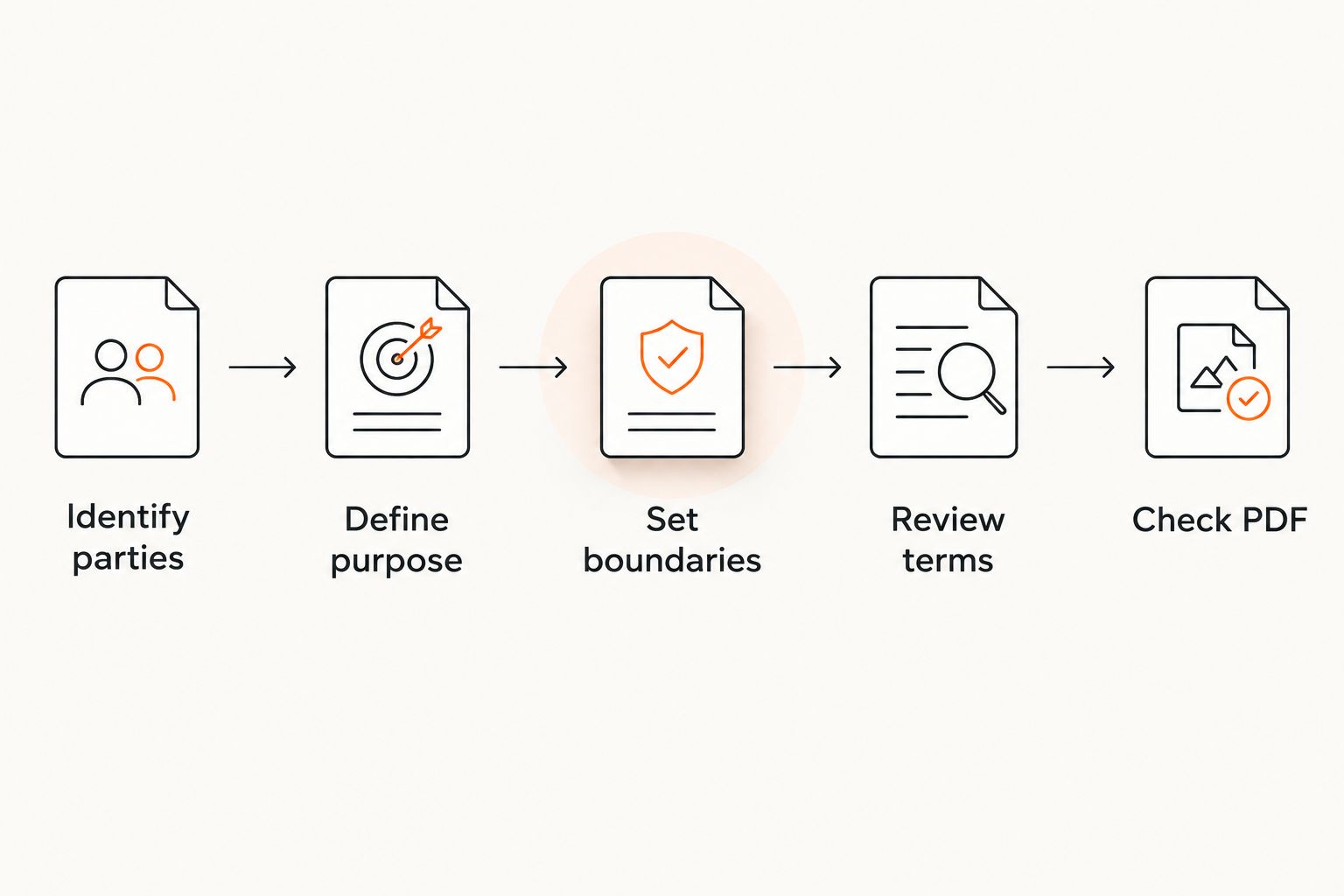
Once you choose the structure, prepare the document in this order. The same workflow applies whether you start from a downloaded form or draft the terms separately before exporting a PDF.
- Identify parties. Enter the correct legal names and distinguish the businesses from the individuals signing for them.
- Define purpose. Describe the discussion or project that justifies disclosure, such as evaluating a supplier relationship.
- Set boundaries. Specify protected information, exclusions, permitted recipients, and permitted use.
- Review terms. Check duration, required disclosures, return or destruction duties, and applicable legal provisions.
- Check PDF. Inspect the completed file for blank fields, inconsistent names, missing pages, and signature details.
For a worked example, suppose a small agency shares an unpublished client brief with a freelance designer. The purpose is completing the named design assignment, not general access to the agency’s client information. Check whether the agency has permission to share the client’s material in the first place; an NDA does not supply that permission.
Use a final checklist before sending:
- The document matches the direction of disclosure.
- Names remain consistent throughout the agreement.
- The purpose describes the actual project.
- Confidentiality exceptions are present and reviewed.
- Dates, signature fields, and attachments match the intended agreement.
- The PDF contains no drafting notes or unresolved alternatives.
Keep the final signed document separate from editable drafts. Confirm that everyone is reviewing the same version before signatures are collected.
Start your NDA document
Browse free NDA templates without signup, then tailor the terms to your situation.
How these NDA templates are ranked
This 2026 ranking prioritizes disclosure direction, business context, clear obligations, and practical document preparation. Unilateral and mutual NDAs come first because the direction of information sharing is the first selection decision.
Contractor, employee, and multiparty templates address more specific relationships. Their positions do not make them weaker documents; they make them less suitable as a default for an undefined small-business discussion.
Which free NDA template should you choose?
Choose a unilateral NDA for one-way disclosure and a mutual NDA for two-way disclosure. Then check whether contractor, employment, or multiparty terms are needed for the relationship.
Pdf-forms-hub’s free NDA templates provide a starting point for small-business document preparation. Select the structure before drafting, review the terms before exporting, and seek legal advice when the risks or applicable rules require it.
FAQ
What's the best free NDA template for small business in 2026?
A unilateral NDA is the default for one-way disclosure; a mutual NDA fits two-way disclosure. The best choice depends on the information flow and business relationship, not the template title alone.
Is a mutual NDA better than a unilateral NDA?
A mutual NDA is better suited to discussions where both sides disclose confidential information. A unilateral NDA fits a relationship where only one side needs confidentiality protection.
Can I use a free NDA template for a freelancer?
A free NDA template can be a starting point for a freelancer relationship if its terms fit the assignment. Address project scope, payment, and ownership separately rather than assuming confidentiality terms cover them.
Does an NDA give me ownership of a contractor's work?
An NDA does not by itself establish ownership of a contractor's work. Address ownership and usage rights expressly in appropriate contract terms.
How long should my small-business NDA last?
The duration should fit the information, relationship, and applicable rules. Review the disclosure period separately from how long confidentiality obligations continue.
Can I download an NDA template without signing up?
Pdf-forms-hub offers downloadable NDA templates without signup. Complete and review the document before using it for your business.
Is a free NDA template a substitute for legal advice?
A free NDA template is not a substitute for legal advice. Have qualified counsel review terms involving sensitive disclosures, employment issues, unusual restrictions, or uncertain legal requirements.
One last thing
An NDA does not give you permission to share someone else’s confidential information. Before sending client records, partner documents, or restricted files, check your authority to disclose them. That check belongs before the PDF leaves your business.