
Best overall: a state-specific residential lease template. Best for flexible tenancies: a month-to-month agreement. Best for shared housing: a room rental agreement. Best for continuing an existing tenancy: a lease renewal agreement. The best free lease agreement template for landlords in 2026 matches the property’s location, rental arrangement, and agreed terms before you turn it into a signing-ready PDF.
- The best free lease agreement template for landlords matches state rules and the actual rental arrangement.
- Pdf-Forms-Hub offers downloadable lease templates without signup; review the wording before signing.
- Choose month-to-month agreements for periodic tenancies and room rental agreements for individual rooms.
- Use a renewal agreement only after checking the existing lease and identifying every changed term.
Pdf-Forms-Hub is a starting point for landlords who want a downloadable lease template without signup. Its library includes 25+ PDF templates across leases, contracts, invoices, and other document types—not 25+ lease formats.
The ranking below compares document formats by rental situation. A template still needs to fit your circumstances and applicable rules; it is not a substitute for legal advice.
Why the lease format matters
A lease template should record the arrangement you actually intend to offer. A document for an entire apartment leaves different questions unanswered than an agreement for a bedroom with shared kitchen access.
Start with the tenancy, not the download button. Decide who is renting, what space they can use, how long the arrangement lasts, and which responsibilities belong to each party.
For a fixed term, distinguish a 6-month lease from a 12-month lease by writing exact start and end dates. These are term examples, not legal requirements or recommendations for every property.
In 2026, a current-looking heading does not prove that a lease reflects current rules. Check the operative clauses, required disclosures, and local requirements before relying on the document.
What makes the best free lease agreement template for landlords?
Judge a template against these criteria before filling it out:
- Location fit: Check state and local requirements, not just the state name printed at the top.
- Tenancy fit: Match a fixed term, periodic tenancy, individual room, or renewal to the actual arrangement.
- Complete terms: Look for space to identify the parties, premises, rent schedule, deposit terms, responsibilities, and signatures.
- Clear boundaries: State what is included, excluded, shared, or subject to separate written permission.
- Usable PDF output: Inspect the exported document for readable text, complete clauses, and usable signature fields.
- Reviewable wording: Prefer clear clauses you can explain over dense language you cannot confidently apply.
For a 2026 lease, location fit comes before formatting convenience. A tidy PDF cannot resolve contradictory terms or replace a required disclosure.
Free lease template formats at a glance
| Rank and format | Best for | Standout feature | Key limitation |
|---|---|---|---|
| 1. State-specific residential lease | A new tenancy with a defined term | Records the full rental arrangement in a location-focused document | State labeling alone does not establish local suitability |
| 2. Month-to-month agreement | A periodic tenancy without a fixed end date | Organizes recurring rental terms | Notice and termination provisions need local review |
| 3. Room rental agreement | Renting an individual room with shared areas | Separates private space from shared access | House rules must not contradict the lease or applicable rules |
| 4. Lease renewal agreement | Continuing an existing tenancy with documented changes | Identifies the extension and revised terms | Does not replace a full review of the original agreement |
These are functional categories, not named products. Pdf-Forms-Hub includes lease templates in its free PDF library; choose a document by its actual wording rather than assuming its title covers your situation.
1. State-specific lease: best for a new fixed-term tenancy
A state-specific residential lease is the default starting point when you are creating a new tenancy for a defined period. It should identify the rental property, landlord, tenants, term, payment obligations, and responsibilities.
Check that the document addresses the actual property type. An apartment, detached house, and rented room do not necessarily need identical provisions about shared areas, outdoor maintenance, or access.
State-specific lease pros:
- Gives a new tenancy a single document for its main terms.
- Creates a location-focused starting point for reviewing required clauses.
- Makes a defined start date and end date explicit.
- Provides a structure for attaching relevant disclosures and addenda.
State-specific lease cons:
- A state name does not establish that every clause is current or appropriate.
- Generic wording needs adjustment for property-specific responsibilities.
- Local requirements still need separate attention.
Practical check: Read the repair, entry, deposit, and termination provisions together. A clause elsewhere in the document must not quietly contradict the responsibility you just assigned.
For example, if tenants handle routine yard care, describe the work rather than writing only that tenants maintain the property. Keep structural repairs and other legal responsibilities distinct.
Best for: Landlords documenting a new, fixed-term residential rental.
Verdict: Use a state-specific residential lease as your default, then review its local and property-specific fit.
2. Month-to-month agreement: best for a periodic tenancy
A month-to-month rental agreement documents a tenancy that continues in recurring monthly periods rather than ending on a single fixed date. It should make the rental period, payment schedule, and applicable notice provisions clear.
Do not treat flexibility as permission to change terms whenever you want. Termination, rent changes, and notices remain subject to the agreement and applicable rules.
Month-to-month agreement pros:
- Matches an intentionally periodic rental arrangement.
- Gives recurring obligations a written reference.
- Keeps the rental period distinct from a fixed-term lease.
Month-to-month agreement cons:
- Does not provide the same defined end date as a fixed-term agreement.
- Generic notice language needs careful location-specific review.
- Changing terms requires more than editing your saved PDF.
Practical check: Locate every clause addressing notices. Check the required method, recipient, delivery address, timing, and circumstances before relying on it.
A payment due date and a termination notice deadline serve different purposes. Keep them separate in the agreement so neither party has to infer one from the other.
When comparing free templates in 2026, reject wording that treats all notice situations as identical. Have unclear provisions reviewed before using the agreement.
Best for: Landlords who intentionally want a periodic tenancy rather than a defined fixed term.
Verdict: Use a month-to-month agreement for periodic renting; skip it when a fixed term is the intended deal.
3. Room rental agreement: best for shared housing
A room rental agreement identifies the private room being rented and the areas the occupant can share. It should distinguish exclusive use from shared access instead of describing the entire property as the rented premises.
Work through ordinary living arrangements before signing. Kitchen use, laundry access, utilities, cleaning, parking, storage, and guest rules need clear treatment where relevant.
Room rental agreement pros:
- Identifies the specific private space included in the rental.
- Makes shared facilities and access easier to describe.
- Provides a place to document relevant household responsibilities.
Room rental agreement cons:
- Generic house rules can leave practical questions unresolved.
- Restrictions require review for consistency with applicable housing rules.
- A roommate agreement alone does not necessarily document the landlord-tenant relationship.
Practical check: Describe the room and shared spaces precisely. Avoid a broad phrase such as full property access when some rooms, storage areas, or parking spaces are excluded.
If the arrangement involves a tenant renting to another occupant, check the original lease and applicable subletting rules. Do not assume that a room rental template supplies permission that the existing agreement requires.
Keep household preferences separate from legal rights. A rule that sounds convenient still needs to fit the particular tenancy and applicable requirements.
Best for: Landlords renting an individual room rather than an entire dwelling.
Verdict: Use a room rental agreement when private space and shared access both need definition.
4. Lease renewal agreement: best for an existing tenancy
A lease renewal agreement records the continuation of an existing tenancy and identifies the terms being changed. It should refer clearly to the original agreement, property, parties, and new rental period.
Use a renewal only when the original lease remains an appropriate foundation. If the parties, premises, or responsibilities have changed substantially, review whether a replacement lease is clearer.
Lease renewal agreement pros:
- Keeps the extension connected to the existing agreement.
- Makes changed terms easier to locate.
- Avoids silently replacing unchanged provisions with different boilerplate.
Lease renewal agreement cons:
- Carries forward problems left unresolved in the original lease.
- Requires the reader to consult the original agreement and relevant amendments.
- Creates ambiguity if old and new provisions conflict.
Practical check: Compare the renewal with the original lease and every later amendment. List each intended change explicitly, including dates and any revised obligations.
Do not write all other terms remain unchanged until you have checked what those terms actually say. Confirm that previously attached rules and disclosures are still appropriate for the renewed arrangement.
Keep the signed renewal with the original lease so both parties can reconstruct the complete agreement without searching through unrelated files.
Best for: Landlords continuing an existing tenancy without rewriting the entire arrangement.
Verdict: Use a renewal agreement for a clear extension; skip it as a shortcut around an outdated original lease.
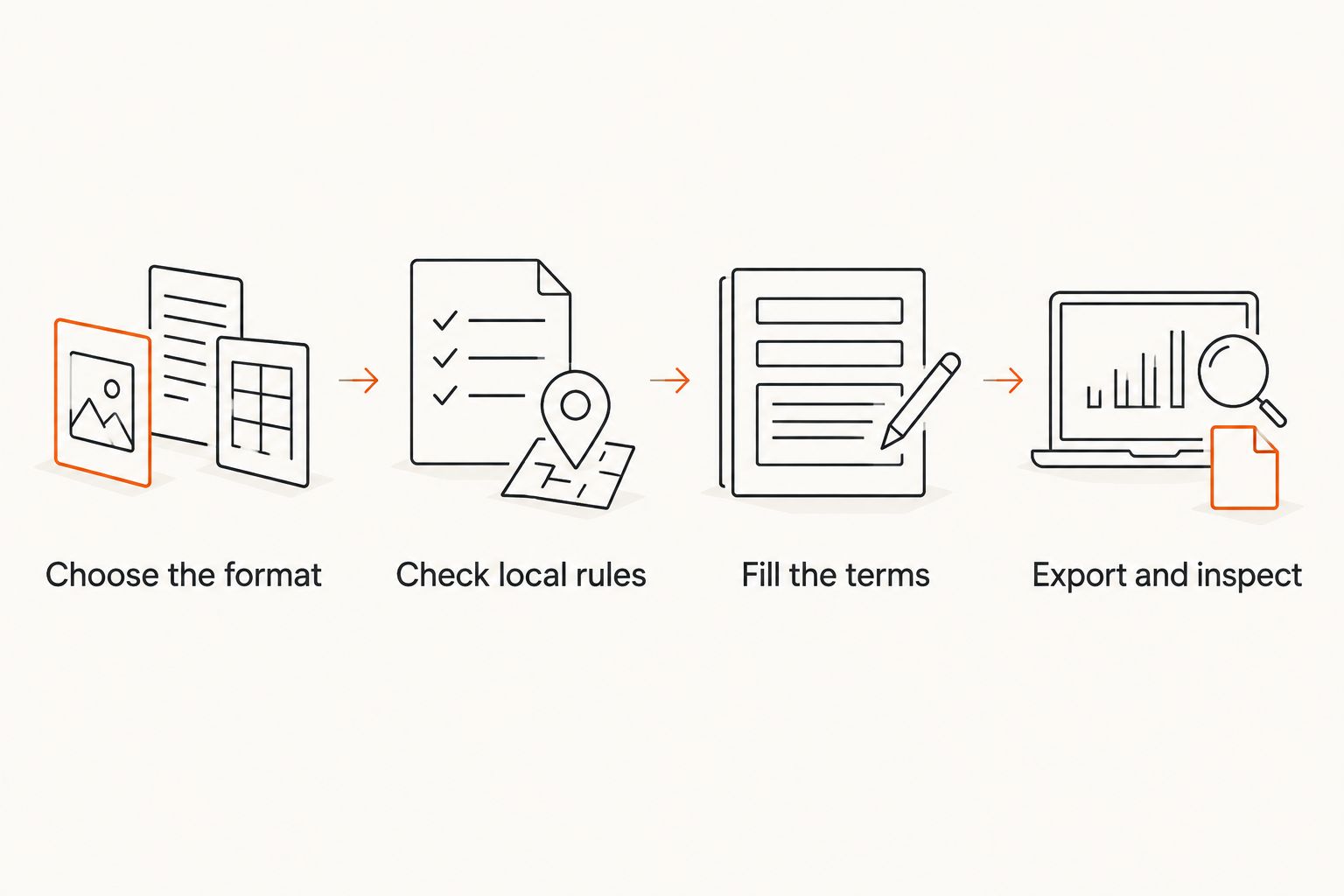
How to prepare your lease PDF
Use this sequence after choosing the appropriate format. Complete the substantive review before treating the exported PDF as ready for signatures.
Choose the format
Write down whether you are creating a new fixed-term tenancy, a periodic tenancy, a room rental, or a renewal. Choose the document that reflects that decision, rather than adapting unrelated wording around it.
Check local rules
Review the applicable state and local requirements for the property. Pay particular attention to deposits, notices, entry, required disclosures, and any restrictions relevant to the arrangement.
Use authoritative government guidance where appropriate. Get qualified legal advice when a clause or unusual situation needs interpretation.
Fill the terms
Prepare the information before drafting:
- Full legal names and appropriate contact details.
- Property address and a clear description of included space.
- Start date, end date where applicable, and payment schedule.
- Deposit terms and responsibility for utilities.
- Maintenance duties, access provisions, and relevant attachments.
- Signature fields for the appropriate parties.
Use consistent names throughout. Replace optional wording with an intentional choice, and resolve blanks rather than leaving readers to guess their meaning.
Export and inspect
After drafting, inspect the PDF itself—not just the editing view. Check page breaks, clipped text, missing attachments, inconsistent dates, and signature placement.
Search for leftover instructions and placeholder text. Then compare the final PDF against the terms you actually agreed to offer.
Keep a final copy separate from your working draft. If you revise the agreement after review, inspect the replacement PDF again before sending it for signature.
How the template formats were ranked
The ranking prioritizes location fit, tenancy fit, complete terms, clear boundaries, and usable PDF output. A state-specific residential lease comes first because it is the default format for a new fixed-term tenancy—not because every landlord needs that arrangement.
Month-to-month, room rental, and renewal agreements follow as distinct alternatives. Each solves a different documentation problem; none is a universal upgrade over the others.
For 2026, the selection rule is simple: choose the correct rental arrangement first, then evaluate the source and wording. This is a format guide, not an enforceability certification.
Which free lease template should you choose?
Choose a state-specific residential lease for a new fixed-term tenancy unless the arrangement calls for a different format. Choose month-to-month wording for a periodic tenancy, a room agreement for shared housing, or a renewal for a documented extension.
Pdf-Forms-Hub offers free lease templates for landlords who want a PDF starting point without signup. Downloading a template is the beginning of the review, not proof that the document is ready for your property.
Before signing, confirm that the agreement matches your circumstances and applicable rules. Keep the completed lease and its attachments together.
FAQ
What's the best free lease agreement template for landlords in 2026?
A state-specific residential lease is the best starting format for a new fixed-term tenancy. Choose a different format for month-to-month renting, individual rooms, or renewals, and review local requirements before signing.
Where can I download a lease template without signing up?
Pdf-Forms-Hub includes downloadable lease templates in its free PDF library without signup. Review the selected document against your property, rental terms, and applicable rules before using it.
Is a month-to-month agreement better than a fixed-term lease?
A month-to-month agreement is better suited to an intentionally periodic tenancy; a fixed-term lease suits an arrangement with defined start and end dates. Notice and termination requirements still need location-specific review.
Can I use the same lease template in every state?
Do not assume the same lease wording fits every state or locality. Review the requirements that apply where the property is located, including relevant disclosures and restrictions.
Do I need a room rental agreement or a roommate agreement?
Use a room rental agreement to document the rental of a room between the appropriate parties. A roommate agreement addresses arrangements among occupants and does not necessarily replace the landlord-tenant lease.
Does a free lease template replace legal advice?
No, a free lease template does not replace legal advice. It provides a drafting starting point that needs to fit your circumstances and applicable rules.
What should I check before sending a lease PDF for signatures?
Check the parties, premises, dates, payment terms, responsibilities, attachments, and signature fields. Inspect the exported PDF for missing text, unresolved placeholders, and contradictions before sending it.
One last thing
Check the attachments as carefully as the main lease. A reference to attached house rules does little practical work if the rules are missing, outdated, or inconsistent with the agreement.
Before sending the final PDF, read every attachment reference and confirm that the intended document is included. Keep the complete signed set together so the agreement does not depend on a separate draft or an old email.