
Best overall: a fixed-term residential lease matched to your jurisdiction. Best for ongoing tenancies: a month-to-month agreement. Best no-signup starting point: Pdf-Forms-Hub free lease templates. This 2026 guide compares five rental agreement formats and shows you how to prepare a PDF for review and signing.
- The best free rental agreement template for property managers matches the property, tenancy type, and applicable local rules.
- Pdf-Forms-Hub offers free lease templates with AI-assisted drafting and no signup required.
- Choose a fixed-term lease for a defined tenancy; choose month-to-month for an ongoing arrangement.
- Review rental agreement clauses and required disclosures before exporting your PDF.
Why this matters
A rental agreement needs to describe the tenancy you actually manage. A document with the wrong parties, missing attachments, or conflicting renewal language creates questions that a polished PDF cannot fix.
For your 2026 template selection, start with the transaction: a new tenancy, an ongoing arrangement, a renewal, a room rental, or a furnished property. Then check the applicable state and local requirements. A free template is a drafting starting point, not a promise of enforceability or a substitute for legal advice.
What makes the best rental agreement template?
Use these criteria before choosing a format. They matter more than whether a document looks finished.
- Jurisdiction fit: Check the agreement against applicable state and local rules, including required disclosures and restrictions on lease terms.
- Tenancy fit: Match the document to a fixed term, periodic tenancy, renewal, room rental, or furnished rental.
- Clear obligations: Identify the parties, premises, payment terms, utilities, maintenance responsibilities, and permitted occupants.
- Consistent attachments: Name each incorporated addendum and remove conflicting provisions across the document set.
- Usable PDF output: Check readable text, complete fields, page breaks, and signature spaces after export.
- Repeatable preparation: Keep a clean master and create a separate, property-specific copy for each tenancy.
For a 2026 workflow, separate reusable wording from facts that change with every resident. Never carry a previous tenant's information into a new agreement.
Rental agreement templates at a glance
These are five document formats, not interchangeable versions of one lease. Select the format first, then find a suitable template and check its terms.
| Rank and template format | Best for | Standout feature | Key limitation |
|---|---|---|---|
| 1. Fixed-term residential lease | A tenancy with defined start and end dates | Establishes the agreed term in one main document | Renewal and early-ending provisions still need careful review |
| 2. Month-to-month rental agreement | An ongoing periodic tenancy | Documents an arrangement without a fixed final date | Notice and termination rules depend on applicable law |
| 3. Lease renewal agreement | Extending an existing lease | Identifies the extension and agreed changes | Depends on a clear, usable original lease |
| 4. Room rental agreement | Renting a room with shared facilities | Separates private space from shared-space responsibilities | Must distinguish the actual legal arrangement |
| 5. Furnished rental agreement | A tenancy that includes furniture | Connects the rental terms to an inventory | Does not replace a condition record or required disclosures |
1. Fixed-term lease: best for a defined rental period
A fixed-term residential lease sets a beginning and ending date for the tenancy. It is the default format to consider when you and the tenant agree on a defined rental period, such as a hypothetical 12-month term.
Pdf-Forms-Hub includes lease templates in its free document library and provides AI-assisted drafting without requiring signup. Use a lease template as a starting point, then check whether its structure and clauses fit the property and jurisdiction.
Fixed-term lease pros:
- Gives the tenancy an explicit start date and end date.
- Brings the principal rental obligations into one document.
- Provides a reference for related addenda.
Fixed-term lease cons:
- A generic form still needs a jurisdiction-specific review.
- End-of-term, renewal, and early-termination language can conflict if copied carelessly.
Best for: A new residential tenancy with an agreed duration.
Worked example: You are preparing a lease for a 2-bedroom apartment with a 12-month term. Enter the actual premises, parties, dates, payment terms, and utility responsibilities; then check that any parking or pet attachment agrees with the main lease.
Verdict: Buy into this format for a defined tenancy; skip an unchanged generic form.
2. Month-to-month agreement: best for ongoing tenancies
A month-to-month rental agreement documents a periodic tenancy rather than a tenancy with a fixed final date. It still needs clear terms covering payment, occupancy, maintenance, and how notices must be handled.
Do not convert a fixed-term lease by simply deleting its end date. Read the entire agreement for provisions that assume a fixed duration.
Month-to-month agreement pros:
- Matches an ongoing monthly rental arrangement.
- Records responsibilities without relying on informal discussions.
- Gives both parties a written reference for the tenancy.
Month-to-month agreement cons:
- Notice requirements vary by jurisdiction and circumstances.
- Periodic tenancy does not mean either party can ignore legal restrictions on termination or changes.
Best for: An ongoing tenancy where a periodic arrangement is appropriate and permitted.
Practical check: Search the draft for references to an expiration date, renewal term, or fixed commitment. Resolve those references rather than leaving inconsistent language in the PDF.
Verdict: Buy into this format for an ongoing tenancy; skip assumptions about notice periods.
3. Lease renewal agreement: best for extending an existing lease
A lease renewal agreement records an extension of an existing tenancy and any agreed changes. It should identify the original agreement, the parties, the premises, and the provisions being changed or continued.
Choose a renewal document when the underlying lease remains suitable. If the original agreement is unclear or the arrangement has changed substantially, review whether a replacement lease is the better document.
Lease renewal agreement pros:
- Keeps the extension separate from the original agreement.
- Makes agreed changes easier to locate.
- Avoids retyping unchanged terms when continuation is appropriate.
Lease renewal agreement cons:
- Cannot repair an unsuitable original lease merely by referring to it.
- Creates ambiguity if it does not explain which document controls conflicting terms.
Best for: Continuing a tenancy under a clear existing lease with specifically documented changes.
Worked example: A tenant agrees to a hypothetical 6-month extension. Record the new term precisely and identify each changed provision; do not assume that a new end date explains every other change.
Verdict: Buy into a renewal format when the original lease remains suitable; skip it as a patch for an unclear agreement.
4. Room rental agreement: best for shared living arrangements
A room rental agreement identifies the space rented to an occupant and the facilities shared with others. It should make responsibilities for shared areas clear rather than describing the property as though one tenant controls the entire home.
First identify who is contracting with whom. An owner renting a room, a tenant subletting a room, and roommates allocating responsibilities are different arrangements.
Room rental agreement pros:
- Identifies private space and shared facilities.
- Records arrangements for utilities and common-area upkeep.
- Provides space to address household rules explicitly.
Room rental agreement cons:
- A room rental form is not automatically suitable for a sublease or roommate arrangement.
- Household rules still need to fit applicable law and any governing lease.
Best for: A room tenancy with clearly identified parties and shared-space responsibilities.
Practical check: Describe access to the kitchen, bathroom, storage, and parking where relevant. Distinguish contractual obligations from informal preferences, and avoid contradictory rules across attachments.
Verdict: Buy into this format for a genuine room tenancy; skip it when the contracting relationship is different.
5. Furnished rental agreement: best for rentals with furniture
A furnished rental agreement connects the tenancy terms to the furniture and other included items. Use an inventory or furnishing attachment to identify what is supplied rather than relying on the word furnished alone.
Furnished does not necessarily mean short-term or vacation rental. Select the underlying tenancy format separately and check any rules that apply to the property's actual use.
Furnished rental agreement pros:
- Identifies the items included with the premises.
- Separates supplied furnishings from a tenant's belongings.
- Supports a clearer handover when paired with a condition record.
Furnished rental agreement cons:
- An inventory does not establish condition unless condition is documented.
- Furniture-related clauses cannot replace lawful deposit and damage procedures.
Best for: A tenancy in which furniture or household items form part of the rental arrangement.
Practical check: Use specific descriptions, such as dining table or bedroom dresser, instead of broad categories such as furniture. Keep the inventory consistent with the actual handover.
Verdict: Buy into this format when furnishings are included; skip a bare inventory without condition documentation.
How to turn a rental template into a usable PDF
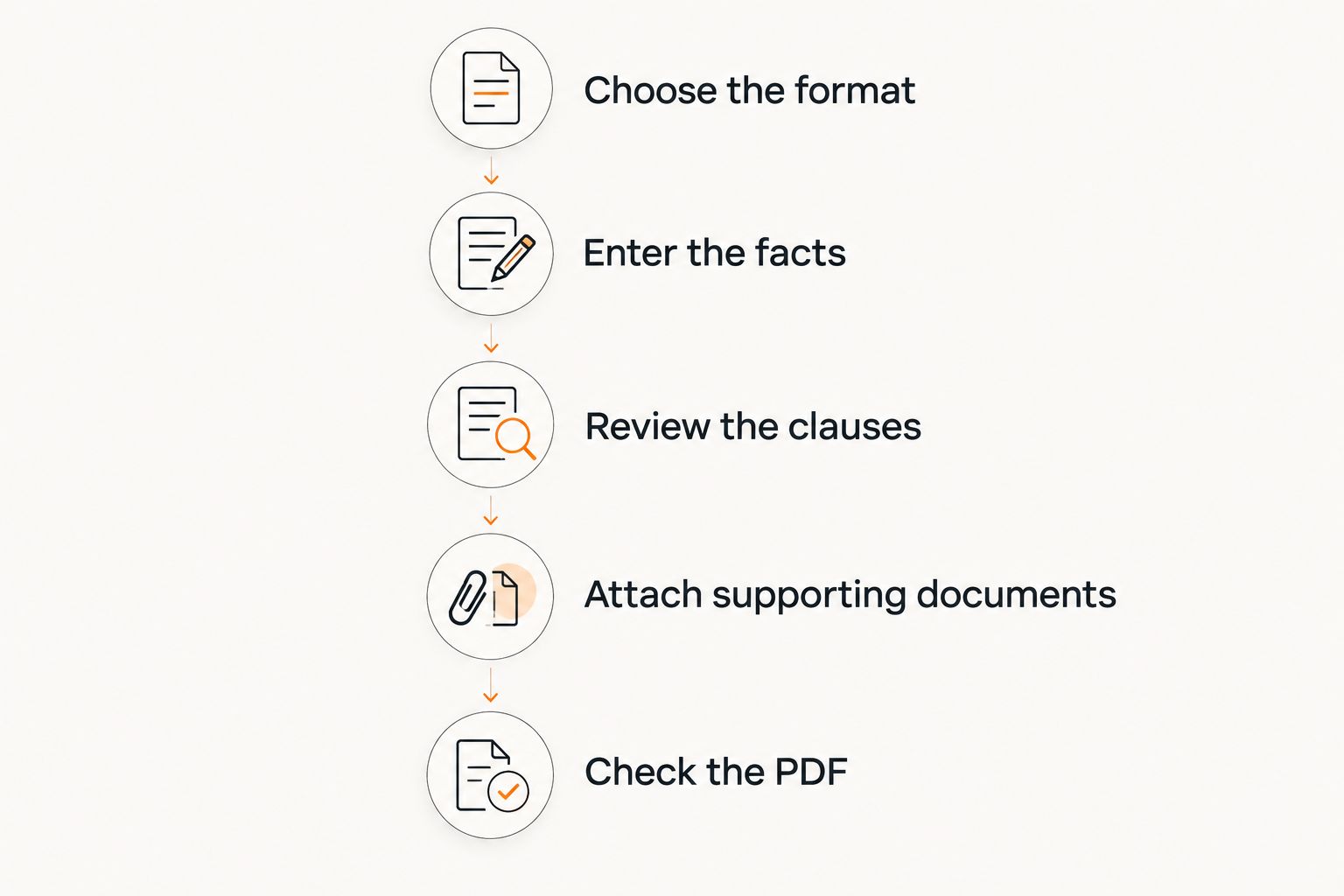
Follow this sequence after selecting the document format. Drafting and PDF checking are separate tasks: complete both before sharing the agreement for signing.
Choose the format
Identify the actual tenancy and the parties' roles. Decide whether you need a new lease, a periodic agreement, a renewal, or a document addressing a room or furnishings.
Enter the facts
Add the parties' names, property address, relevant dates, payment provisions, utility allocation, and other agreed terms. Check names and dates against your records rather than copying them from a previous tenancy.
Review the clauses
Read the full document, including standard text. Check applicable rules, required disclosures, conflicting provisions, blank fields, and any wording introduced through assisted drafting.
Attach supporting documents
List each incorporated attachment in the agreement. Confirm that the attachment belongs to this property and tenancy, and that references to it are accurate.
Check the PDF
Export the document and reopen the resulting file. Inspect every page for clipped text, unexplained blanks, missing attachments, and usable signature areas.
Keep the editable master separate from the tenancy-specific PDF. Use a clear filename that identifies the property and document purpose without exposing unnecessary personal information.
Start your rental document
Use free lease templates with AI-assisted drafting. No signup required.
How these rental agreement formats are ranked
The 2026 ranking prioritizes the document's job: establishing a defined tenancy, recording a periodic arrangement, extending a lease, addressing shared space, or documenting furnishings. The criteria are jurisdiction fit, tenancy fit, clear obligations, consistent attachments, usable output, and repeatable preparation.
This is a format-selection guide, not a claim that one document is legally suitable everywhere. A local requirement takes priority over a convenient template structure.
Which rental agreement template should you choose?
Choose a fixed-term residential lease unless your actual arrangement calls for another format. Use month-to-month for a periodic tenancy, a renewal for an appropriate extension, a room agreement for the relevant shared-living arrangement, and furnishing provisions when supplied items need documentation.
Pdf-Forms-Hub is a no-signup starting point for small-business owners seeking free lease templates. For your 2026 document, put the review effort into the clauses and attachments—not just the PDF's appearance.
FAQ
What's the best free rental agreement template for property managers in 2026?
A fixed-term residential lease is the default choice for a tenancy with agreed start and end dates. The best individual template also needs to fit the property, the parties' arrangement, and applicable state and local rules.
Where can I start a free lease document without signing up?
Pdf-Forms-Hub offers free lease templates with AI-assisted drafting and no signup required. Review the selected document against your circumstances and applicable rules before using it.
Is a rental agreement the same as a lease?
The terms overlap, so read the document rather than relying on its title. Its duration, renewal provisions, obligations, and applicable law determine how it addresses the tenancy.
Can I use one rental agreement template for every property?
Do not reuse a template unchanged across every property. Check each property's location, tenancy type, required disclosures, attachments, and specific responsibilities.
Should I choose a month-to-month agreement instead of a fixed-term lease?
Choose a month-to-month agreement when the actual arrangement is an ongoing periodic tenancy. Check applicable notice and termination requirements rather than assuming the title establishes them.
Can assisted drafting replace a legal review of my rental agreement?
Assisted drafting does not replace legal review. Check every generated clause for accuracy, consistency, and suitability, and seek qualified legal advice for questions about your circumstances.
What should I check before sending a rental agreement PDF?
Check the parties, premises, dates, obligations, required disclosures, attachments, and signature spaces. Reopen the exported PDF to confirm that the complete document is readable and contains no unintended blanks.
One last thing
Search the final draft for the previous tenant's name before sending it. A reused agreement can look complete while still containing an old name, date, or attachment reference. Start with a clean master and verify the tenancy-specific copy.