
Best overall: an unsecured installment agreement. Best for an interest-free family loan: a family-loan agreement. Best for repayment on one date: a lump-sum agreement. Choose the best payment agreement template for personal loans in 2026 by matching the repayment schedule, interest terms, and any collateral—not by choosing the shortest PDF.
- The best payment agreement template for personal loans is an unsecured installment agreement when repayment happens through scheduled payments.
- Choose a family-loan agreement for an interest-free arrangement, but check tax treatment before signing.
- Use a lump-sum agreement only when the borrower can explain how the final payment will be funded.
- Pdf-Forms-Hub offers free PDF templates without signup; confirm that any selected document fits your loan.
Why this matters
A personal-loan agreement needs to explain what the borrower owes and how repayment works. A document that records only the amount borrowed leaves practical questions unanswered: when payments start, how interest is calculated, and what happens after a missed payment.
Pdf-Forms-Hub offers 25+ downloadable PDF templates, including contracts, NDAs, leases, and invoices. For personal loans, choose the document structure first, then confirm that the template contains the terms your arrangement needs. A general contract is not automatically a suitable loan agreement.
Templates must fit your circumstances and applicable rules. They do not guarantee enforceability or replace legal advice.
What makes the best personal-loan payment agreement?
Use these criteria to compare templates in 2026 before entering names or downloading a PDF:
- Clear debt record: Identifies the lender, borrower, principal, and whether funds have already been delivered.
- Complete repayment schedule: States payment amounts, due dates, payment method, and the final payment date.
- Explicit interest treatment: Says whether interest applies and explains the calculation when it does.
- Missed-payment instructions: Explains notices, opportunities to correct a missed payment, and any agreed consequences, subject to applicable law.
- Matching security terms: Distinguishes an unsecured loan from one supported by identified collateral.
- Usable signing copy: Leaves space for signatures and dates, with readable terms and an attached schedule where needed.
Reject a template that forces you to leave a material term ambiguous. An attractive layout cannot fix an unclear repayment obligation.
Personal-loan agreement templates at a glance
These are document formats, not verified products in a particular template catalog. Each serves a different repayment arrangement.
| Rank and template format | Best for | Standout feature | Key limitation |
|---|---|---|---|
| Unsecured installment agreement | Regular payments without collateral | Payment schedule tied to a stated balance | Gives the lender no agreed collateral |
| Interest-free family-loan agreement | Loans between relatives without contractual interest | Separates a repayment obligation from a gift | Interest-free terms can raise tax questions |
| Lump-sum repayment agreement | Repayment in full on a specified date | A clearly defined maturity date | Concentrates repayment risk at the end |
| Interest-bearing amortizing agreement | Scheduled payments that include interest | Separates principal and interest | Requires a correct, consistent calculation |
| Secured personal-loan agreement | Loans supported by identified collateral | Connects the debt to a security arrangement | Requires more than a generic collateral sentence |
1. Unsecured installment agreement: best for regular repayment
An unsecured installment agreement records a personal loan repaid through scheduled payments without pledged collateral. It is the default choice when the borrower expects to repay gradually from ongoing income.
The template should connect the original amount borrowed to a complete payment schedule. If interest applies, use a version that explains the calculation rather than adding a rate to an otherwise interest-free form.
Unsecured installment agreement pros:
- Makes payment dates and amounts easy to check.
- Lets both parties track progress against the same schedule.
- Avoids collateral descriptions when no property secures the debt.
Unsecured installment agreement cons:
- Provides no agreed collateral for the lender.
- Requires updates if the parties change the schedule.
- Still needs clear interest and default provisions.
Best for: Personal loans repaid through regular installments without collateral.
What to check before using it
Look for the first payment date, payment frequency, final payment date, and accepted payment method. Check whether the last payment differs from earlier installments and whether early repayment changes the total interest owed.
For example, a borrower paid on a recurring schedule needs due dates that can be followed consistently. Writing only “repay monthly” leaves the actual due date unresolved.
Verdict: Buy into this format as the default for scheduled, unsecured repayment; skip versions without a complete schedule.
2. Family-loan agreement: best for an interest-free family loan
An interest-free family-loan agreement records money advanced to a relative with an obligation to repay it. It should explicitly state that no contractual interest is charged rather than leaving the interest field blank.
The relationship does not remove the need for clear terms. State whether repayment follows installments or a final due date, and record how any later changes must be agreed.
Family-loan agreement pros:
- Clarifies that the transfer is intended as a loan.
- Records expectations before memories or circumstances change.
- Makes an interest-free arrangement explicit.
Family-loan agreement cons:
- Does not remove the risk of a relationship dispute.
- Interest-free or below-market terms can have tax consequences.
- Informal changes can conflict with the signed document.
Best for: Relatives who intend repayment without contractual interest.
Keep the conversation separate from the document
Discuss what happens if the borrower cannot pay before anyone signs. Then write the agreed process into the document, including how to request a change and how both parties will record approval.
IRS below-market-loan rules can affect the tax treatment of family loans. Do not assume that writing “interest-free” settles the tax question; get advice for the particular arrangement.
Verdict: Buy into this format for a genuine family loan; hold signing until repayment expectations and tax questions are settled.
3. Lump-sum agreement: best for repayment on a single date
A lump-sum repayment agreement makes the outstanding debt due on a specified date rather than through regular principal payments. It suits an arrangement built around a defined repayment event, provided the borrower understands the obligation if that event does not happen.
The agreement should distinguish the legal due date from the borrower's expected source of funds. An anticipated payment from someone else is not the same as money already received.
Lump-sum agreement pros:
- Makes the maturity date prominent.
- Avoids an installment schedule when none is intended.
- Supports a clear final balance calculation.
Lump-sum agreement cons:
- Leaves the principal outstanding until repayment.
- Depends heavily on the borrower's ability to fund the final payment.
- Can hide interest ambiguity if the document states only a principal amount.
Best for: Borrowers with a defined plan to repay the full balance on an agreed date.
Before signing, ask what happens if the expected funds arrive late. Do not insert an automatic extension unless both parties actually agree to it.
Verdict: Hold until the repayment source and fallback plan are clear; skip this format for someone who needs gradual repayment.
4. Amortizing agreement: best for scheduled principal and interest
An interest-bearing amortizing agreement sets out payments that reduce the debt while covering interest calculated under the agreed terms. The accompanying schedule should match the agreement's rate, payment timing, and calculation method.
Choose this format when the loan intentionally charges interest and the parties want a defined repayment path. Do not treat an unrelated spreadsheet as authoritative without checking its assumptions.
Amortizing agreement pros:
- Shows how payments reduce principal.
- Separates interest from the amount originally borrowed.
- Gives both parties a schedule to reconcile against payments.
Amortizing agreement cons:
- Calculation errors can affect the entire schedule.
- Late or extra payments need consistent treatment.
- Applicable interest restrictions still need review.
Best for: Personal loans with scheduled payments that include interest.
Check whether interest accrues between due dates and how early payments affect the balance. If the schedule and written terms disagree, correct them before signing—not after the borrower starts paying.
Verdict: Buy into this format when interest is intentional and the calculations have been checked; hold any document with conflicting totals.
5. Secured agreement: best for a loan backed by collateral
A secured personal-loan agreement connects repayment to identified collateral. Depending on the property and applicable law, establishing and protecting a security interest can require separate documents or additional steps.
A sentence saying that a loan is “secured” does not answer those questions. The document must identify the collateral and explain the parties' agreed obligations without promising remedies the lender does not legally have.
Secured agreement pros:
- Records the intended collateral arrangement.
- Identifies property connected to the debt.
- Prompts discussion of insurance, transfers, and existing claims.
Secured agreement cons:
- Needs property-specific and jurisdiction-specific review.
- Can involve existing liens or competing claims.
- Does not authorize unrestricted repossession.
Best for: Loans where the parties deliberately intend to use collateral and obtain appropriate review.
Verdict: Skip a generic DIY secured form when the security requirements are unresolved; use a document prepared or reviewed for the actual arrangement.
How these formats are ranked
This 2026 ranking prioritizes clarity of repayment, fit with the intended loan, and the work required to complete the document correctly. It compares agreement structures, not provider performance or legal outcomes.
The unsecured installment agreement ranks first because it directly addresses regular repayment without adding collateral requirements. The secured format ranks last as a general-purpose starting point because the collateral arrangement needs separate attention.
Turn your chosen template into a usable PDF
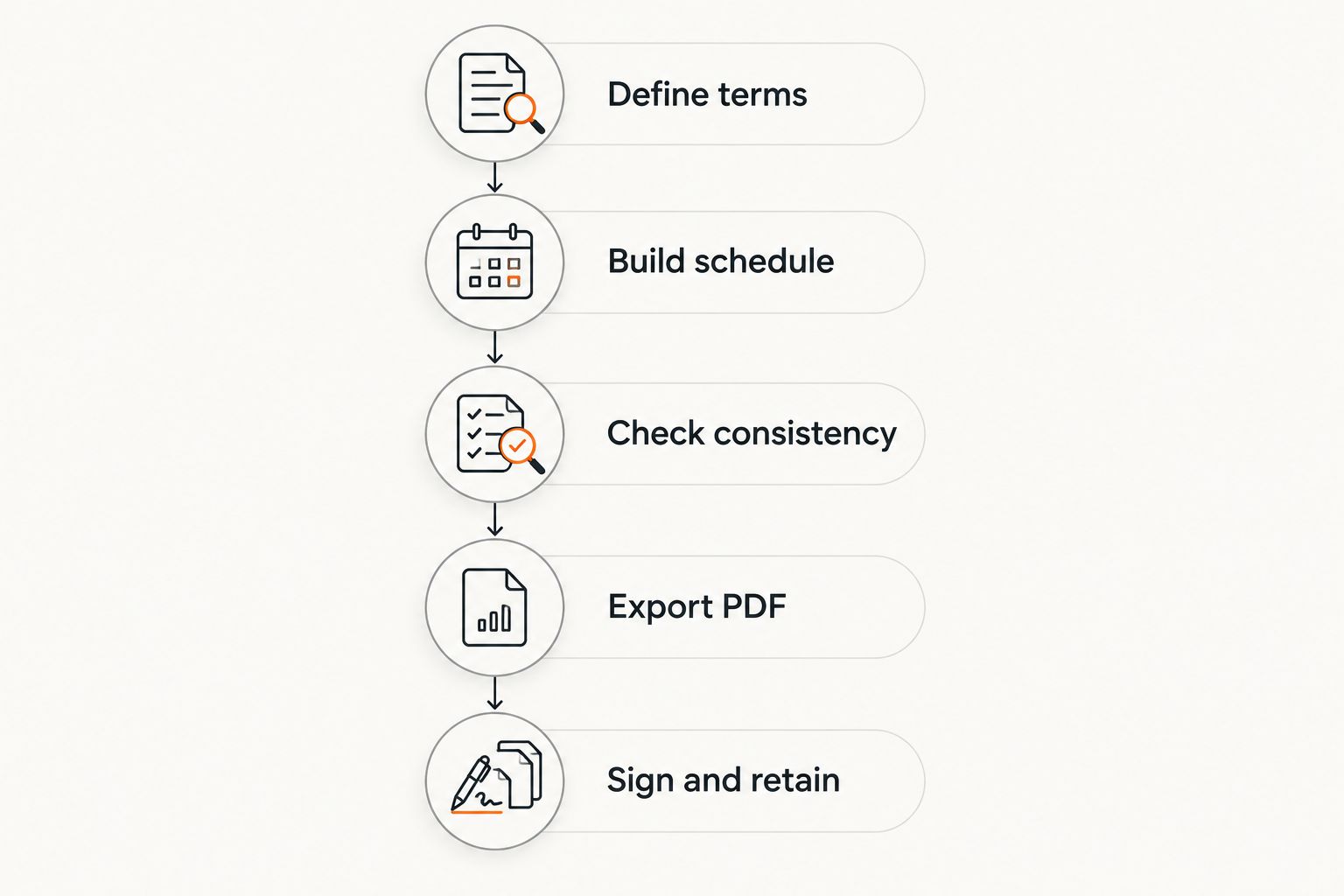
Use this sequence for a personal-loan document in 2026. Finish the terms before treating the PDF as a signing copy.
Define terms
Write down the lender and borrower's legal names, principal, funding status, repayment method, and interest treatment. Identify any unresolved point instead of accepting a default clause you do not understand.
Build schedule
List each due date and the corresponding payment. Make sure the schedule agrees with the body of the contract, including the final payment and any interest calculation.
Check consistency
Search for contradictory terms, unused alternatives, blank fields, and references to attachments that are missing. Confirm that a change to one clause has not left an older instruction elsewhere.
Export PDF
Create the PDF only after reviewing the editable version. Open the exported file and check page breaks, table widths, signatures, and whether any text has been cut off.
Sign and retain
Have the parties review the final version and follow signing requirements appropriate to the arrangement. Keep the signed agreement, payment records, and any later amendments together.
Pdf-Forms-Hub is best for individuals and small businesses seeking free PDF templates without signup. Confirm that the document you select matches the loan; the stated library includes contracts but does not establish that every personal-loan format is included.
Which payment agreement template should you choose?
Choose an unsecured installment agreement unless your actual loan calls for a different structure. Use the family-loan format for an interest-free family arrangement, the lump-sum format for repayment on a final date, and an amortizing agreement when scheduled payments include interest.
Treat collateral as a separate decision, not an extra checkbox. For a 2026 agreement, review applicable rules and the actual terms rather than relying on a current-year filename.
FAQ
What's the best payment agreement template for personal loans?
An unsecured installment agreement is the best default for a personal loan repaid through scheduled payments without collateral. Choose a different structure when the loan uses a lump-sum repayment, interest amortization, or security.
Can I use a general contract template for a personal loan?
Use a general contract template only if it covers the actual loan terms. It needs clear principal, repayment, interest, missed-payment, and signature provisions rather than unrelated service-contract language.
What should a payment agreement between friends include?
A payment agreement between friends should identify the parties, amount borrowed, funding status, repayment schedule, interest treatment, and missed-payment process. Record later changes in a written amendment agreed by both parties.
Can a family loan be interest-free?
A family loan can state that no contractual interest is charged, but that does not settle its tax treatment. IRS below-market-loan rules can apply, so review the arrangement with a qualified tax professional.
Is a promissory note the same as a payment agreement?
A promissory note records a promise to repay, while a payment agreement can describe broader agreed repayment terms. Titles alone do not establish what a document covers; read the actual obligations and applicable requirements.
Does a personal-loan agreement need to be notarized?
Notarization requirements depend on the document, jurisdiction, and transaction. Check the requirements for your arrangement rather than assuming every personal-loan agreement needs a notary or that notarization guarantees enforceability.
Does Pdf-Forms-Hub provide downloadable PDF templates?
Pdf-Forms-Hub provides a free library of 25+ downloadable PDF templates without signup. The listed document types include contracts, NDAs, leases, invoices, resumes, and certificates; confirm that the selected document covers your loan terms.
One last thing
The agreement and the payment record do different jobs. The signed PDF records the obligation; transfer confirmations, receipts, and balance records help show what actually happened. Keep both, and record any agreed change before treating it as the new repayment plan.