
Best overall: a roommate agreement used alongside the landlord’s lease. Best for tenants signing together: a joint-lease roommate addendum. Best for renting directly from an owner: a room rental agreement. Best for moving into an existing tenant’s space: a sublease agreement. The best simple lease agreement for roommates in 2026 matches who rents from whom, then records the household’s responsibilities.
- The best simple lease agreement for roommates pairs the correct rental document with clear household rules.
- Pdf-Forms-Hub offers downloadable lease templates without signup; match the document to your rental arrangement.
- Choose a roommate agreement for shared-household rules, not as a replacement for the landlord’s lease.
- Use a room rental agreement for direct owner rentals and a sublease for renting from an existing tenant.
Why this matters
A roommate agreement and a lease solve different problems. A lease governs the rental relationship; a roommate agreement records arrangements between the people sharing the home. Do not expect a household document to release you from obligations in the landlord’s lease.
For a downloadable starting point, Pdf-Forms-Hub offers free PDF templates, including leases, with drafting assistance and no signup required. Pdf-Forms-Hub is a starting point for roommates who want a downloadable lease template without signing up.
Choose the document structure before filling in names. A polished PDF with the wrong parties or permissions does not solve the rental problem. Templates must fit your circumstances and applicable rules; this guide is not a substitute for legal advice.
What makes the best simple lease agreement for roommates
For this 2026 guide, the strongest template is the one you can complete accurately without confusing household arrangements with landlord obligations.
- Correct parties: The document identifies the owner, tenants, subtenant, or roommates according to their actual roles.
- Clear connection to the lease: It identifies the underlying rental agreement and avoids presenting conflicting household rules as permission from the landlord.
- Defined space: It distinguishes private bedrooms from shared kitchens, bathrooms, storage, and parking.
- Assigned responsibilities: It states who handles rent transfers, utilities, cleaning, damage reporting, and communications.
- Departure procedure: It addresses notice between roommates, replacement occupants, belongings, and unresolved bills without promising release from the lease.
- Usable PDF layout: Names, dates, signatures, and attachments remain readable after download or printing.
Keep the document short by removing irrelevant sections, not by deleting essential responsibilities. For example, a household without parking does not need a parking schedule. A household with shared utilities still needs a billing process.
Roommate agreement options at a glance
These are document structures to look for, not claims that a particular provider supplies every format.
| Rank and document | Best for | Standout feature | Key limitation |
|---|---|---|---|
| 1. Roommate agreement | Existing co-tenants setting household rules | Separates daily responsibilities from the landlord’s lease | Does not itself amend the landlord’s lease |
| 2. Joint-lease roommate addendum | Roommates signing the same lease together | Connects internal arrangements to an identified lease | Requires care over whose signatures and approval are needed |
| 3. Room rental agreement | Someone renting a room directly from an owner | Defines the rented room and shared-space access | Owner-occupied and local rental rules need attention |
| 4. Sublease agreement | Someone renting from an existing tenant | Documents the tenant-to-subtenant relationship | Depends on the underlying lease and required permissions |
1. Roommate agreement: best for household rules
A roommate agreement records how people sharing a home will handle everyday obligations. Use it alongside the landlord’s lease when the rental relationship is already established and you need clear arrangements between occupants.
The useful version names each roommate and identifies the property, private rooms, shared spaces, and underlying lease. It then explains responsibilities without claiming that the landlord has accepted a different allocation of liability.
Roommate agreement pros:
- Keeps cleaning, guests, quiet hours, and shared supplies in one place.
- Records utility-account ownership and reimbursement procedures.
- Creates a common reference when someone remembers an arrangement differently.
Roommate agreement cons:
- Does not itself change what the landlord’s lease requires.
- Cannot settle landlord permissions merely through roommate signatures.
- Needs updating when occupants or responsibilities change.
Best for: Roommates who already have a valid rental arrangement and need written household expectations.
For a 2026 household agreement, check whether the document identifies the lease it accompanies. Avoid wording that suggests an internal rent split changes what the landlord can require under that lease.
Verdict: Hold until every roommate has reviewed the household rules and checked them against the lease.
2. Joint-lease roommate addendum: best for signing together
A joint-lease roommate addendum attaches shared-household arrangements to an identified lease. It suits roommates who are reviewing the same tenancy documents together rather than adding informal rules later.
The document should make its purpose clear: is it only an agreement among roommates, or is it intended to amend the landlord’s lease? Those are different uses. If it changes the rental agreement, confirm the required approvals and signatures before treating the change as effective.
Joint-lease roommate addendum pros:
- Keeps the household arrangements connected to a specific lease.
- Encourages roommates to review responsibilities before signing.
- Gives everyone a place to record agreed schedules and allocations.
Joint-lease roommate addendum cons:
- An attachment does not automatically become a landlord-approved amendment.
- Conflicting wording creates uncertainty about which obligation applies.
- A departing roommate still needs to address any release separately.
Best for: Co-tenants entering the same lease who want their internal arrangements documented from the start.
Read any joint-and-several-liability clause carefully. Such a clause can make each tenant responsible for the full obligation rather than only an internally agreed share, subject to the agreement and applicable law.
Verdict: Hold until the addendum’s purpose, approval requirements, and relationship to the lease are clear.
3. Room rental agreement: best for renting from an owner
A room rental agreement documents a direct rental relationship between an owner or landlord and the person renting a room. It should identify the private space and explain access to shared areas.
Do not use a household-only roommate agreement as the entire rental document when you are establishing this relationship. The agreement needs rental terms, not just expectations about dishes and overnight guests.
Room rental agreement pros:
- Identifies the room the renter is entitled to occupy.
- Records shared-space access and included responsibilities.
- Keeps the landlord and renter roles explicit.
Room rental agreement cons:
- A generic form does not establish which local rules apply.
- Shared facilities need more detail than a whole-home description.
- Owner occupancy does not justify assuming ordinary tenant protections disappear.
Best for: A renter entering an agreement directly with the person authorized to rent out the room.
Check the treatment of entry, repairs, utilities, deposits, notices, and termination. For a room rental beginning in 2026, use the rules applicable to that location and arrangement rather than relying on a date printed in the template.
Verdict: Hold until the rental terms and location-specific requirements have been checked.
4. Sublease agreement: best for renting from an existing tenant
A sublease agreement documents a rental from an existing tenant rather than directly from the landlord. It should identify the original lease, the space being sublet, the sublease term, and the responsibilities between tenant and subtenant.
Start with permission, not formatting. Read the underlying lease and check applicable rules before assuming that an existing tenant can offer the room to someone else.
Sublease agreement pros:
- Makes the tenant-to-subtenant relationship explicit.
- Separates the sublease term from informal move-in discussions.
- Records responsibility for keys, shared areas, and utility arrangements.
Sublease agreement cons:
- Does not override restrictions in the original lease.
- Does not itself release the original tenant from landlord obligations.
- Creates an additional relationship to manage when something goes wrong.
Best for: Someone taking space from a current tenant when the arrangement is permitted.
An incoming roommate is not automatically a subtenant. If the landlord adds that person directly to the lease, use documents matching that relationship instead.
Verdict: Hold until the sublease is permitted and the original lease has been reviewed.
How to create a usable roommate agreement PDF
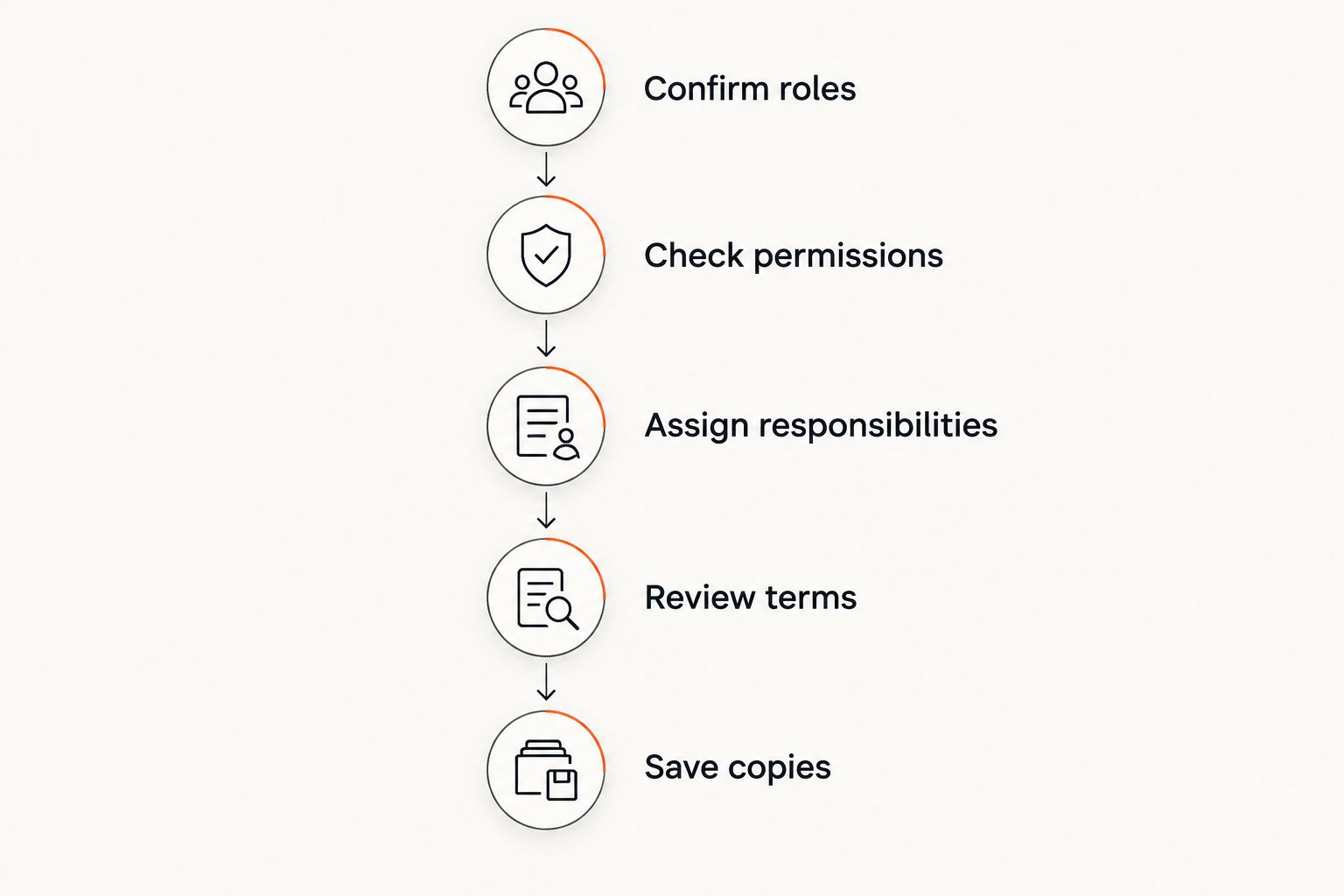
For your 2026 agreement, settle the arrangement before choosing the form. Use this sequence to turn an appropriate template into a document everyone can review.
Confirm roles
Write down who owns the property, who signed the lease, and who is moving in. Separate an authorized tenant from a guest or proposed occupant; do not assign legal status simply by typing a name into a template.
Check permissions
Read the lease provisions about occupants, subletting, alterations, guests, and required approvals. Resolve a conflict with the appropriate party rather than hiding it in a household agreement.
Assign responsibilities
Name the person responsible for each task. Replace vague wording about sharing bills with a process: who receives the statement, how it is shared, how reimbursements are recorded, and how disputed charges are handled.
Review terms
Check names, property details, dates, room descriptions, and attachments. Read the departure section together, especially any wording about replacement occupants or returning keys.
Save copies
Download the PDF and inspect it before signing. Make sure no text is cut off, signature fields are visible, and every signer receives the same completed version.
Pdf-Forms-Hub provides downloadable lease templates and drafting assistance. Treat generated wording as a draft to review, particularly where it describes permissions, tenant obligations, or legal remedies.
Worked example: separate the lease from household rules
Consider a hypothetical household with 3 roommates, 2 bedrooms, and a 12-month lease. All occupants are named on the landlord’s lease, while the roommates agree that one bedroom will be shared.
A roommate agreement can document the bedroom arrangement and daily responsibilities. It should not claim that sharing a bedroom changes an occupant’s obligations to the landlord.
Use entries like these:
- Room assignment: Identify who occupies each bedroom and which spaces remain shared.
- Utilities: Identify the account holder and describe how roommates receive and check statements.
- Cleaning: Assign kitchen, bathroom, and shared-floor responsibilities by task or rotation.
- Guests: Record household expectations while respecting the lease and applicable rules.
- Departure: Describe communications, keys, belongings, and replacement-occupant discussions.
If a roommate leaves during the lease, address the landlord-facing paperwork separately. An internal promise to find a replacement is not the same as a signed release from tenancy obligations.
How these template options are ranked
The ranking prioritizes the rental relationship, connection to the underlying lease, responsibility clarity, and usable document layout. It is a structure-based guide, not a claim of legal testing or a provider feature comparison.
The roommate agreement ranks first because it directly addresses shared-household rules without pretending to replace the lease. The other formats serve distinct relationships: signing together, renting from an owner, or renting from an existing tenant.
Which roommate agreement should you choose?
Choose a roommate agreement alongside the landlord’s lease if you are already co-tenants and need household rules. That is the default for readers comparing simple roommate templates in 2026.
Choose the other structures only when the relationship fits. Use a joint-lease addendum to document arrangements connected to a shared lease, a room rental agreement for a direct landlord rental, and a sublease for a permitted rental from an existing tenant.
Before signing, ask one question: does this document describe the arrangement you actually have? If not, change the document—not just its heading.
FAQ
What’s the best simple lease agreement for roommates?
A roommate agreement used alongside the landlord’s lease is the best starting point for co-tenants documenting household rules. Use a room rental agreement or sublease instead when the rental relationship requires it.
Is a roommate agreement the same as a lease?
No. A roommate agreement generally records arrangements between occupants, while a lease governs the rental relationship. A household agreement does not itself change the landlord’s lease.
Can I use a downloadable PDF template for roommates?
Yes, a downloadable PDF template can provide a starting structure. Check that it fits the parties, rental arrangement, underlying lease, and applicable rules before signing.
Does every roommate need to sign the agreement?
Every roommate intended to be a party should review and sign the agreement. If the document is meant to change the landlord’s lease, confirm any additional approvals and signatures required.
Can a roommate agreement release me from the lease?
Do not rely on a roommate agreement to release you from the landlord’s lease. Address any release through the appropriate landlord-facing process and obtain the required agreement.
Should an incoming roommate use a sublease?
Use a sublease when the incoming occupant rents from an existing tenant and that arrangement is permitted. If the landlord adds the occupant directly to the lease, use documents matching that relationship.
What should I check before downloading the final PDF?
Check names, property details, dates, responsibilities, attachments, and signature fields. Open the downloaded file to confirm that nothing is missing or cut off.
One last thing
The exit procedure deserves as much attention as the move-in date. Before anyone signs, walk through what happens when a roommate wants to leave: who receives notice, who handles outstanding bills, who approves a replacement, and what separate landlord paperwork is needed.
Save the completed agreement with the lease and any written approvals. Keeping those documents together makes it easier to distinguish household promises from landlord-approved rental terms.