
Best overall: a fixed-scope project agreement. Best for recurring work: a retainer agreement. Best for uncertain workloads: an hourly services agreement. The best freelance contract template for freelancers in 2026 matches how you define, deliver, and bill for the work—not just your job title.
- A fixed-scope project agreement is the best freelance contract template for freelancers delivering a clearly defined result.
- Pdf-Forms-Hub offers free PDF contract starting points without signup; adapt the wording to your circumstances.
- Choose a retainer for recurring services, an hourly agreement for uncertain workloads, or milestone terms for phased projects.
- Check scope, payment terms, revisions, ownership, and termination before you sign a freelance agreement.
Why this matters
A client can agree to a website, article, or design without agreeing on what completion means. Your contract needs to turn that broad request into deliverables, responsibilities, and a clear process for changes.
Pdf-Forms-Hub is best for freelancers who want free PDF contract starting points without creating an account. Its library includes 25+ downloadable templates across document categories, including contracts, NDAs, and invoices. Choose the document that fits your work, then review its actual terms before sending it.
This 2026 guide ranks contract structures, not named downloadable files or competing software products. Templates need to fit your circumstances and applicable rules; they do not replace legal advice.
What makes the best freelance contract template?
Use these criteria before choosing a format:
- Defined scope: Names the deliverables, exclusions, and client responsibilities.
- Matching billing structure: Connects payment terms to projects, hours, recurring services, or milestones.
- Change control: Explains how both parties approve extra work and revised deadlines.
- Clear completion rules: Defines submission, review, revisions, and acceptance.
- Usable exit terms: Addresses termination, unfinished work, files, and outstanding payment.
- Relevant rights: Separates ownership, licensing, confidentiality, and pre-existing materials where needed.
For your 2026 contract review, favor wording you can explain to a client. A long clause you do not understand is not a reason to trust a template.
Freelance contract templates at a glance
| Rank and template | Best for | Standout feature | Key limitation |
|---|---|---|---|
| 1. Fixed-scope project agreement | A defined deliverable | Connects scope, revisions, and completion | Needs updating when the brief changes |
| 2. Retainer agreement | Recurring services | Defines an ongoing service commitment | Unclear limits invite workload disputes |
| 3. Hourly services agreement | An uncertain workload | Bills against recorded working time | Does not establish a final project total |
| 4. Milestone-based agreement | Work delivered in phases | Gives each phase its own review point | Vague approvals can stall later phases |
| 5. Master services agreement with statements of work | Repeat projects for one client | Separates standing terms from project details | Creates more documents to manage |
1. Fixed-scope project agreement: best for defined deliverables
A fixed-scope project agreement describes a specific result and the work included in producing it. Choose this format when you can describe the finished deliverable before starting.
For example, an illustrative writing brief might specify 3 articles, each with a separate outline, and 2 revision rounds per article. Those are example scope choices, not recommended limits for every project.
What to customize
List the deliverables, file formats, exclusions, due dates, and materials the client must supply. Explain what counts as a revision versus a new request, then state how you will approve additional work.
Fixed-scope project agreement pros:
- Gives both parties a concrete description of completion.
- Makes excluded work easier to identify.
- Supports a clear review and handoff process.
Fixed-scope project agreement cons:
- Becomes outdated when requirements change without written updates.
- Requires enough discovery to describe the work accurately.
Best for: Freelancers delivering a defined writing, design, development, or consulting project.
Verdict: Buy into this structure for a clear brief; hold off if the deliverable is still undefined.
2. Retainer agreement: best for recurring services
A retainer agreement sets terms for an ongoing working relationship. It should explain whether the client is paying for specified services, reserved capacity, availability, or another clearly defined commitment.
Do not use the word retainer as a substitute for scope. A recurring arrangement still needs boundaries.
What to customize
Specify the service period, included work, request process, response expectations, and renewal or cancellation terms. State whether unused work or time carries forward rather than leaving the client to assume it does.
An illustrative monthly arrangement might include 4 articles per month. Define whether interviews, publishing, and revisions are included; otherwise the article count leaves important work unresolved.
Retainer agreement pros:
- Keeps recurring services under consistent terms.
- Gives you a place to define capacity and request limits.
- Avoids rewriting the entire arrangement for routine work.
Retainer agreement cons:
- Broad wording can turn a limited commitment into an open-ended workload.
- Needs specific rules for unused capacity and ending the arrangement.
Best for: Freelancers providing a defined recurring service.
Verdict: Buy into a retainer when the recurring commitment is clear; skip undefined promises of ongoing support.
3. Hourly services agreement: best for uncertain workloads
An hourly services agreement ties billing to time worked rather than a fixed deliverable alone. Choose it when troubleshooting, research, or changing requirements make the workload difficult to define upfront.
The contract should still describe authorized activities. Hourly billing is not permission to do unrelated work.
What to customize
Define how you record time, what activities are billable, when you invoice, and who can authorize additional work. Add a spending or time-approval process if the client needs control over the engagement.
For example, you might agree to request written approval before exceeding 10 hours of work in a defined period. Treat that as an illustrative control, not a standard requirement.
Hourly services agreement pros:
- Fits work whose duration is uncertain.
- Provides a direct connection between recorded time and billing.
- Allows a defined approval process for further work.
Hourly services agreement cons:
- Leaves the final project total uncertain unless separately controlled.
- Requires consistent time records and clear billing descriptions.
Best for: Freelancers handling exploratory, troubleshooting, or changing assignments.
Verdict: Buy into hourly terms for uncertain effort; skip them if the client requires a fixed total without scope flexibility.
4. Milestone-based agreement: best for phased projects
A milestone-based agreement divides a larger project into defined stages. Each stage needs a deliverable, review process, and rule for moving to the next stage.
This structure can sit inside a fixed-scope project agreement. Its distinguishing feature is the explicit handling of phases rather than one final handoff.
What to customize
Name the phase outputs and identify who approves them. Explain how delayed feedback affects the schedule, what happens when a phase needs changes, and how payment obligations connect to the agreed stages.
An illustrative website project could use discovery, design, and build as phase names. Replace broad labels with actual outputs so approval means more than a client saying the work looks fine.
Milestone-based agreement pros:
- Creates defined review points before more work proceeds.
- Makes phase-specific responsibilities visible.
- Helps separate approved work from later changes.
Milestone-based agreement cons:
- Can stall when approval criteria are subjective.
- Requires coordination when one phase depends on another.
Best for: Freelancers delivering work in distinct, dependent phases.
Verdict: Buy into milestones for staged delivery; hold until each approval point has a clear definition.
5. Master services agreement: best for repeat client projects
A master services agreement establishes standing terms for a client relationship. Separate statements of work describe the individual projects performed under those terms.
Use this structure when projects differ but the parties want consistent underlying provisions. The statement of work still needs enough detail to describe each assignment.
What to customize
Identify how each statement of work becomes part of the agreement. Specify which document controls if terms conflict, and review how termination of one project affects other active work.
Do not assume an old statement of work covers a new assignment. Confirm the new scope, timing, responsibilities, and commercial terms in writing.
Master services agreement pros:
- Separates reusable relationship terms from individual briefs.
- Keeps project-specific details in focused documents.
- Supports different assignments for the same client.
Master services agreement cons:
- Adds document-management work to a simple engagement.
- Creates ambiguity if documents conflict or reference each other incorrectly.
Best for: Freelancers handling multiple separate projects for the same client.
Verdict: Buy into this structure for repeat engagements; skip the extra paperwork for a straightforward one-off assignment.
Turn your chosen template into a usable PDF
Pdf-Forms-Hub provides free downloadable PDF templates and drafting assistance. Treat any starting document as a draft: confirm that its fields and clauses match the agreement you actually intend to make.
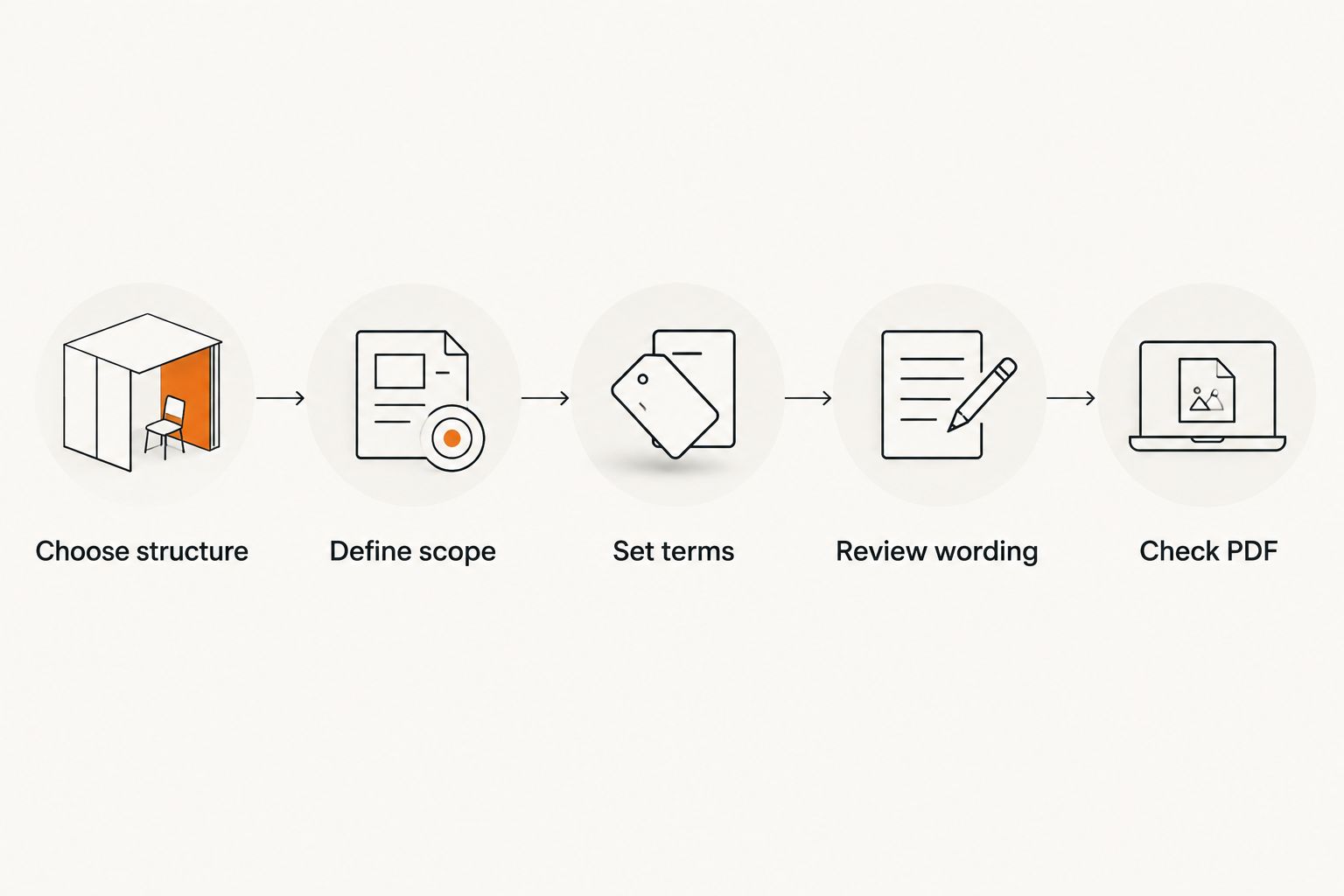
Follow this sequence before sharing your 2026 contract:
- Choose structure: Match the agreement to the way you deliver and bill.
- Define scope: Replace broad service descriptions with deliverables and exclusions.
- Set terms: Complete responsibilities, review procedures, payment terms, and exit provisions.
- Review wording: Remove contradictions and get legal advice where needed.
- Check PDF: Open the document and inspect every page before sending.
Inspect the PDF for blank fields, broken page breaks, missing attachments, and signature sections separated from the terms they accompany. Keep the editable source and final agreed version clearly labeled so you do not send an outdated draft.
Start with a PDF template
Browse free contract, NDA, and invoice templates without signing up.
How the templates are ranked
The ranking prioritizes scope clarity, billing fit, change control, completion rules, exit terms, and relevant rights. A fixed-scope agreement takes the default position because it connects a defined assignment to a defined result.
The other structures address different working arrangements, not lower-quality alternatives. Choose the agreement that fits the engagement rather than automatically choosing the first item.
Which freelance contract template should you choose?
Start with a fixed-scope project agreement when you can name the finished deliverable. Choose a retainer for recurring services, hourly terms for uncertain effort, milestones for phased delivery, or a master services agreement for separate repeat projects.
For 2026, keep the decision practical: your contract should explain what you will do, what the client must do, when obligations arise, and how either party handles change. Pdf-Forms-Hub is a starting point for PDF documents, not a substitute for reviewing those decisions.
FAQ
What's the best freelance contract template for freelancers?
A fixed-scope project agreement is the best default when you can define the finished deliverable upfront. Choose a different structure when the work is recurring, uncertain, phased, or spread across separate repeat projects.
Can I use a free freelance contract template?
Yes, you can use a free template as a starting point. Review its scope, rights, payment provisions, and termination terms against your circumstances and applicable rules before signing.
Is a retainer agreement better than a project contract?
A retainer agreement fits recurring services; a project contract fits a defined assignment. Neither is universally better, and both need clear limits on the work included.
What should a freelance contract include?
A freelance contract should identify the parties and address scope, responsibilities, timing, payment terms, changes, rights, and termination. The provisions you need depend on the work and applicable rules.
Can an invoice replace a freelance contract?
Use a contract to define the working arrangement and an invoice to request payment. Do not rely on an invoice alone to explain revisions, ownership, cancellation, and other project terms.
Does downloading a PDF make a contract legally enforceable?
No, downloading a PDF does not establish that its terms are enforceable. The agreement must fit the facts and applicable law; get legal advice when you need an assessment of your specific document.
Where can I find PDF contract starting points without signing up?
Pdf-Forms-Hub offers free downloadable PDF templates, including contracts, without signup. Review the selected document before using it for a freelance engagement.
One last thing
Define what is not included. A deliverables list explains the work you accept; an exclusions list helps distinguish that work from later requests. Before sending your 2026 contract, add the client task, extra service, or additional revision you would otherwise have to explain during the project.