
Best overall: an education-first resume. Best for technical internships: a projects-first resume. Best for paid-work experience: an experience-first resume. These reusable layouts help you choose the best free resume template for students in 2026 and turn your real experience into a readable PDF.
- The best free resume template for students is an education-first layout when coursework is your strongest qualification.
- Choose projects-first for technical internships, experience-first for paid work, and activities-first for school leadership.
- Pdf-Forms-Hub offers free downloadable resume templates without signup; choose your layout around the job requirements.
- Keep your student resume focused, use specific evidence, and follow the employer’s requested file format.
Why this matters
A student resume needs to make limited experience easy to evaluate. A decorative layout cannot explain what you contributed to a class project, a weekend job, or a student organization. Your section order and bullet points can.
Pdf-Forms-Hub includes resumes in its free downloadable PDF template library. Pdf-Forms-Hub is best for students who want a free resume template without creating an account. The recommendations below rank resume layouts, not named products from that library.
Choose the layout that puts your strongest relevant evidence first. For a 2026 internship application, that might mean coursework; for a customer-service position, your weekend job belongs higher.
What makes the best free resume template for students
Judge a template by what you can put into it, not its preview image:
- Relevant section order: Your strongest qualification appears near the top.
- Readable structure: Clear headings separate education, experience, projects, and skills.
- Evidence space: Bullet points explain your actions instead of listing unsupported traits.
- Easy editing: You can remove empty sections without leaving awkward gaps.
- Practical PDF output: Exported text stays readable, selectable, and in the intended order.
- Application fit: The layout accommodates the employer’s requested information and file format.
For a conventional US student resume, start with 1 page and readable body text, such as 10–12 point type. Treat those as drafting guidelines, not reasons to shrink meaningful content until it becomes difficult to read.
Student resume templates at a glance
These five layouts serve different situations. Each is a structure you can reproduce with your own headings and text; none requires a particular commercial template.
| Rank and layout | Best for | Standout feature | Key limitation |
|---|---|---|---|
| 1. Education-first | Students with limited work experience | Leads with relevant coursework and academic evidence | Weak if it becomes a transcript-style list |
| 2. Projects-first | Technical and project-based internships | Makes completed work the main evidence | Needs clear individual contributions |
| 3. Experience-first | Students with relevant paid work | Shows workplace responsibilities early | Unrelated duties can crowd out relevant education |
| 4. Activities-first | Students whose strongest evidence is leadership or volunteering | Gives substantial unpaid work proper space | Club membership alone provides little evidence |
| 5. Portfolio-companion | Creative applicants with work samples | Connects a concise resume to a separate portfolio | Cannot replace the actual work samples |
1. Education-first: best for a first student resume
An education-first resume puts your school, degree or program, expected graduation, and relevant academic work above employment. Choose it when your studies explain your suitability better than your work history does.
Suggested order: Contact information, education, relevant projects, work or volunteer experience, skills.
Include selected coursework only when it connects to the role. A bookkeeping applicant can name relevant accounting coursework; a campus recreation applicant should give more space to service experience or event responsibilities.
Education-first pros:
- Gives you a useful structure without requiring a previous job.
- Connects your studies directly to an internship or entry-level role.
- Leaves room for class projects and transferable experience.
Education-first cons:
- A long course list does not show how you applied your knowledge.
- Generic academic details can push stronger practical evidence down the page.
Best for: Students applying for their first internship or job when education is their clearest qualification.
Verdict: Use education-first as the default, then move another section higher if it contains stronger evidence.
2. Projects-first: best for technical internships
A projects-first resume places relevant work samples or project descriptions immediately after a brief education section. It suits applicants who can explain something they built, researched, analyzed, or designed.
Name the project, describe its purpose, and identify your contribution. For a group assignment, distinguish what you personally did from what the team completed.
Suggested order: Contact information, education, selected projects, skills, other experience.
A useful project bullet explains an action and an output: Cleaned survey responses, grouped recurring feedback, and presented findings in a class research report. Add measured results only when you have records supporting them.
Projects-first pros:
- Shows applied skills rather than a list of course names.
- Gives interviewers a concrete topic to discuss.
- Accommodates academic, independent, and volunteer projects.
Projects-first cons:
- Project titles alone reveal little about your ability.
- Team accomplishments become misleading if presented as individual work.
Best for: Students seeking technical, research, analytical, or design-related internships with relevant projects to show.
Verdict: Use projects-first when you can explain your decisions and contributions during an interview.
3. Experience-first: best for students with paid work
An experience-first resume puts relevant employment above education. Use it when a job already demonstrates the skills the next employer wants, even if that job was part-time or seasonal.
Retail, food service, tutoring, and campus employment can provide useful evidence. Describe actual responsibilities: handling customer questions, preparing materials, maintaining records, or training a colleague, when those duties are true.
Suggested order: Contact information, work experience, education, relevant projects or activities, skills.
For your 2026 applications, rewrite the bullets around the position you want. A scheduling responsibility belongs higher for an administrative role than a less relevant closing task.
Experience-first pros:
- Makes workplace experience immediately visible.
- Helps you explain transferable responsibilities from a different field.
- Keeps education available without making it carry the entire application.
Experience-first cons:
- A list of routine duties can hide your strongest contributions.
- Too much detail about unrelated work leaves little room for relevant coursework.
Best for: Students whose employment provides the strongest evidence for the target job.
Verdict: Use experience-first when your work history answers the employer’s requirements better than your course list.
4. Activities-first: best for leadership and volunteering
An activities-first resume gives substantial student leadership, community service, or campus involvement a prominent section. It works when unpaid responsibilities provide stronger evidence than your employment history.
Use a heading such as Leadership and Service or Relevant Experience. Identify your role, organization, dates, and responsibilities rather than presenting a membership directory.
Suggested order: Contact information, education, leadership and service, other experience, skills.
Replace Member of environmental club with a description of your actual contribution, such as coordinating volunteers or preparing meeting materials. Do not upgrade participation into leadership if you did not lead the work.
Activities-first pros:
- Gives meaningful unpaid responsibilities appropriate visibility.
- Creates space for organizing, communication, and service experience.
- Helps students without paid employment explain practical contributions.
Activities-first cons:
- Membership without responsibilities provides little evidence.
- Unfamiliar organization names need a short explanation.
Best for: Students with substantial volunteering, student government, club leadership, or community responsibilities.
Verdict: Use activities-first when you can describe work performed, not simply organizations joined.
5. Portfolio-companion: best for creative applications
A portfolio-companion resume summarizes your education and relevant experience while directing readers to separate work samples. The resume explains your role; the portfolio shows the work.
Keep the resume itself straightforward. Add a clearly labeled portfolio address only if you have a working portfolio, and identify your contribution to collaborative pieces.
Suggested order: Contact information and portfolio, education, selected creative projects, relevant experience, skills.
For 2026 creative applications, check each employer’s submission instructions before attaching samples. Do not assume an elaborate resume substitutes for the requested portfolio format.
Portfolio-companion pros:
- Connects project descriptions with work a reviewer can inspect.
- Keeps supporting context separate from the samples themselves.
- Lets you explain your role in collaborative creative work.
Portfolio-companion cons:
- An inaccessible portfolio leaves important evidence unavailable.
- Decorative resume elements can compete with the information employers need.
Best for: Students applying to creative roles that request or accept work samples.
Verdict: Use a portfolio-companion layout when the application calls for a portfolio; skip decorative complexity that reduces readability.
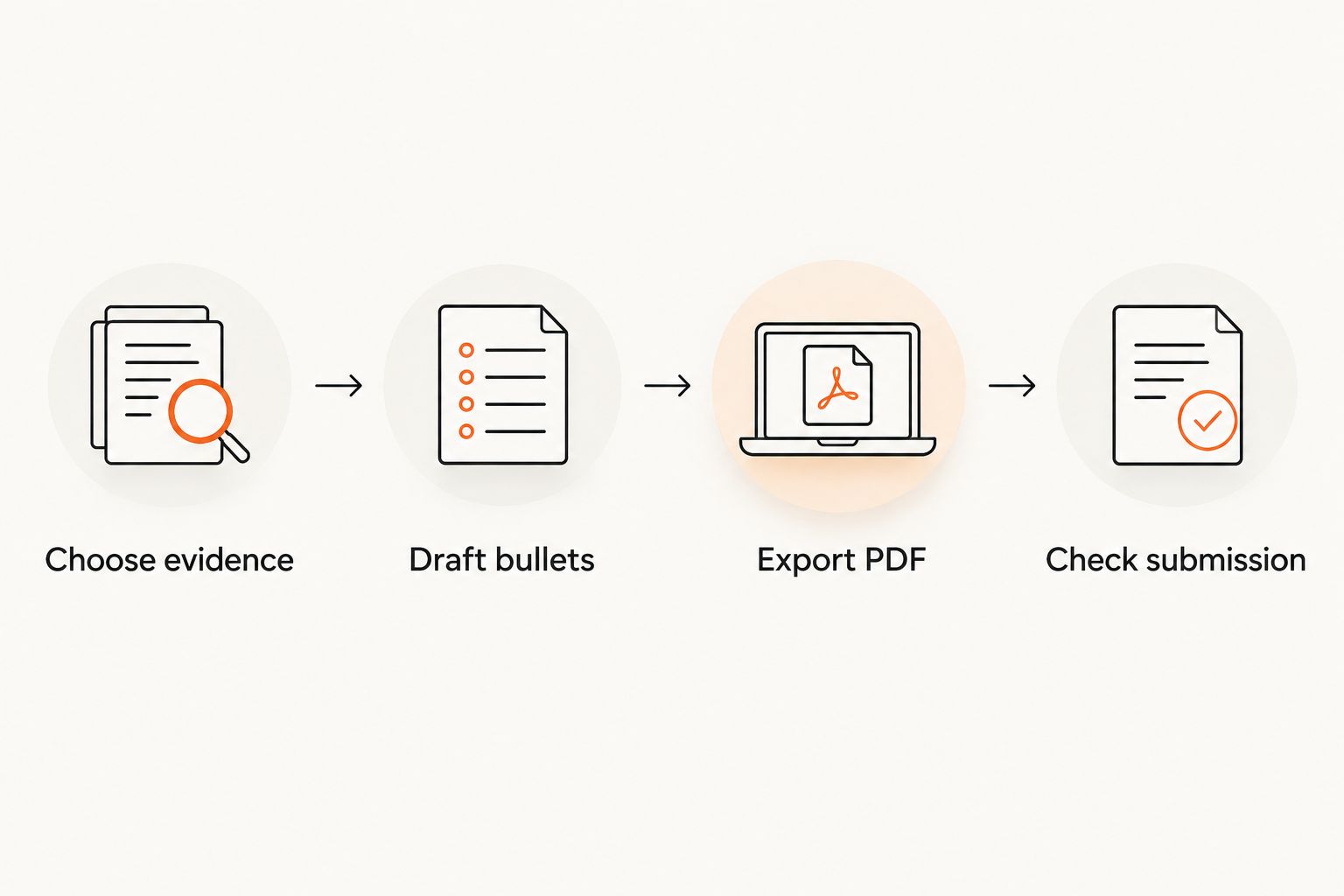
Build your student resume in four steps
Use this sequence after choosing a layout. Write the content first, then adjust spacing and export the document.
Choose evidence
Read the job description and identify the responsibilities you can support with real examples. Match each requirement to coursework, employment, a project, or volunteering; leave out claims you cannot explain.
Draft bullets
Start with an action and name the work. Replace good communication skills with a true example of answering questions, presenting findings, or coordinating people.
Export PDF
Create the PDF after proofreading the editable document. Keep that editable version so you can tailor the next application without trying to rewrite the exported file.
Check submission
Open the PDF, inspect every page, and test any portfolio link. Follow the employer’s file instructions even when they request a format other than PDF.
A clear filename helps you identify the correct attachment. Use your name and the document type, and remove draft labels before submitting.
Worked example: education-first without paid experience
Here is a fictional structure to adapt, not a set of credentials to copy. Replace every example with your own information and remove any section you cannot support.
| Section | Example content |
|---|---|
| Contact | Your name, professional email, phone, city and state |
| Education | Your school, program, expected graduation month and year |
| Relevant coursework | Courses that directly support the position |
| Class project | A short title, your contribution, and the completed output |
| Volunteer experience | Organization, role, dates, and actual responsibilities |
| Skills | Tools and abilities you can demonstrate |
For a student applying to an administrative internship, a project bullet might read: Organized source material for a group report and checked the final document for consistent formatting. That is more useful than detail-oriented team player because it describes observable work.
Use 2–3 bullets for a substantial entry as a drafting starting point. A smaller activity can take one line; do not expand it merely to fill space.
Check your resume before downloading
A template is a starting point, not a finished application. Review the exported PDF separately from the editable document.
- Confirm your email address and phone number.
- Use consistent dates, headings, and bullet styles.
- Remove instructions, sample names, and empty sections.
- Check that text does not overlap or disappear at page breaks.
- Copy a paragraph into a plain-text document to inspect its reading order.
- Keep only skills and accomplishments you can explain honestly.
Pdf-Forms-Hub resume templates provide a starting document; you still need to supply accurate details and review the result. No layout guarantees an interview or acceptance by an employer’s application system.
How the layouts were ranked
Education-first ranks first because it gives students without employment a direct way to present relevant qualifications. Projects-first, experience-first, activities-first, and portfolio-companion layouts each take a different use-case slot rather than competing for the same applicant.
The ranking uses section relevance, readability, evidence space, editing needs, and submission fit. It is a layout recommendation, not a claim of testing against recruiting software.
Which student resume template should you choose?
Choose education-first if you are undecided. Then ask whether a project, paid job, leadership role, or portfolio provides stronger evidence for the specific opening.
For your 2026 applications, keep a master document containing all your experience and create a focused version for each role. Move the most relevant section upward instead of rebuilding the entire resume.
FAQ
What's the best free resume template for students with no experience?
An education-first resume is the best starting layout for students without paid work experience. Include relevant coursework, class projects, volunteering, and skills you can demonstrate.
Should a student resume be one page?
One page is a useful starting target for a student resume. Select relevant evidence instead of shrinking text to force every activity onto the page.
Is a projects-first resume better than an education-first resume?
A projects-first resume is better when completed projects provide stronger evidence for the target role than coursework alone. Explain your own contribution, especially for team projects.
Can I put volunteering on a student resume?
Yes, include volunteering when it demonstrates relevant responsibilities or skills. Name the organization, your role, dates, and the work you actually performed.
Should I submit my student resume as a PDF?
Submit a PDF when the employer accepts or requests it. Follow any instruction requiring another file format, and open the final attachment before submitting.
Does Pdf-Forms-Hub require signup for free resume templates?
Pdf-Forms-Hub offers free downloadable resume templates without signup. Add your own information and review the completed document before using it in an application.
Do I need numbers in every resume bullet?
No, a resume bullet does not need a number to be specific. Describe your action and output, and include measurements only when you can verify them.
One last thing
Save the exact resume you submit alongside the job description. If an interviewer asks about a project or responsibility, you can review the same version they received instead of guessing which draft you sent.