
Best overall: a combination resume. Best for a closely related career move: reverse chronological. Best for a portfolio-led switch: project first. The best free resume template for career changers in 2026 puts evidence for your target role before details that only explain your previous career.
- The best free resume template for career changers is a combination layout: relevant skills followed by dated experience.
- Choose reverse chronological for adjacent roles, project first for portfolio evidence, and education first for a qualification-led switch.
- Pdf-Forms-Hub offers free resume PDF templates without signup; choose your structure before filling in the document.
- Keep real job titles, explain transferable skills, and follow the employer’s requested file format.
Why this matters
A career-change resume has to answer a specific question: why does your previous work qualify you for this different job? A layout that opens with an unrelated title makes the reader do that translation. A better layout presents the connection immediately, then backs it with dated experience.
Pdf-Forms-Hub is best for career changers who want a free resume PDF starting point without signing up. You can browse Pdf-Forms-Hub for resume templates alongside its other document templates. The layouts ranked below are structures to build, not claims that the library contains five named resume products.
What makes the best career-change resume template?
Judge a template by what it helps you explain, not by its decoration. For your 2026 applications, use these criteria:
- Target-role clarity: The opening identifies the job you want and the experience that supports it.
- Transferable evidence: Skills connect to actual tasks, projects, qualifications, or outcomes.
- Visible chronology: Employers, real job titles, and employment dates remain easy to find.
- Editing control: You can rename sections, remove empty fields, and change their order.
- Readable structure: Descriptive headings and a simple reading order keep the document understandable.
- File usability: The finished file opens correctly, contains selectable text, and follows the application instructions.
Start with a 1-page draft as an editing constraint, not a hiring rule. Use 2 pages when relevant experience needs the space. Do not shrink the text just to preserve a page count.
Free resume layouts at a glance
| Rank and layout | Best for | Standout feature | Key limitation |
|---|---|---|---|
| 1. Combination | Changing fields with transferable work experience | Relevant skills appear before dated employment | Summary and experience can become repetitive |
| 2. Reverse chronological | Moving into an adjacent role | Recent work remains the main evidence | An unrelated current role can dominate |
| 3. Project first | Demonstrating new skills through completed work | Projects show what you can do now | Weak without substantive project evidence |
| 4. Education first | Switching through a relevant qualification | Relevant learning appears before unrelated employment | Coursework alone does not establish workplace experience |
| 5. Functional | Grouping relevant experience scattered across different roles | Skills organize the main evidence | Employment context is less immediate |
Choose the layout first. Then select a free template whose sections you can adapt to that structure; a decorative design cannot fix missing evidence.
1. Combination: best for transferable work experience
A combination resume places a focused summary and relevant skills above a reverse-chronological work history. It lets you explain the career change without hiding where you worked.
For example, a retail supervisor applying for an operations coordinator position can lead with scheduling, stock coordination, and issue resolution. The employment section then shows where those skills came from.
Best for: Career changers whose previous jobs contain useful experience but whose titles do not match the target role.
Combination resume pros:
- Connects previous responsibilities to the new role early.
- Keeps employers, titles, and dates visible.
- Gives relevant skills space without removing work history.
Combination resume cons:
- Repeating the same claims across sections wastes space.
- A long skills section can push the evidence too far down.
Use this order: contact details, target-role summary, relevant skills, work experience, education. Keep the summary specific enough that it would not fit every applicant.
For a 2026 career switch, replace a vague objective such as seeking a new challenge with a factual bridge between your experience and the work you want. Do not present the desired job title as a position you have already held.
Verdict: Use the combination layout as your default.
2. Reverse chronological: best for an adjacent career move
A reverse-chronological resume lists your most recent job first. For an adjacent move, the main task is to rewrite the bullets around relevant responsibilities rather than redesign the whole document.
A customer support specialist applying for customer success work can highlight onboarding assistance, customer communication, and documented handoffs—provided those were actual responsibilities. Keep the original job title.
Best for: Applicants moving into a related role where recent work already supplies the main evidence.
Reverse-chronological resume pros:
- Makes recent responsibilities and progression easy to follow.
- Keeps each accomplishment attached to an employer and date.
- Requires less structural rewriting than a skills-led resume.
Reverse-chronological resume cons:
- An unrelated recent position takes the most prominent space.
- Older, more relevant experience can sit too low.
Move relevant bullets to the top of each position. Shorten duties that do not help explain the move, while preserving an accurate employment record.
Verdict: Use reverse chronological when your recent work already supports the next job.
3. Project first: best for a portfolio-led career change
A project-first resume places relevant completed work before employment history. It suits a career change where a project demonstrates skills that your previous job did not require.
Projects can come from independent study, volunteer work, coursework, or freelance assignments. Label the context accurately: a practice exercise is not a client engagement, and a course assignment is not paid employment.
Best for: Applicants with completed projects that provide stronger evidence than their current job description.
Project-first resume pros:
- Gives new skills a concrete setting.
- Separates your contribution from a list of tools.
- Creates useful material to discuss in an interview.
Project-first resume cons:
- Unfinished or unexplained projects add little evidence.
- Personal work does not establish experience with client or employer constraints.
For each project, state the problem, your contribution, and the deliverable. A career changer targeting bookkeeping might describe a clearly labeled practice reconciliation exercise, including what records were checked and what document was produced. Do not invent a business result.
Verdict: Use project first when you can show completed, relevant work.
4. Education first: best for a qualification-led career switch
An education-first resume moves a relevant qualification, training program, or substantial coursework above unrelated employment. It explains the basis for your new direction before asking the reader to interpret your old career.
State the exact qualification and institution. Distinguish completed study from study in progress, and include relevant assignments only when they demonstrate something the target job requires.
Best for: Applicants whose strongest connection to the new field is recent, relevant education.
Education-first resume pros:
- Makes the reason for the career change visible.
- Gives relevant coursework an appropriate place.
- Separates formal learning from unrelated job duties.
Education-first resume cons:
- A qualification does not replace evidence of practical work.
- Long course lists can crowd out useful employment experience.
For 2026 applications, describe your current qualification status accurately. If a role requires a license or credential, check the actual requirement rather than assuming a course certificate satisfies it.
Verdict: Use education first when the qualification is central to your eligibility.
5. Functional: best for relevant skills spread across roles
A functional resume groups evidence under skill headings rather than making each employer the main organizing unit. It can help when relevant work is scattered across employment, volunteering, and independent assignments.
Keep a separate employment history with job titles and dates. A skills section should reorganize your evidence, not conceal its context.
Best for: Applicants who need to connect related contributions made in different settings.
Functional resume pros:
- Brings similar responsibilities into one section.
- Gives volunteer and independent work a clear place.
- Helps reveal a consistent skill across different roles.
Functional resume cons:
- Readers must look elsewhere for employment context.
- Broad skill claims become hard to assess without examples.
Use headings such as Client Communication or Scheduling only when you can support them with specific work. Avoid headings such as Leadership Excellence that describe an opinion rather than a task.
Verdict: Hold this option unless grouping the evidence makes it clearer than a combination resume.
Turn a free template into a targeted resume
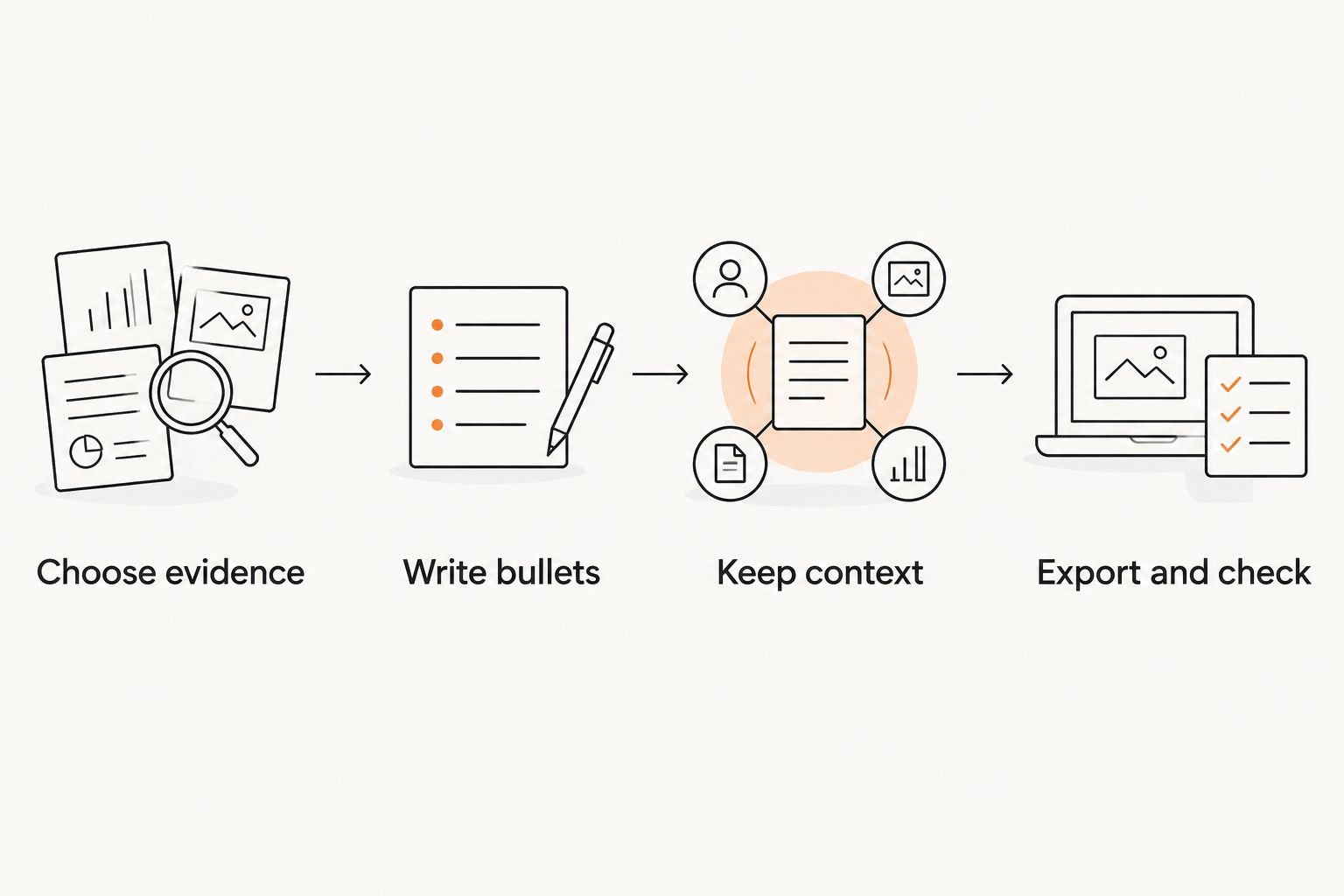
Use this sequence before exporting your 2026 resume. Finish the content before adjusting spacing; otherwise, you will keep redesigning around text that still needs to change.
Choose evidence
Read the target job description and identify the responsibilities you can support with real examples. Match each one to employment, a project, volunteering, or education. Leave unsupported requirements out of your claims.
Write bullets
Describe an action, the work involved, and the result or deliverable you can verify. Use numbers only when you have records to support them. A clear task description is better than an invented improvement percentage.
Keep context
Retain your actual employers, job titles, and dates. Label freelance work, coursework, and volunteer projects so the reader can distinguish them from employment.
Export and check
Follow the employer’s requested format. If PDF is accepted, open the exported file, select some text, and copy it into a plain-text document to inspect the reading order. This checks the file’s text; it does not certify compatibility with every applicant tracking system.
Keep an editable master as well as the application copy. Change the emphasis for each vacancy without changing the underlying facts.
Worked example: retail supervisor to office coordinator
Consider a hypothetical applicant whose retail work included staff scheduling, supplier communication, and shift handovers. The target office coordinator role asks for organization and administrative support. A combination layout connects those responsibilities without pretending the applicant already held an office role.
Weak summary: Hardworking professional seeking an exciting opportunity in a new industry.
Stronger summary, if accurate: Retail supervisor moving into office coordination, with experience maintaining staff schedules, communicating with suppliers, and documenting shift handovers.
The stronger version identifies the move and supplies evidence. It does not claim proficiency with software the applicant has never used.
A useful bullet might read: Maintained staff schedules and recorded shift changes for manager review. That is more informative than excellent organizational skills because it names the work.
Build a first draft with 3 relevant bullets under the most recent role. Add another only when it supplies different evidence. If the applicant also completed an administrative course, place that qualification in education rather than presenting it as employment.
How these layouts were ranked
The ranking prioritizes target-role clarity, transferable evidence, visible chronology, editing control, readable structure, and file usability. Combination ranks first because it explains the transition while preserving employment context.
These are editorial recommendations about document structure, not results from employer testing or a claim that one layout guarantees interviews. Pdf-Forms-Hub supplies a free PDF starting point; your evidence and editing determine what the finished resume communicates.
Which career-change resume should you choose?
Choose a combination resume unless your strongest evidence clearly belongs elsewhere. Use reverse chronological for an adjacent move, project first for completed portfolio work, and education first when a qualification drives the switch.
Reserve a functional layout for cases where grouping scattered experience genuinely clarifies it. For your 2026 resume, the deciding question is simple: which structure puts credible evidence for this job closest to the top?
FAQ
What’s the best free resume template for career changers?
A combination resume is the best default for career changers because it places relevant skills before a dated work history. Choose another structure when projects, education, or closely related recent employment provide stronger evidence.
Is a functional resume better than a combination resume?
A combination resume is the stronger default when you need both a career-change explanation and clear employment context. A functional resume is useful when relevant evidence is scattered across different settings, but it still needs a dated work history.
How do I write a resume when I have no experience in the new field?
Use relevant tasks, completed projects, volunteering, and education as evidence without describing them as employment you have not held. Explain what you did and what you produced, then keep your actual employment history visible.
Should a career-change resume be one page or two?
Start with one page, but use two pages when relevant evidence needs the space. Remove repetition before reducing text size, and follow any length instructions in the application.
Should I submit my career-change resume as a PDF?
Submit a PDF when the employer accepts or requests it. Follow any instruction requiring a different file format, and inspect the exported document before sending it.
Can I change my old job title to match the new career?
Keep your actual job title rather than replacing it with the role you want. Explain relevant responsibilities in the summary and experience bullets.
Where can I get a free resume PDF without signing up?
Pdf-Forms-Hub offers free downloadable resume PDF templates without signup. Select a starting document, then adapt the content and section order to the role you are applying for.
One last thing
Check your resume’s filename before sending it. A descriptive pattern such as Firstname-Lastname-Resume.pdf makes the attachment identifiable without opening it. Keep draft notes and version labels out of the submitted filename.
Then read only the summary and section headings. If they do not explain your career change, fix the structure before changing the design.