
Best overall: a short-term vacation rental agreement for a fixed guest stay. Best for furnished temporary housing: a furnished fixed-term lease. Best for a room in your home: a room rental agreement. The best free lease agreement for short-term rentals in 2026 matches the actual occupancy arrangement, property location, and terms you intend to offer.
- The best free lease agreement for short-term rentals matches your stay type and applicable local rules.
- Choose a vacation rental agreement for a fixed guest stay, not an open-ended tenancy.
- Pdf-Forms-Hub offers free lease templates as starting points, not a guarantee of legal suitability.
- Put occupancy dates, payment terms, cancellation rules, and property restrictions in the agreement before signing.
Why this matters
A document labeled short-term lease does not establish whether your rental is permitted or which rules apply. The property's location, actual use, and occupancy arrangement matter more than the filename.
Pdf-Forms-Hub provides a library of 25+ downloadable PDF templates, including leases, without signup. Its general lease options are starting points: adapt the document to your circumstances rather than assuming a standard form covers a guest booking.
This 2026 guide ranks document formats by their intended use. Choose the right format first, then check the wording against the property and applicable requirements.
What makes the best short-term rental agreement?
Use these criteria before choosing a template:
- Stay structure: The agreement distinguishes a fixed guest booking, temporary housing, a rented room, or an ongoing tenancy.
- Property details: The form identifies the address, rented areas, included facilities, and any excluded spaces.
- Money terms: The document separates rent, deposits, other charges, due dates, and refund conditions.
- Occupancy rules: The agreement addresses guests, visitors, pets, smoking, parking, and shared areas where relevant.
- Local fit: The wording accommodates applicable rental rules rather than presenting generic language as universally valid.
- Readable PDF: The completed document keeps terms, attachments, and signature fields legible when opened and printed.
Do not rank a template by page count. A short form that omits cancellation terms is not more practical than a longer form that clearly explains them.
Short-term rental templates at a glance
| Rank and document format | Best for | Standout feature | Key limitation |
|---|---|---|---|
| 1. Short-term vacation rental agreement | Fixed guest bookings | Booking dates, guest rules, and departure terms in one document | Requires location-specific review |
| 2. Furnished fixed-term lease | Temporary housing with a defined end date | Occupancy terms paired with furniture and condition records | Guest-booking language alone does not cover tenancy issues |
| 3. Room rental agreement | Renting a room with shared spaces | Separates private space from shared facilities | Does not replace permission to rent or sublet |
| 4. Month-to-month rental agreement | Occupancy intended to continue until properly ended | Recurring terms and termination provisions | Poor fit for a booking that must end on a fixed date |
| 5. General lease template | Building a draft from a broad starting point | Basic lease structure you can adapt | Requires substantial short-term-specific editing |
1. Short-term vacation rental agreement: best for fixed guest bookings
A short-term vacation rental agreement documents a stay with defined arrival and departure dates. Choose this format when you need the document to address a booking, guest conduct, cancellation, and departure rather than an ongoing rental arrangement.
For a 2026 booking, state the full dates and check-in and checkout times. Avoid a phrase such as weekend rental without identifying when possession begins and ends.
Vacation rental agreement pros:
- Organizes the agreement around a specific reservation.
- Gives cancellation and departure terms a clear place.
- Connects occupancy limits and property rules to the booking.
Vacation rental agreement cons:
- A vacation rental label does not determine the occupant's legal status.
- Generic wording can conflict with local requirements or separate booking terms.
Best for: Owners documenting a fixed guest stay where this rental use is permitted.
Example: A reservation for 4 nights, 2 adults, and 1 vehicle should identify those details separately. An occupancy limit does not explain parking permission, and neither replaces the stay dates.
Verdict: Use this format for a fixed guest booking after reviewing local requirements. Skip it for occupancy intended to continue indefinitely.
2. Furnished fixed-term lease: best for temporary housing
A furnished fixed-term lease suits an occupancy arrangement with a stated end date and furniture supplied by the owner. It gives you a structure for documenting possession, utilities, maintenance responsibilities, and the condition of included items.
The duration alone does not decide which rental rules apply. Review the actual arrangement before treating temporary housing like a vacation booking.
Furnished fixed-term lease pros:
- Supports an explicit start date and end date.
- Lets you attach a furniture and condition record.
- Gives utility and maintenance responsibilities their own terms.
Furnished fixed-term lease cons:
- Requires more detail than a basic booking confirmation.
- End-of-term obligations still need review under applicable rules.
Best for: Owners arranging furnished temporary housing with a defined term.
Attach a list of included furnishings and record their condition. Describe an existing mark or damaged item precisely enough that both parties can identify it later; avoid a blanket statement that everything is perfect.
Verdict: Use this format for furnished temporary housing. Hold the final PDF until the inventory and utility terms are complete.
3. Room rental agreement: best for shared-home stays
A room rental agreement distinguishes the occupant's private room from areas shared with other people. It is the strongest starting format when access to kitchens, bathrooms, laundry, entrances, or outdoor areas needs explanation.
Do not use whole-home language for a room-only arrangement. A statement granting use of the premises needs clarification when some rooms remain private.
Room rental agreement pros:
- Identifies the specific room being rented.
- Separates shared-space access from exclusive use.
- Provides space for visitor, cleaning, and household rules.
Room rental agreement cons:
- Does not establish that the owner or tenant has permission to offer the room.
- Needs careful wording about access, privacy, and shared responsibilities.
Best for: Owners or authorized renters documenting room-only occupancy.
List shared facilities individually. Kitchen access, pantry storage, laundry access, and use of a driveway are different permissions; the phrase shared amenities leaves those questions unanswered.
Verdict: Use this format for a room with shared facilities. Skip a whole-property template unless you rewrite its access provisions.
4. Month-to-month rental agreement: best for ongoing occupancy
A month-to-month rental agreement is designed for occupancy that continues on a recurring basis until properly ended. It is not simply another name for a short booking that happens to last a month.
If your 2026 arrangement is intended to continue, the agreement needs clear recurring terms and termination provisions. Do not promise that a guest-booking cancellation clause performs the same function.
Month-to-month rental agreement pros:
- Matches an arrangement without a predetermined final departure date.
- Organizes recurring rent and ongoing responsibilities.
- Provides a place to address termination and notice.
Month-to-month rental agreement cons:
- Creates the wrong document structure for a fixed reservation.
- Notice and termination provisions require jurisdiction-specific attention.
Best for: Owners and occupants who intend an ongoing rental rather than a single booking.
Decide whether the arrangement ends automatically on an agreed date or continues until properly terminated. Those are different instructions, and a template should not contain both without explaining how they work together.
Verdict: Use this format for genuinely ongoing occupancy. Skip it when your agreement needs a fixed checkout date.
5. General lease template: best for building a custom draft
A general lease template gives you a broad starting structure for identifying the parties, property, term, and responsibilities. Pdf-Forms-Hub includes leases within its free downloadable template library.
Pdf-Forms-Hub is best for individuals and small businesses seeking a free general lease starting point. That is a drafting use case, not a claim that a general lease is ready for every short-term rental.
General lease template pros:
- Starts the draft with a recognizable lease structure.
- Helps organize the parties, premises, and occupancy term.
- Provides a base you can review against a property-specific checklist.
General lease template cons:
- Requires editing for booking-specific cancellation and departure terms.
- Standard clauses can mismatch the actual rental arrangement.
Best for: Readers prepared to adapt and review a general lease rather than download a finished vacation-rental contract.
Pdf-Forms-Hub lease templates should be checked against the same criteria as any other starting document. Review every clause; adding a short-term heading does not correct conflicting provisions elsewhere.
Verdict: Use a general template to build a draft. Hold off on signing until the short-term provisions and applicable rules have been reviewed.
How to turn a template into a usable PDF
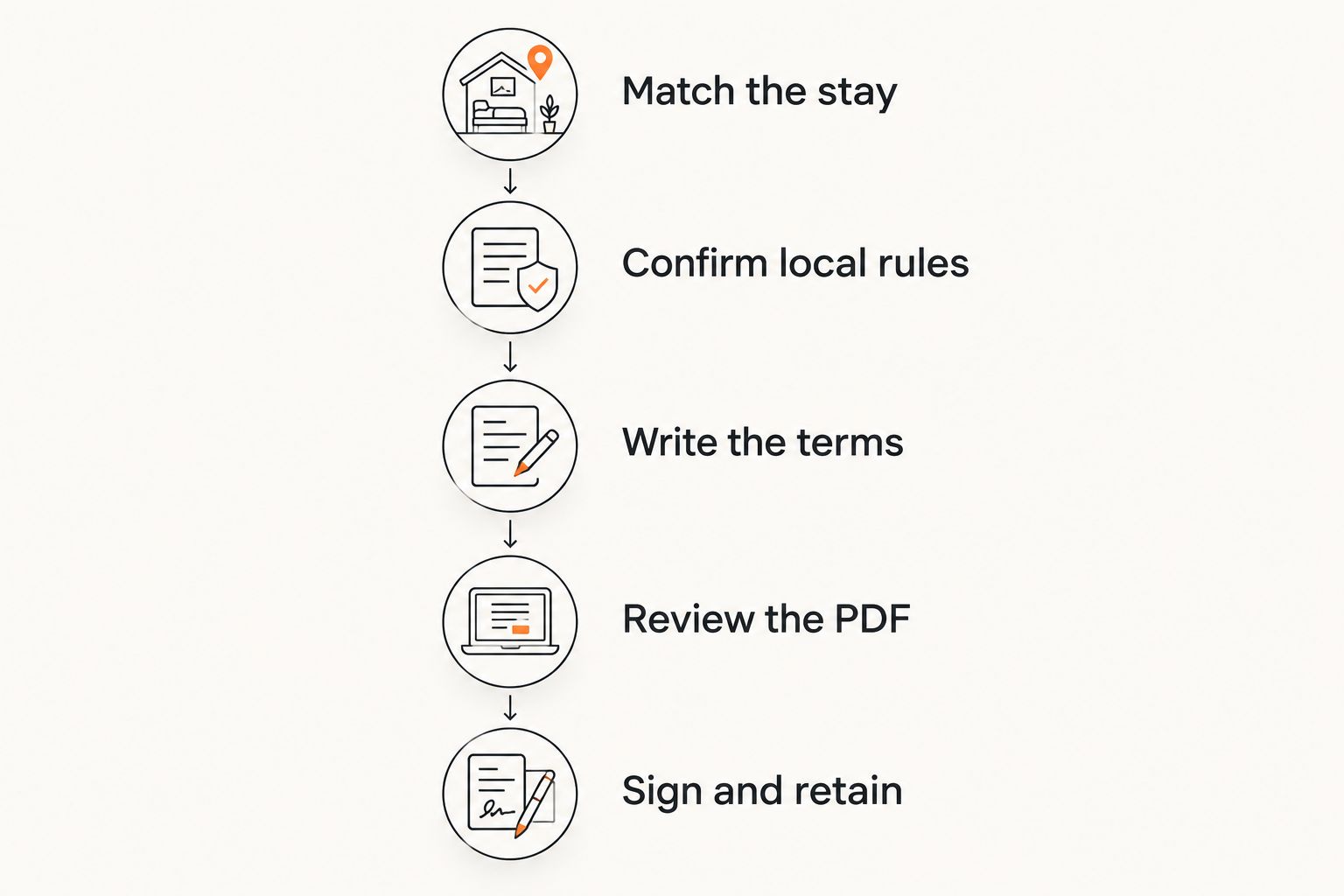
Prepare the rental facts before editing. For your 2026 agreement, use this sequence so that missing decisions do not become blank spaces in the signed document.
Match the stay
Choose the document format that describes the actual arrangement. Identify whether you are offering a whole property, a room, furnished temporary housing, or ongoing occupancy.
Confirm local rules
Check requirements that apply to the property and intended use, including any relevant registration, occupancy, building, association, or subletting restrictions. A signed document does not replace permission to operate the rental.
Write the terms
Enter the parties' names, property address, occupancy dates, payment schedule, deposit provisions, cancellation terms, and responsibilities. Resolve contradictions between the agreement, house rules, and any booking terms before asking for signatures.
Review the PDF
Open the exported document and read it from beginning to end. Check for clipped text, empty fields, missing attachments, inconsistent dates, and signature blocks that do not identify the parties.
Sign and retain
Complete the agreed signing process and give each party the final version. Keep the signed agreement with its attachments rather than storing an unsigned draft as the booking record.
Worked example: replace vague terms with specific decisions
Consider a hypothetical 2026 stay from August 14 to August 18 for 2 adults using 1 parking space. The agreement still needs more than those booking details.
| Vague wording | Decision to document |
|---|---|
| Arrival in the afternoon | Agreed check-in time and access instructions |
| Parking included | Which space the occupant can use |
| No extra guests | Whether the restriction covers overnight occupants, visitors, or both |
| Deposit returned afterward | Applicable return terms and permitted deductions |
| Leave the property clean | Specific departure tasks and how they relate to other cleaning terms |
Do not copy a hypothetical rule into your agreement without deciding whether it fits. For example, a visitor restriction needs different wording from a limit on overnight occupants.
Before signing, check:
- All dates match the reservation and attachments.
- Payment and cancellation provisions do not contradict each other.
- The document identifies included and excluded areas.
- House rules use the same guest and occupant definitions.
- Blank fields are completed or clearly marked as not applicable.
- Each party receives the same final document.
How these formats are ranked
The ranking prioritizes fit with a short-term rental arrangement, then clarity of occupancy, payment, property rules, and document completion. It is a format-selection guide, not a claim that individual providers or downloaded files were tested.
A vacation rental agreement ranks first for fixed guest bookings because its intended structure matches that use. A room agreement ranks higher for shared-home occupancy, while a general lease requires more adaptation.
Which short-term rental agreement should you choose?
Choose a short-term vacation rental agreement for a fixed guest booking. Switch to a furnished fixed-term lease for temporary housing, a room agreement for shared-home occupancy, or a month-to-month agreement for an ongoing arrangement.
Use a general lease only when you are ready to adapt its terms. Templates need to fit your circumstances and applicable rules; this guide and any template are not substitutes for legal advice.
FAQ
What's the best free lease agreement for short-term rentals?
A short-term vacation rental agreement is the best starting format for a fixed guest booking. Choose a different format for furnished temporary housing, shared rooms, or ongoing occupancy, and review the terms against applicable rules.
Can I use a regular lease for a vacation rental?
A regular lease can serve as a draft, but it needs review and adaptation for the vacation-rental arrangement. Check booking dates, departure terms, cancellation provisions, guest rules, and any conflicting standard clauses.
Does a short stay always count as a vacation rental?
No. The length of the stay alone does not establish the legal classification. Check the property's location, actual use, and applicable rental rules.
Does Pdf-Forms-Hub offer free lease templates?
Pdf-Forms-Hub includes leases in its free library of 25+ downloadable PDF templates, with no signup required. Review and adapt the selected document before using it for a short-term rental.
What should I include in a short-term rental agreement?
Include the parties, property, stay dates, payment terms, cancellation provisions, occupancy rules, responsibilities, and signature fields. Add property-specific details and review the document for applicable requirements.
Is a month-to-month agreement suitable for a fixed guest booking?
A month-to-month agreement is not the right default for a booking with a fixed departure date. It is structured for recurring occupancy that continues until properly ended.
Should I attach house rules to the rental agreement?
Attach house rules when they form part of the agreed rental terms, and identify the attachment clearly. Check that guest limits, parking rules, and departure instructions do not conflict with the main agreement.
One last thing
Search the finished PDF for conflicting terms, not just empty fields. A completed agreement can still promise a fixed departure date in one section and recurring occupancy in another. Resolve that conflict before anyone signs.