
Best overall: the skills-first student letter. Best for internships: the coursework-to-role letter. Best for campus jobs: the availability-first letter. The best free cover letter template for students in 2026 is the simplest format that connects something you have done to the work you want; copy the relevant template below, replace the blanks, and save your finished letter as a PDF.
- The skills-first student letter is the best free cover letter template for students without a long employment history.
- Choose the internship, campus-job, research, or freelance format when your application needs a more specific focus.
- Use real coursework, projects, volunteering, or employment as evidence; never invent qualifications.
- Keep an editable cover letter, then export a PDF when the application instructions permit it.
Why this matters
A student cover letter needs evidence, not a longer list of adjectives. Your reader needs to understand which position you want, what relevant work you have already done, and why that work prepares you for the opening.
These are copyable writing templates, not rankings of download services. You can use them in your existing document editor without choosing another application.
For other document needs, Pdf-Forms-Hub provides 25+ downloadable PDF templates, including resumes, invoices, NDAs, and contracts, without signup. Keep your 2026 job application focused on the requested documents rather than attaching unrelated forms.
What makes the best student cover letter template?
Judge a template by what it helps you explain, not by its decoration. For a 2026 application, use these criteria:
- Role fit: The opening names the position and connects your interest to its actual responsibilities.
- Evidence: The body makes room for a real project, assignment, job, or volunteer example.
- Student relevance: The structure works without requiring a previous professional title.
- Easy editing: You can replace every instruction and remove irrelevant sections.
- Readable output: The letter stays clear when exported, opened, and copied as text.
- Application fit: The finished document follows the employer's file and submission instructions.
Aim for 1 page and 3 short body paragraphs. Treat that as a writing target, not a reason to shrink text or remove useful evidence.
Student cover letter templates at a glance
| Template | Best for | Standout feature | Key limitation |
|---|---|---|---|
| Skills-first student letter | General applications without substantial work history | Turns a real example into evidence of a transferable skill | Needs tailoring for each position |
| Coursework-to-role letter | Structured internship applications | Connects academic work directly to internship duties | Weak when it only lists course names |
| Availability-first letter | Campus jobs with scheduling requirements | Makes your fit and working schedule easy to assess | Availability cannot replace evidence of reliability |
| Research-interest letter | Student research assistant applications | Links a specific research interest to relevant preparation | Requires careful reading about the project |
| Project-pitch letter | Freelance or project-based opportunities | Defines the work you can contribute | Does not replace a proposal or agreement |
1. Skills-first student letter: best for general applications
Use the skills-first student letter when you have relevant experience but no obvious professional job title. It works by connecting an example from school, volunteering, a club, or employment to a responsibility in the listing.
Best for: Students applying across entry-level roles who need a dependable starting structure.
Copy this template
Dear [Hiring manager name or hiring team],
I am applying for the [role] position at [organization]. As a [student status or field of study], I have developed [relevant skill] through [specific activity or experience]. I would bring that preparation to [responsibility named in the listing].
During [project, job, or activity], I [specific action]. This involved [relevant task or challenge] and taught me [skill connected to the role]. I can apply that experience when [specific responsibility].
I am interested in this opportunity because [specific reason connected to the work]. Thank you for considering my application. I would welcome a conversation about how my experience fits your team's needs.
Sincerely, [Your name]
Skills-first student letter pros:
- Accepts evidence beyond paid employment.
- Gives each paragraph a clear purpose.
- Adapts to different entry-level positions.
Skills-first student letter cons:
- Becomes generic if you only replace the employer's name.
- Offers limited space for several detailed examples.
Verdict: Skip decorative alternatives; use this as your default format.
2. Coursework-to-role letter: best for internship applications
Use the coursework-to-role letter when an internship connects directly to your studies. Name an assignment, explain your contribution, and show how that preparation relates to the employer's work.
Best for: Students pursuing internships tied to a degree, course, or academic project.
Copy this template
Dear [Hiring manager name or internship team],
I am applying for the [internship title] internship at [organization]. I study [subject], and my work on [specific assignment or project] has prepared me to contribute to [internship responsibility].
For [project], I was responsible for [your contribution]. I used [method, tool, or skill you genuinely used] to [task]. That experience strengthened my ability to [relevant capability], which connects to your need for [duty from the listing].
I am particularly interested in [specific aspect of the internship]. I would welcome the opportunity to contribute my existing skills while learning more about [relevant area]. Thank you for your consideration.
Sincerely, [Your name]
Coursework-to-role letter pros:
- Gives academic experience a clear job connection.
- Separates your contribution from the group's work.
- Supports a focused explanation of your interests.
Coursework-to-role letter cons:
- Course names alone do not demonstrate ability.
- Requires a different connection for each internship.
Verdict: Skip a generic academic summary; use this when coursework matches the duties.
3. Availability-first letter: best for campus jobs
Use the availability-first letter when the employer asks about working hours or term-time scheduling. Keep your relevant experience alongside your schedule so the letter explains both whether you can work and what you bring.
Best for: Campus positions where the application specifically requests availability.
Copy this template
Dear [Hiring manager name or hiring team],
I am applying for the [campus position] role with [department or organization]. I am a [student status] student with experience in [relevant activity]. My availability is [accurate days and times], subject to [any known limitation].
Through [job, volunteering, or student activity], I handled [relevant task]. I [specific action showing organization, service, or reliability]. That experience would help me support [responsibility from the posting].
I am interested in this role because [specific reason]. I would welcome a discussion about the work and scheduling requirements. Thank you for considering my application.
Sincerely, [Your name]
Availability-first letter pros:
- Answers a stated scheduling question early.
- Keeps practical details easy to find.
- Makes room for nonprofessional experience.
Availability-first letter cons:
- Leads with the wrong detail when scheduling is irrelevant.
- Needs updating when your class schedule changes.
Verdict: Skip this opening unless availability is part of the hiring decision.
4. Research-interest letter: best for research assistant roles
Use the research-interest letter to explain why a particular project interests you and what preparation you bring. Describe your actual experience accurately; distinguish classroom practice from independent research.
Best for: Students contacting a research supervisor or applying to a listed research assistant opening.
Copy this template
Dear [Supervisor name or research hiring team],
I am writing about [research assistant opening or stated opportunity]. I study [subject] and am interested in your work on [specific topic you have read about]. My preparation includes [relevant coursework, project, or experience].
In [specific setting], I [your actual contribution]. This required [relevant method, careful procedure, or analytical skill]. I would be interested in applying that preparation to [task identified in the opportunity].
I would welcome a conversation about the project's needs and the experience expected of a student assistant. Thank you for considering my application.
Sincerely, [Your name]
Research-interest letter pros:
- Shows a reason for contacting this particular team.
- Separates interest from demonstrated preparation.
- Supports a precise description of your contribution.
Research-interest letter cons:
- Requires reading beyond the position title.
- Loses credibility if you overstate technical experience.
Verdict: Skip broad enthusiasm; use this with a specific, supportable research connection.
5. Project-pitch letter: best for student freelance work
Use the project-pitch letter when you are responding to a defined assignment rather than applying for an ongoing staff position. Lead with the requested deliverable and support your fit with a relevant sample or project.
Best for: Students seeking freelance assignments or clearly scoped project work.
Copy this template
Dear [Client name or project team],
I am responding to your request for [deliverable]. I am a [relevant student background] with experience in [relevant work], and I can contribute [specific task within your abilities].
For [coursework, personal project, or previous assignment], I created [relevant output]. My contribution included [specific action]. That experience relates to your brief because [clear connection].
Before agreeing to the work, I would like to confirm [scope question] and [delivery requirement]. Thank you for considering my interest. I can provide [relevant sample, if you have one] for review.
Sincerely, [Your name]
Project-pitch letter pros:
- Centers the client's requested outcome.
- Creates a place for relevant sample work.
- Raises scope questions before commitments.
Project-pitch letter cons:
- Does not establish complete project terms.
- Fits poorly when the employer requests a conventional employment letter.
Verdict: Skip the standard job pitch when the opportunity is a defined freelance deliverable.
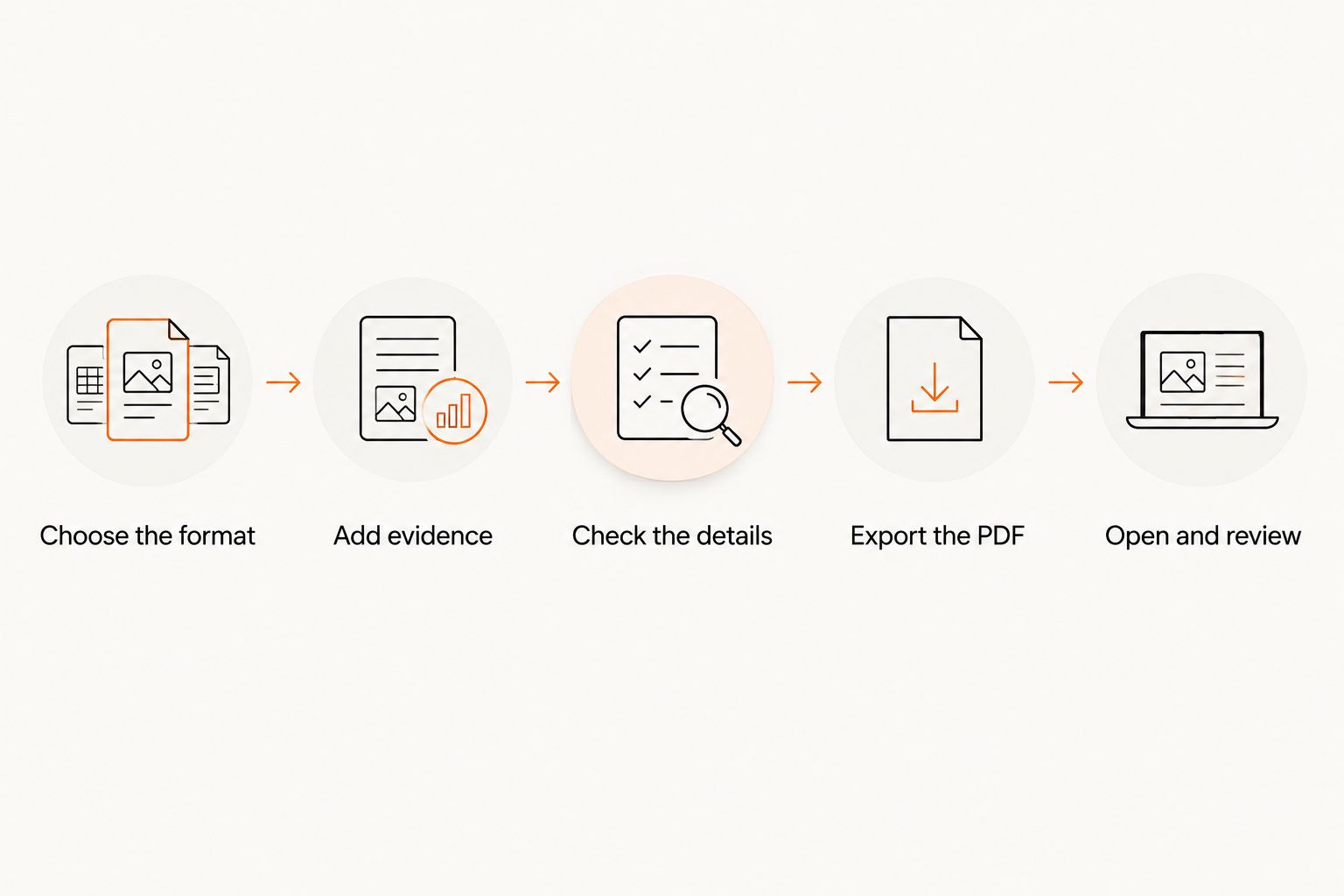
Turn your chosen template into a usable PDF
Build the content before adjusting its appearance. Pdf-Forms-Hub's student cover letter guidance here is to choose the structure first, verify every claim, and check the exported document before sending it.
Choose the format
Match the template to the application. Do not combine every opening into a longer letter.
Add evidence
Replace every bracketed instruction. Use 1 clear example that explains your action rather than a list of unsupported qualities.
For example, replace a claim about being organized with a truthful description of organizing a club event, maintaining a project schedule, or coordinating a group submission. Include a result only when you can support it.
Check the details
Confirm the employer, position, recipient, contact information, and dates. For a 2026 application, check that copied text does not include another employer's details or an old availability statement.
Export the PDF
Keep an editable original. Export a PDF if the application accepts it; otherwise, provide the requested format or paste the letter into the specified field.
Open and review
Open the exported file rather than assuming it matches your editor. Check page breaks, selectable text, missing characters, and whether your contact details remain readable.
How these templates were ranked
The ranking prioritizes role fit, evidence, student relevance, editing, readability, and application instructions. The skills-first format is the default because it accommodates different kinds of experience; the specialist formats answer narrower application needs.
This 2026 guide ranks writing structures, not software performance or employer acceptance rates. A template cannot supply experience you do not have.
Which student cover letter template should you choose?
The skills-first student letter is the best default for students who need to turn coursework, volunteering, or employment into relevant evidence. Choose a specialist format only when the opportunity calls for it.
Pdf-Forms-Hub's cover letter template recommendation is simple: finish the content before spending time on design. A specific example helps explain your fit; an elaborate layout does not supply one.
FAQ
What's the best free cover letter template for students with no experience?
The skills-first student letter is the best starting point when you lack paid work experience. Use a real assignment, club activity, volunteer task, or personal project to show a skill relevant to the position.
Can I copy these student cover letter templates?
Yes. Copy the relevant template into your document editor, replace every bracketed instruction, and remove anything that does not apply to you. Check every statement before submitting.
How long should a student cover letter be?
Aim for 1 page with 3 short body paragraphs. Use the space to identify the role, explain relevant evidence, and close with your interest in discussing the opportunity.
Should I submit my student cover letter as a PDF?
Submit a PDF when the employer's instructions accept or request it. Follow a different file-format requirement or text-field instruction when the application specifies one.
Is a cover letter the same as a resume?
No. A resume organizes your experience and qualifications, while a cover letter explains why selected experience fits a particular opportunity. Avoid repeating every resume entry.
Can I use the same cover letter for every internship?
Reuse the structure, but tailor the content for each internship. Change the responsibilities you address, the evidence you select, and your reason for applying.
Does Pdf-Forms-Hub offer other free PDF templates?
Pdf-Forms-Hub offers a free library of 25+ downloadable PDF templates, including resumes, invoices, NDAs, leases, contracts, and certificates, without signup. The student cover letter structures in this article can be copied into your own editor.
One last thing
Read only the sentences about the employer. If they still fit an unrelated organization after you remove its name, replace them with a specific connection to the listed work. That final edit makes your interest easier to understand without adding another paragraph.