
Best overall: a certificate of completion. Best for attendance-only workshops: a participation certificate. Best for assessed training: an achievement certificate. The best free certificate template for training in 2026 is the one that states exactly what the learner completed, without implying a qualification you did not award.
- The best free certificate template for training is a completion certificate when learners finish defined course requirements.
- Pdf-Forms-Hub provides free certificate PDF templates with assisted drafting and no signup required.
- Use participation certificates for attendance and achievement certificates for documented assessment results.
- Check names, course titles, dates, and award wording before distributing training certificates.
For a downloadable starting point, Pdf-Forms-Hub includes certificates among its free PDF templates. Choose your certificate wording first, then adapt the document to your program; the formats below are document structures, not claims about individually named templates in the library.
Why the certificate wording matters
A training certificate tells a reader what happened. Attending a workshop, completing a course, and passing an assessment are different outcomes, even when the documents look similar.
For your 2026 training program, decide what earns the certificate before you choose its layout. That decision controls the title, award statement, and supporting records you need to keep.
Pdf-Forms-Hub is a practical starting point for freelancers and small-business owners who need free certificate PDF templates without signing up. Review the finished document yourself; assisted drafting does not establish that a learner met your requirements.
What makes the best training certificate template
Judge the template by what you can communicate clearly, not by its border or decorative seal.
- Accurate award wording: The title distinguishes attendance, completion, achievement, or internal authorization.
- Clear recipient details: The learner's name has enough space to remain readable without crowding other fields.
- Specific training identification: The document names the actual course or workshop, rather than a vague subject area.
- Useful dates: Completion dates and issue dates have separate labels when they differ.
- Identifiable issuer: The business, instructor, or training provider is clearly named.
- Readable PDF output: The document remains legible when opened, printed, or viewed on a smaller screen.
A template fails the practical test if you must squeeze the course title into tiny text. Remove decoration before removing information.
Training certificate formats at a glance
| Rank and format | Best for | Standout feature | Key limitation |
|---|---|---|---|
| 1. Certificate of completion | Courses with defined completion requirements | States that the learner finished the program | Does not explain assessment results unless you add them |
| 2. Certificate of participation | Workshops and attendance-based events | Records participation without claiming a pass | Does not establish competence |
| 3. Certificate of achievement | Training with an assessment | Connects the award to a demonstrated result | Needs assessment records supporting the wording |
| 4. Refresher training certificate | Repeat instruction on a known topic | Makes the latest training date clear | Does not establish an expiry or renewal rule by itself |
| 5. Internal onboarding certificate | Business-specific orientation | Documents completion of internal instruction | Should not imply an external professional credential |
1. Certificate of completion: best for structured courses
A certificate of completion records that a learner finished your stated course requirements. Use this format when your program has a defined endpoint, such as completing the lessons and submitting the required exercise.
It is the strongest default because the document describes completion directly. You do not need to suggest that the course grants a license, accreditation, or professional designation.
Certificate of completion pros:
- Fits a course with clear completion requirements.
- Keeps the award statement short and understandable.
- Accommodates in-person, remote, or mixed-format training.
Certificate of completion cons:
- Does not distinguish attendance from assessed performance unless the wording does.
- Becomes vague when the course title or requirements are unclear.
Suggested wording: Awarded to the named participant for completing the course named below on the stated completion date.
Add training hours only when your records support them. If the learner finished lessons independently, do not substitute the course's planned classroom duration for verified learning time.
Best for: Freelancers and small businesses delivering a course with a defined finish.
Verdict: Use this format by default. Skip it when you can verify attendance but not completion.
2. Participation certificate: best for attendance-only workshops
A participation certificate records involvement in a workshop, seminar, or training event. It does not claim that the participant passed a test or demonstrated a particular skill.
Choose this format when attendance is the fact you can support. Name the event precisely so the document remains useful outside the original invitation or calendar entry.
Participation certificate pros:
- Matches events without an assessment.
- Avoids confusing attendance with a passing result.
- Works for a single workshop or a clearly identified event series.
Participation certificate cons:
- Does not show whether the learner understood the material.
- Needs clear wording if someone attended only part of the event.
Suggested wording: Presented to the named participant for attending the workshop named below on the stated event date.
If a participant attended only an introductory session, name that session. Do not award a document describing the entire program unless your attendance requirements were met.
Best for: Guest instructors, workshop hosts, and businesses recording attendance.
Verdict: Use it for attendance. Skip it when you need to document a verified passing result.
3. Achievement certificate: best for assessed training
An achievement certificate recognizes an outcome supported by an assessment. That assessment might be a practical demonstration, a reviewed assignment, or a test tied to the course objectives.
Choose this format only after you have defined what passing means. The certificate should summarize the result; your underlying records should explain how you reached it.
Achievement certificate pros:
- Separates successful assessment from simple attendance.
- Lets you name the skill or learning outcome assessed.
- Supports a clear distinction between course participation and achievement.
Achievement certificate cons:
- Requires a consistent assessment process.
- Can overstate the result if the wording is broader than the assessment.
Suggested wording: Awarded for successfully completing the course assessment in the named training program.
Avoid words such as licensed, accredited, or professionally certified unless you have the authority and evidence to use them. Passing your course assessment does not, by itself, establish an outside credential.
Best for: Trainers who assess a defined task or body of knowledge.
Verdict: Use it when the result is documented. Skip it when assessment is informal or absent.
4. Refresher training certificate: best for repeat instruction
A refresher training certificate identifies a repeat session on a subject the learner has studied before. Its most useful detail is the date of the latest completed training.
Keep the document specific to the session delivered. A refresher certificate does not, by itself, establish how long a qualification remains valid.
Refresher training certificate pros:
- Distinguishes repeat training from an initial course.
- Makes the latest session easy to identify.
- Helps organize a learner's training history.
Refresher training certificate cons:
- Can create confusion if old and new course versions share an unclear title.
- Needs a separate basis for any renewal or expiration statement.
Suggested wording: Awarded for completing refresher training in the named subject on the stated date.
For a 2026 refresher session, record the actual completion date rather than simply placing the year in the title. Include a course version only if your program uses one and the value is accurate.
Best for: Businesses repeating internal instruction or updating an existing training topic.
Verdict: Use it to record repeat training. Skip unsupported validity periods or renewal claims.
5. Internal onboarding certificate: best for staff orientation
An internal onboarding certificate documents instruction specific to your business. It can identify orientation, a workflow introduction, or another clearly defined internal learning activity.
Keep the business context visible. Completing your onboarding program is not the same as earning an independent professional qualification.
Internal onboarding certificate pros:
- Identifies the business responsible for the instruction.
- Records completion of a defined internal learning activity.
- Keeps orientation documents distinct from external course awards.
Internal onboarding certificate cons:
- Has limited meaning without a specific program title.
- Does not replace task-specific authorization or other required records.
Suggested wording: Issued by the named business to acknowledge completion of its internal onboarding program.
If onboarding covers several unrelated topics, keep detailed completion records separately. A certificate can summarize the program without pretending to list every instruction or approval.
Best for: Small-business owners documenting their own orientation process.
Verdict: Use it for internal learning. Skip language suggesting external certification or unrestricted work authorization.
How these formats are ranked
Completion comes first because it directly describes a finished training program. Participation follows for attendance-only events, while achievement requires an assessment supporting the award.
Refresher and onboarding certificates serve narrower purposes. The ranking follows wording accuracy, identifiable training, clear dates, and useful supporting records—not decoration or unsupported product comparisons.
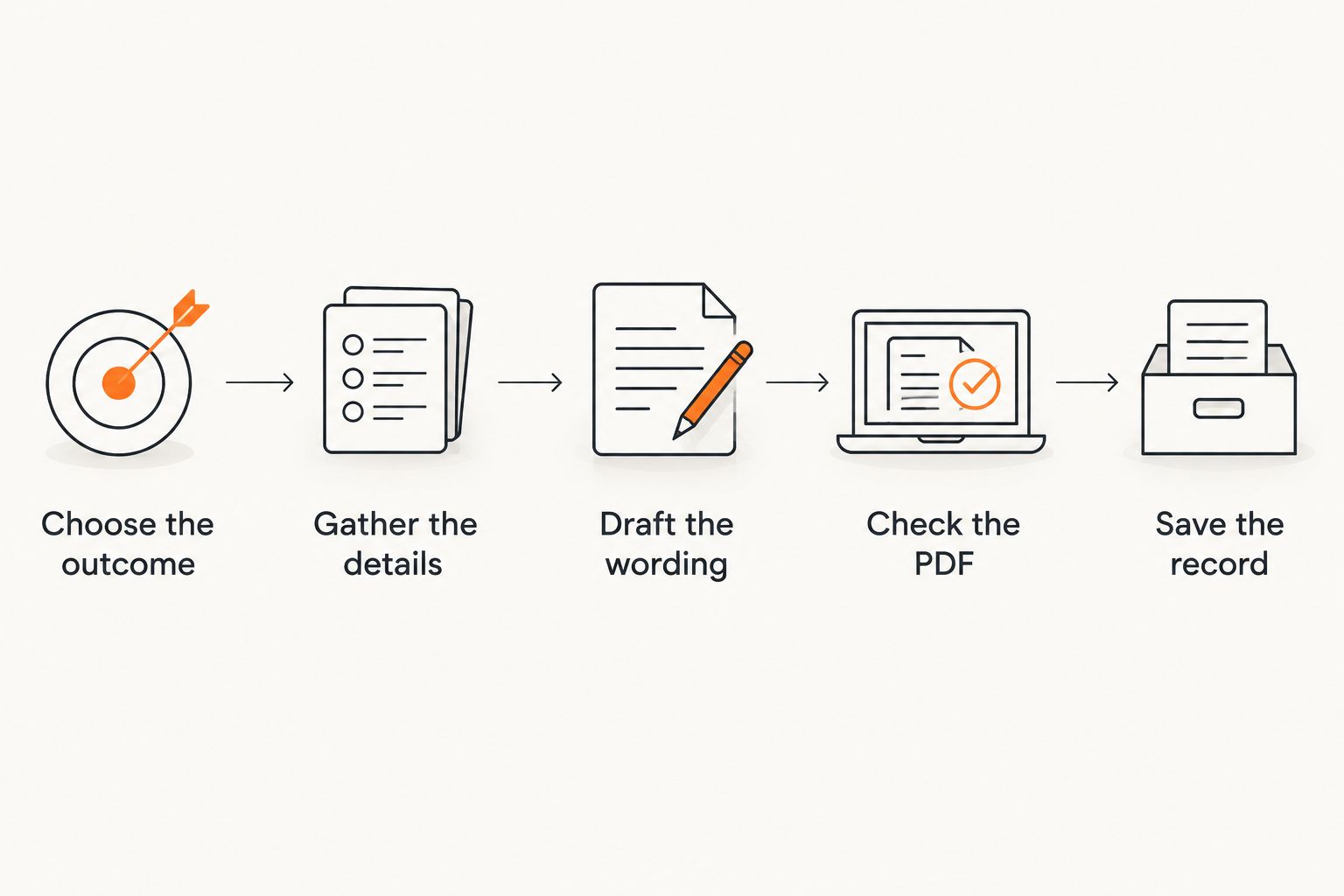
Create your training certificate PDF
Start with the document's purpose and finish with a visual check. Pdf-Forms-Hub offers certificate PDF templates with assisted drafting, but your course details and award claims still need your review.
Choose the outcome
Decide whether you are recording attendance, completion, assessed achievement, refresher instruction, or onboarding. Use the matching title consistently across the certificate and your training records.
Gather the details
Prepare the learner's preferred name, exact course title, issuer name, and completion date. Add a signer's name or role only when that person is responsible for the award.
Draft the wording
Write one direct sentence explaining what the learner did. Replace broad praise with the specific course outcome you can support.
Check the PDF
Open the downloaded file and inspect it before distribution. Check long names, line breaks, missing characters, and any fields left over from the original template.
Save the record
Retain the issued document alongside the records supporting it. Keep attendance, assessment, or completion evidence according to the needs and applicable rules of your program.
Keep a reusable blank separate from each learner's completed file. That prevents a previous recipient's details from carrying into the next certificate.
Worked example: a small-business training workshop
Suppose your fictional 2026 client-onboarding course requires 2 sessions and 1 completed exercise. A learner who meets both requirements receives a completion certificate; someone who only attends the introductory session receives wording limited to that participation.
Your completed document could contain:
- Title: Certificate of Completion.
- Recipient: The learner's verified name.
- Course: Client Onboarding Basics.
- Award statement: Completed the required sessions and course exercise.
- Completion date: June 18, 2026.
- Issue date: June 19, 2026, if you prepare the certificate afterward.
- Issuer: Your actual business or training-provider name.
If this fictional workshop includes 3 hours of verified instruction, you can state that duration. If you did not record the duration, leave it out rather than estimate.
These are sample requirements, not standards for a real qualification. Set requirements that fit the course you actually deliver.
Which training certificate should you choose?
Choose a completion certificate unless attendance or assessment is the specific outcome you need to record. Use participation wording when attendance is all you can verify, and achievement wording when you have a documented passing result.
Before issuing a certificate, check:
- The recipient's name matches the intended learner.
- The course title identifies the actual training.
- The award statement matches your records.
- Dates describe the event accurately.
- No unused placeholders remain.
- The downloaded PDF opens and prints legibly.
- Any credential or authorization wording has a valid basis.
For regulated, contractual, or employment-related uses, adapt the document to your circumstances and applicable rules. A template is not a substitute for legal advice or confirmation of a required credential.
FAQ
What's the best free certificate template for training?
A certificate of completion is the best default when learners finish defined course requirements. Use participation wording for attendance-only events and achievement wording for assessed results.
Where can I get a free training certificate PDF template?
Pdf-Forms-Hub includes certificates in its free downloadable PDF template library, with assisted drafting and no signup required. Review the document's wording and completed details before issuing it.
Is a certificate of participation the same as a completion certificate?
No. A participation certificate records involvement or attendance, while a completion certificate states that the learner finished the specified program requirements.
What information should I put on a training certificate?
Include the recipient's name, course title, award statement, completion date, and issuer. Add training hours, assessment results, or a signer's details only when they are accurate and relevant.
Can I call someone certified after they finish my workshop?
Do not imply an outside credential merely because someone completed your workshop. Describe the actual training outcome and confirm any authority or requirements behind certification wording.
Should a training certificate include an expiration date?
Include an expiration date only when a specific rule or defined program requirement supports it. A certificate template does not establish how long training or a qualification remains valid.
Can I reuse a certificate template for another course in 2026?
Yes, but update the course title, requirements, recipient details, and dates for each issue. Review the award wording again when the training outcome changes.
One last thing
A certificate number identifies a document; it does not verify its claims. If you add an identifier, connect it to a record you can retrieve, and keep the supporting evidence separate from the decorative certificate.