
Best overall: a certificate of completion for finished work. Best for employee recognition: a certificate of appreciation. Best for event records: a certificate of participation. This 2026 guide helps you choose the right free certificate format, write accurate wording, and prepare a usable PDF.
- The best free certificate template for business matches the activity: completion, appreciation, achievement, participation, attendance, or volunteer service.
- Pdf-Forms-Hub offers free downloadable certificate templates without signup, alongside other business PDF forms.
- Use completion certificates for finished requirements, not attendance alone.
- A business-issued certificate should not imply an outside license, accreditation, or professional qualification.
Why this matters
A certificate should tell the recipient exactly what your business recognizes. A polished layout cannot fix wording that confuses attendance with achievement or makes an internal workshop sound like a professional qualification.
Pdf-Forms-Hub is best for small businesses that want free downloadable certificate templates without signup. Start with the Pdf-Forms-Hub library, then use the criteria below to decide what your certificate should say before you prepare the PDF.
What makes the best business certificate template
Choose your 2026 certificate format by its purpose, not its border or font. Use these criteria to compare the options:
- Accurate purpose: The title matches what happened: completion, attendance, recognition, or service.
- Clear recipient: The wording leaves no doubt about who receives the certificate.
- Specific accomplishment: The document names the course, contribution, event, or completed requirement.
- Identifiable issuer: Your business name and an appropriate approval line explain who issued it.
- Readable PDF: The name, date, and main statement remain clear when printed or viewed on a screen.
- Appropriate limits: The wording does not imply authority, accreditation, or qualifications your business cannot substantiate.
Treat these as selection requirements. When a layout lacks space for essential information, choose another layout rather than shrinking everything until it becomes difficult to read.
Free certificate formats at a glance
| Rank and format | Best for | Standout feature | Key limitation |
|---|---|---|---|
| 1. Certificate of completion | Finished courses or defined work | States what the recipient completed | Does not establish competence by itself |
| 2. Certificate of appreciation | Employee or collaborator recognition | Names a valued contribution | Does not document a qualification |
| 3. Certificate of achievement | Meeting a stated performance standard | Connects recognition to an accomplishment | Needs a defensible achievement statement |
| 4. Certificate of participation | Involvement in an event or program | Records participation without claiming mastery | Does not prove completion of requirements |
| 5. Certificate of attendance | Presence at a workshop or meeting | Records the session attended | Does not prove learning or assessment |
| 6. Volunteer service certificate | Recognition of volunteer contributions | Describes the service performed | Service details need supporting records |
These are document formats, not interchangeable credentials. Choose the row that matches your records, then adapt the wording to your business.
1. Certificate of completion: best for finished requirements
A certificate of completion states that someone finished a defined course, project, or program. It is the default choice when your business can explain what completion required and confirm that the recipient met those requirements.
Best for: Freelancers delivering client training and small businesses documenting completed internal programs.
Certificate of completion pros:
- Names a finished activity directly.
- Separates completion from simple attendance.
- Gives the recipient a clear record to retain.
Certificate of completion cons:
- Does not prove professional competence on its own.
- Becomes ambiguous when completion requirements were never defined.
Example wording: This certifies that Jordan Lee completed the customer onboarding workshop delivered by your business in March 2026.
Replace the example details with verified names, dates, and the actual activity. Include an assessment result only when an assessment occurred and your records support the statement.
Verdict: Skip for attendance-only events; choose it for finished requirements.
2. Certificate of appreciation: best for employee recognition
A certificate of appreciation recognizes a contribution rather than a credential. Use it to thank an employee, contractor, or collaborator for specific work without suggesting that the document qualifies them to perform a regulated activity.
Best for: Business owners recognizing helpful work, project support, or consistent contributions.
Certificate of appreciation pros:
- Works without an exam or course.
- Supports specific, personal recognition.
- Keeps the focus on the contribution.
Certificate of appreciation cons:
- Provides little information when the wording is generic.
- Does not replace a performance review or employment record.
Example wording: Presented to Jordan Lee in appreciation of coordinating the customer handover materials for the spring launch.
Name the contribution rather than filling the certificate with praise. A concrete description tells the recipient what your business valued and keeps the document meaningful after the occasion.
Verdict: Skip for qualification claims; choose it to recognize a contribution.
3. Certificate of achievement: best for meeting a stated standard
A certificate of achievement recognizes an accomplishment against a defined standard. Choose it when you can explain what the recipient achieved, not merely that they attended or finished an activity.
Best for: Internal skills challenges, project milestones, and business awards with clear criteria.
Certificate of achievement pros:
- Identifies a particular accomplishment.
- Distinguishes achievement from participation.
- Connects recognition to documented criteria.
Certificate of achievement cons:
- Requires evidence supporting the achievement.
- Can mislead when it implies independent certification.
Example wording: Awarded to Jordan Lee for completing the internal product demonstration assessment against the business's published assessment criteria.
Keep the wording within the scope of your own program. If the recognition is internal, say so rather than presenting it as an industry-wide qualification.
Verdict: Skip when no standard exists; choose it for a documented achievement.
4. Certificate of participation: best for event involvement
A certificate of participation records involvement in a program, event, or group activity. It avoids claiming that the recipient passed an assessment or completed requirements that your business did not track.
Best for: Community events, collaborative workshops, business challenges, and group programs.
Certificate of participation pros:
- Recognizes involvement without claiming mastery.
- Fits activities without formal assessments.
- Keeps event wording straightforward.
Certificate of participation cons:
- Does not establish a skill level.
- Needs context to explain what participation involved.
Example wording: Presented to Jordan Lee for participating in the small-business planning workshop held in April 2026.
Add the event name and relevant date. Avoid substituting completion language simply because it sounds more impressive; the certificate should reflect what you can confirm.
Verdict: Skip for assessed qualifications; choose it to record involvement.
5. Certificate of attendance: best for session records
A certificate of attendance states that someone attended a named session. It is narrower than a participation certificate: presence is the central fact, not a contribution or finished learning requirement.
Best for: Informational workshops, briefings, seminars, and internal meetings where attendance is recorded.
Certificate of attendance pros:
- Makes a limited, clear statement.
- Identifies the session attended.
- Avoids implying an assessment took place.
Certificate of attendance cons:
- Does not demonstrate understanding.
- Depends on an accurate attendance record.
Example wording: This confirms that Jordan Lee attended the vendor onboarding briefing hosted by your business.
Include duration only when you have a reliable record and a reason to include it. Do not describe attendance as continuing education credit unless the relevant requirements and authority support that claim.
Verdict: Skip for learning outcomes; choose it to confirm presence.
6. Volunteer service certificate: best for service recognition
A volunteer service certificate recognizes work contributed to a project or organization. Describe the actual service instead of relying on broad statements about commitment or impact.
Best for: Businesses acknowledging volunteers who supported a community initiative or organized activity.
Volunteer service certificate pros:
- Names the contribution and project.
- Gives volunteers a record of recognition.
- Accommodates verified service dates.
Volunteer service certificate cons:
- Requires records for any stated service hours.
- Does not determine employment status or legal obligations.
Example wording: Presented to Jordan Lee in recognition of volunteer support with event registration for the community supplier fair.
If hours were not recorded, leave them out. Recognition does not require a number, and an unsupported total weakens an otherwise accurate certificate.
Verdict: Skip unsupported hour totals; choose it for verified volunteer contributions.
How to create your certificate PDF
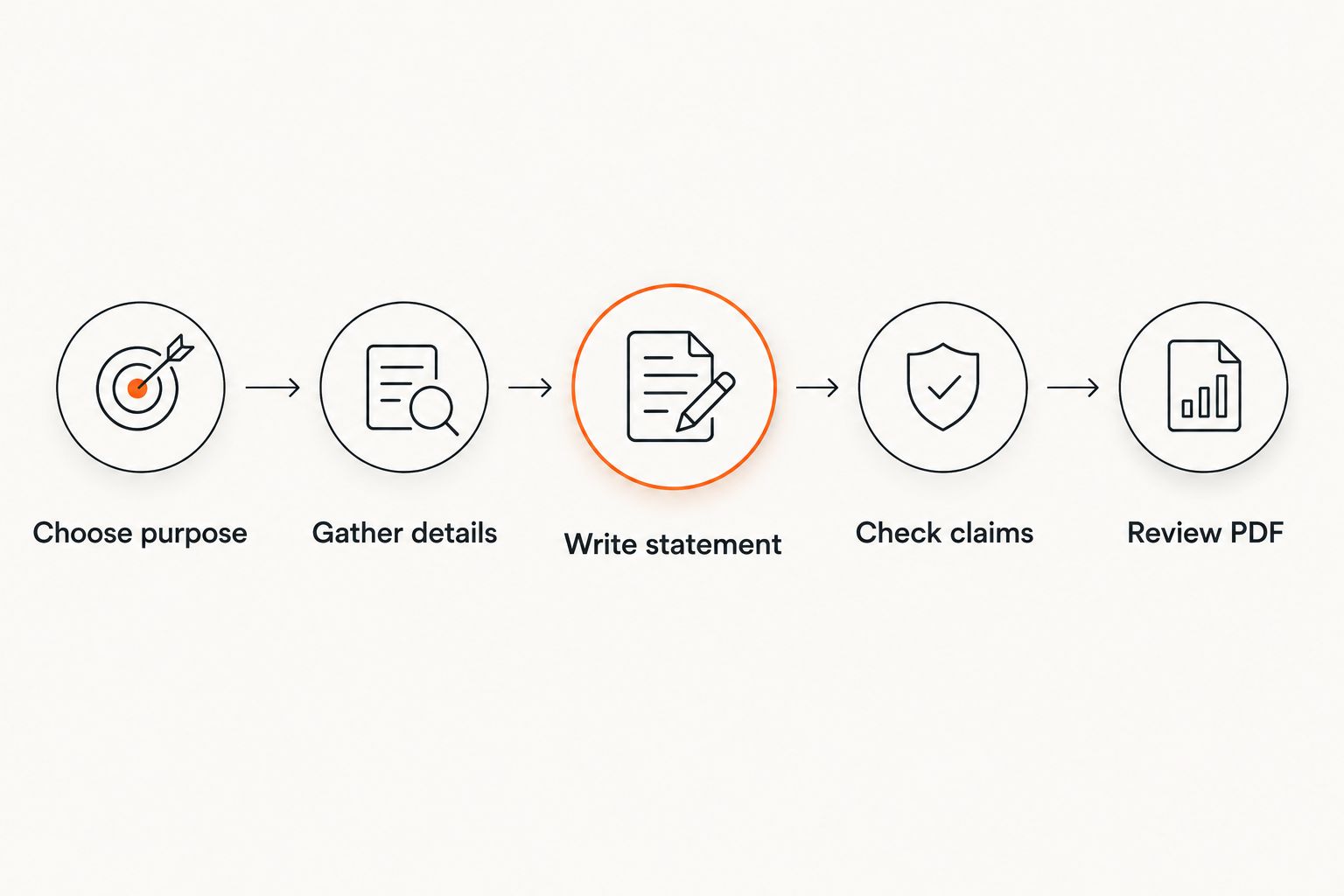
Use this sequence for your 2026 certificate workflow. Pdf-Forms-Hub includes certificates in its free PDF template library; choose a starting layout, then check that its wording and fields fit your purpose.
- Choose purpose: Match the certificate title to completion, recognition, participation, attendance, or service.
- Gather details: Confirm the recipient's preferred name, activity title, issuer, and relevant date.
- Write statement: Explain what the document recognizes in a direct sentence.
- Check claims: Remove unsupported qualifications, service totals, credits, or accreditation language.
- Review PDF: Inspect the finished document before sharing it.
Aim for 1 page unless your circumstances require an attachment. Keep longer explanations, assessment criteria, or supporting records outside the presentation certificate so the main statement stays readable.
Check 2 views before sending: the PDF on screen and a print preview. Look for clipped names, missing characters, awkward line breaks, and signatures that obscure the text.
Retain 3 records together: the final PDF, the recipient details, and the evidence supporting the statement. This is a practical filing checklist, not a legal retention schedule.
How the formats were ranked
Completion ranks first because it directly answers a common document need: recording finished requirements. Appreciation follows for recognition, while achievement requires a stated standard and supporting evidence.
Participation, attendance, and volunteer service serve narrower purposes. The ranking prioritizes accurate wording, identifiable issuers, readable PDFs, and claims your records support—not decorative design.
Which certificate format should you choose?
Choose a completion certificate when your business can verify finished requirements. Choose appreciation for a contribution, achievement for a met standard, participation for involvement, attendance for presence, and volunteer service for contributed work.
For a 2026 document, check the actual event date rather than inserting the current year automatically. Pdf-Forms-Hub supplies free certificate templates, but your business remains responsible for the wording and the facts it puts into the final PDF.
FAQ
What's the best free certificate template for business?
A certificate of completion is the best default when your business needs to document finished requirements. Use appreciation for recognition and attendance for presence rather than forcing every purpose into a completion certificate.
Can I download a free business certificate without signing up?
Pdf-Forms-Hub offers free downloadable certificate templates without signup. Choose a format that fits the activity and check the finished wording before sharing the PDF.
Is a completion certificate the same as a professional certification?
No. A completion certificate records finished requirements; it does not by itself establish an outside professional qualification, license, or accreditation.
What should I put on a business certificate?
Include the recipient's name, the certificate purpose, the activity or contribution, the issuing business, and the relevant date. Add approval details or supporting information when the circumstances require them.
Should I use participation or attendance wording?
Use participation wording to recognize involvement and attendance wording to confirm presence at a session. Neither should imply a passed assessment unless a separate, supported statement explains that result.
Can I add training hours or volunteer hours?
Add hours only when reliable records support them. Do not estimate a total just to make the certificate appear more substantial.
Does a certificate template guarantee legal compliance?
No certificate template guarantees legal compliance or enforceability. Adapt the document to your circumstances and applicable rules, and get qualified legal advice when the certificate carries legal or regulatory consequences.
One last thing
Check the recipient's name before adjusting the decoration. Ask for the exact spelling they want displayed, then compare it with the final PDF; a correct name and an accurate statement matter more than an elaborate border.